What is Etalbond? Aluminium composite panels
Etalbond is a brand of aluminium composite panel; “bond” is the category. The 0.5/3/0.5 mm sandwich, PE, FR and A2 cores, coatings and routing.
Etalbond is not a material but a brand. The material is an aluminium composite panel, and “bond” is the Bulgarian name for the whole category. Here is what sits behind the 0.5 / 3 / 0.5 mm sandwich: PE, FR and A2 cores, fire classes, coatings and the 0.3 mm routing rule.
If you got here after someone said "the panel is bond" or "use Etalbond", the most useful sentence is one nobody says on site: Etalbond is a brand name, not a material. The material is an aluminium composite panel — ACP, or ACM. Etalbond® is the brand the Greek producer Elval Colour makes it under, at its plant in Saint Thomas, Viotia. Alucobond® and Dibond® belong to 3A Composites, Reynobond® to Arconic, Alpolic® to Mitsubishi.
In the Bulgarian trade the word "бонд" detached from any single brand long ago and now names the whole category, the way "jeep" came to mean any off-roader. Convenient in conversation, dangerous in a purchase order: two panels both called "bond" can have different cores, skin thicknesses and fire behaviour. This article covers the material as it is, so you can ask for something specific instead.
In short: an aluminium composite is a sandwich of two 0.5 mm aluminium skins bonded to a plastic or mineral core, usually 3 mm — 4 mm in total. Etalbond, Alucobond, Dibond and Reynobond are brands of the same material. The one thing to ask first is what the core is made of.
The 0.5 / 3 / 0.5 mm sandwich
The standard panel is 4 mm: two 0.5 mm aluminium sheets over a 3 mm core; there is also 3 mm (0.5 / 2 / 0.5) and 6 mm (0.5 / 5 / 0.5).
Why a sandwich? Because the stiffness of a plate rises roughly with the cube of its thickness: push the two load-bearing surfaces apart without adding weight and you gain disproportionately. The skins take tension and compression, the core holds them apart and stops them sliding — the I-beam principle. What is unusual is that the manufacturer publishes the result as a number.
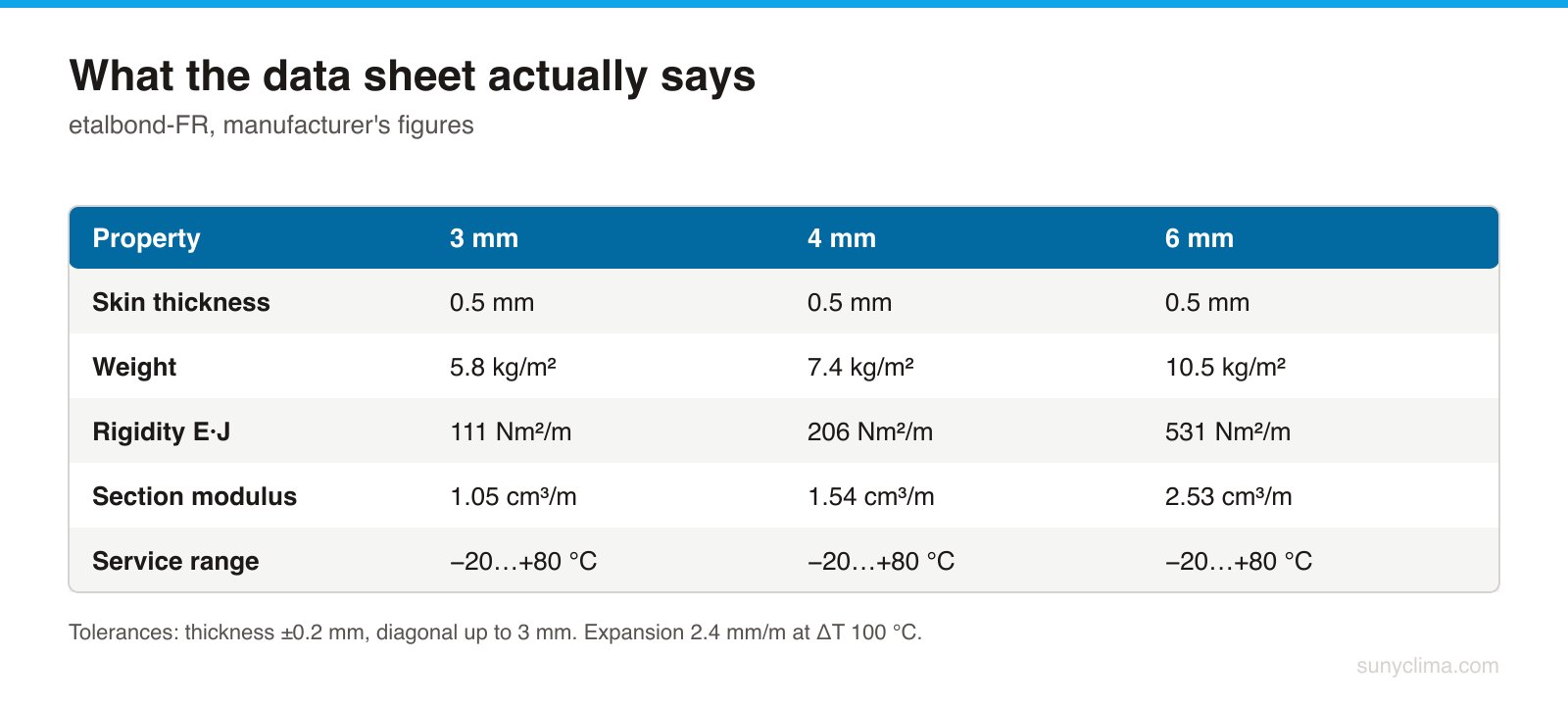
The etalbond-FR sheet shows it: rigidity (E·J) is 111 Nm²/m at 3 mm, 206 at 4 mm and 531 at 6 mm.
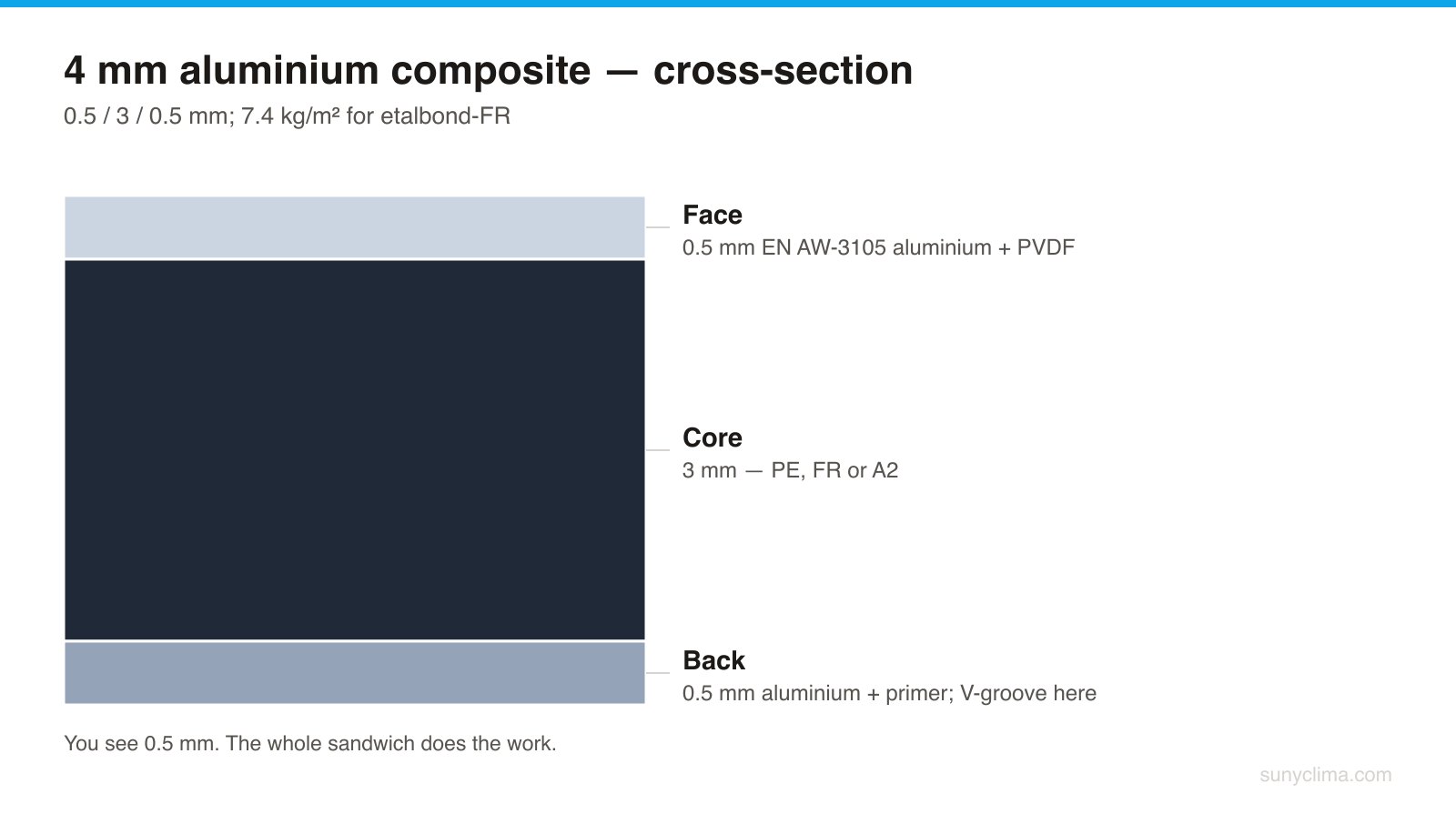
Now the comparison that matters. A 4 mm etalbond-FR panel weighs 7.4 kg/m² (3 mm — 5.8; 6 mm — 10.5). For A2 Elval's own documents disagree: one distributor sheet gives 7.9 kg/m² at 4 mm and 11.4 at 6 mm, the brochure 7.3–7.4 at 4 mm. From here the arithmetic is ours, not a line from the sheet. Solid aluminium of the same weight would be about 2.7 mm thick, at a density of roughly 2.7 g/cm³. Run through the textbook plate formula (E·J = E · b·t³/12) with the same declared modulus of 70,000 N/mm², that sheet comes out at about 120 Nm²/m against the declared 206 for the composite — so at equal weight the sandwich is roughly 1.7 times stiffer.
The converse comes out of the same calculation: at equal thickness solid sheet wins — 4 mm of aluminium gives about 373 Nm²/m — but weighs close to 10.8 kg/m², some 46% more. On a door that hangs off the hinges; on a façade, off the sub-frame. Composite is not the cheaper stand-in for metal; it is the more correct way to put a metal face on a large flat surface.
And a third effect the tables do not show: flatness. A continuously bonded core will not let the skin oil-can, which is why large smooth façade surfaces are composite rather than sheet.
How it is made: paint first, sandwich second
The order of operations explains most of what quality means here. First comes the aluminium coil. The standard alloy for etalbond skins is EN AW-3105 to EN 573-3, in H44 temper (painted) to EN 1396 — an aluminium-manganese alloy, not the strongest but extremely formable — exactly what you want in something that will be folded along a routed groove. Declared: modulus 70,000 N/mm², tensile ≥150 N/mm², yield Rp0.2 ≥120 N/mm², elongation A50 ≥3%.
Second comes painting — of the coil, not the finished panel. The process is coil coating: the coil is unwound, degreased and passivated, run under primer and topcoat rollers, through a curing oven, and rewound. That is why architectural composite does not fade in patches — the coating goes on in controlled microns and is baked at a temperature nobody can reproduce on an installed panel. The back gets a protective primer only.
Third comes lamination: skins and core joined continuously under heat and pressure through an adhesive film. That bond is measurable — etalbond's European Technical Assessment ETA 14/0145 declares a peel strength to ASTM D1781 of ≥167 Nm/m, against the 100 Nm/m generic floor printed by Reynobond and Alpolic. A weak bond delaminates, and it shows as a blister along the edge after a few summers.
The practical consequence: the colour is not paint. It is part of the coil and cannot be touched up on site with a spray can.
The core: PE, FR and A2
This is where everything beyond appearance is decided.
- PE — pure polyethylene, usually LDPE at 0.93–0.96 g/cm³: cheapest, lightest, easiest to rout and fold. Under EN 13501-1, etalbond with a PE core is class E.
- FR — mineral-filled polymer: the polyethylene is cut with a filler, usually aluminium hydroxide, which releases water when heated and suppresses combustion. etalbond-FR is B-s1,d0.
- A2 — over 90% mineral filler with a minimum of binding polymer. Elval's own literature declares A2-s1,d0; one distributor sheet prints A2-s1,d1. The difference is flaming droplets — precisely why you want the declaration for your batch, not a general claim.
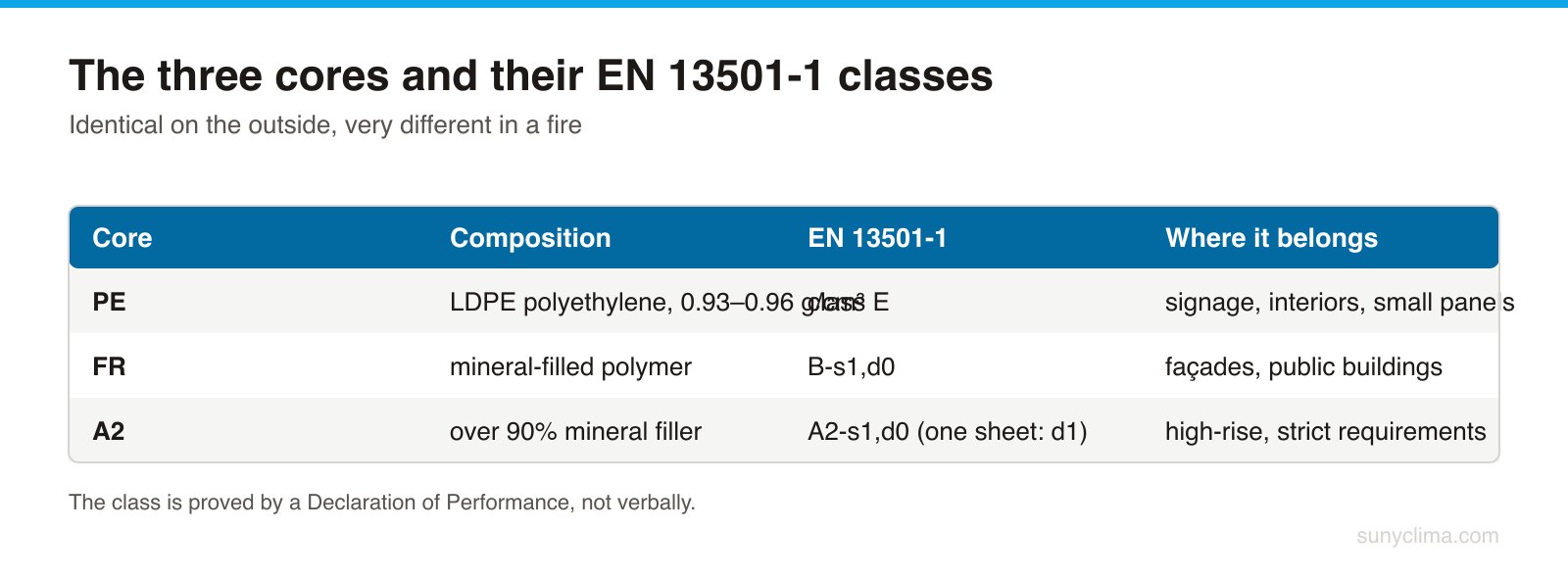
What do the letters mean in practice? EN 13501-1 is not one test but a system of several.
- Class E is proved by the small ignitability test EN ISO 11925-2 alone: the flame must not spread past 150 mm in 20 seconds. A low bar — class E burns, it just does not flash instantly.
- Class B also requires the SBI test (EN 13823, single burning item): a FIGRA fire growth rate ≤120 W/s, total heat release ≤7.5 MJ over 600 s, and lateral flame spread that never reaches the edge of the specimen. A serious constraint, but still combustible.
- Class A2 has to meet the same SBI limits as class B and pass a non-combustibility test (EN ISO 1182) or a calorific value measurement (EN ISO 1716) capped at 3.0 MJ/kg. What separates B from A2 is not stricter SBI numbers but that extra test — the threshold beyond which the material stops being a meaningful source of fuel.
- s1 is smoke: growth ≤30 m²/s² and ≤50 m² total over 600 s. d0 — no flaming droplets in 600 s; d1 — none burning longer than 10 seconds.
The point most often skipped: FR does not mean non-combustible. Class B is "limited contribution to fire", not "does not burn".
Why the core became a life-safety question
Until 2017 many treated core choice as a budget decision. The Grenfell Tower fire in London in June 2017, which killed 72 people, ended that. The inquiry found the composite panels with polyethylene cores to be the primary cause of the fire spread: the polyethylene melted and dripped while burning, starting fires lower down — which explains both the horizontal and the downward spread.
There is a second, purely geometric factor: a ventilated façade has an air gap behind the panels — good for moisture, bad in a fire, because it works like a chimney. A combustible material with a draught behind it burns far faster than the same material in a laboratory specimen.
The conclusion is not that bond is dangerous, but that the same material can be sensible in one place and unacceptable in another. A PE core in an interior sign, or a two-square-metre door panel, is a normal engineering choice; the same core on a twenty-storey façade is not. In Bulgaria the classes come from Ordinance No. Iз-1971, last amended in 2025, and its Article 330 is blunt: above 25 m of occupied height both the insulation and the external covering must be no lower than A2. PE and FR are not in that conversation.
The practical rule for anyone buying: ask for a Declaration of Performance with the EN 13501-1 class written out — letter, then s, then d, as in B-s1,d0 — not a verbal "it's fire rated". No paper with that string on it, and you have not bought what you think you bought.
The coating: PVDF, FEVE and polyester
The second line that decides how the panel looks in ten years is the coating — the sheet lists three levels:
- PVDF-3 / FEVE-3 — three coats at 33 μm on the data sheet, depending on shade. Individual projects specify thicker systems — 43 μm nominal at a 38 μm minimum, for instance. Tolerances follow EN 1396.
- PVDF-2 / FEVE-2 — two coats, target 30 μm.
- VHDPE — target 25 μm. This is the polyester tier.
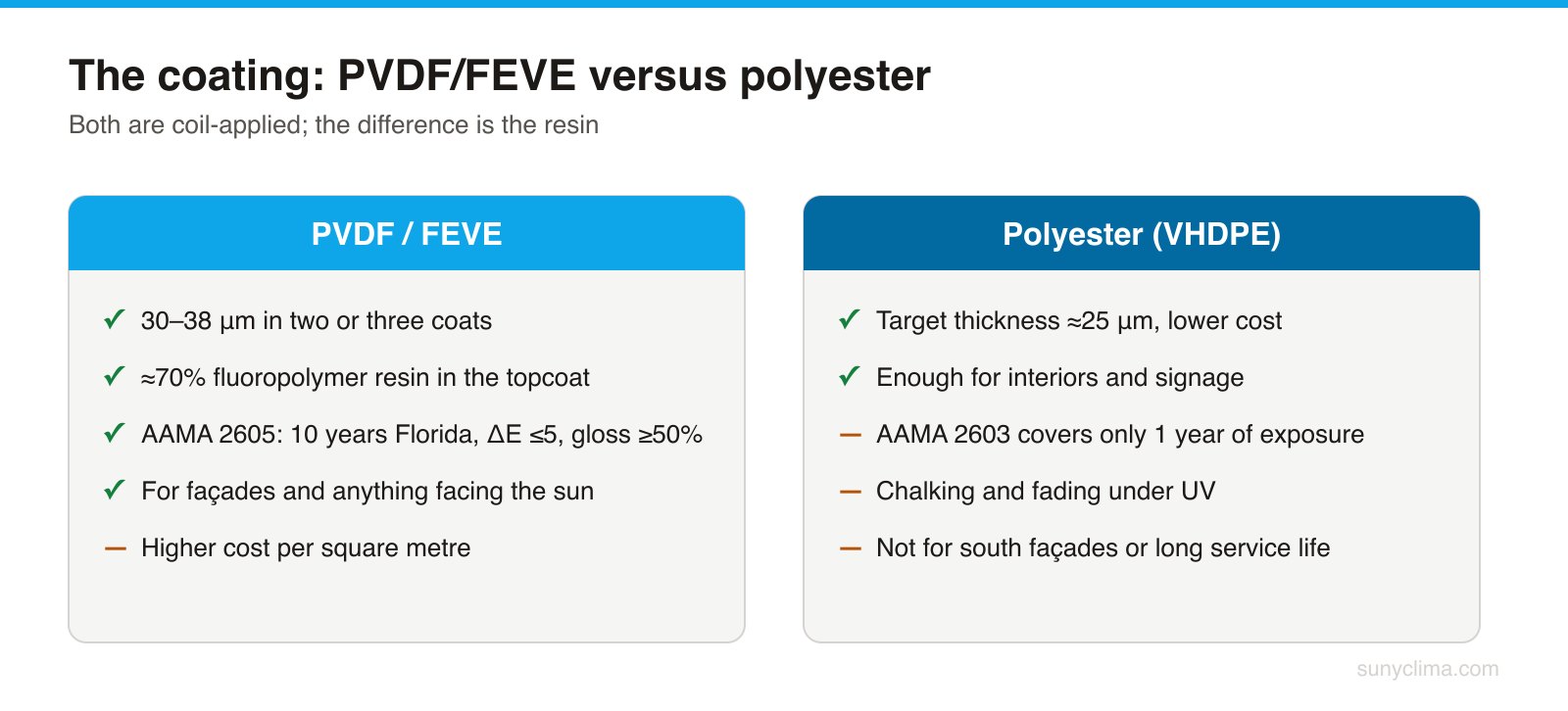
PVDF is polyvinylidene fluoride; architectural systems carry 70–80% fluoropolymer resin in the topcoat — 70% is the classic baseline, and Elval markets 80% for its own. They last for a chemical reason: the carbon–fluorine bond is among the strongest in organic chemistry, and UV does not break it easily. Polyester degrades far faster — the surface chalks and the colour fades.
The difference is quantified in the AAMA specifications: AAMA 2605 demands 10 years of South Florida exposure at ≤5 ΔE colour change, chalk rating ≥8 and gloss retention ≥50%; 2604 asks the same after 5 years, 2603 after 1. The etalbond sheet states its PVDF systems comply with 2605.
Put plainly: polyester is for interiors and signage; PVDF is for anything that faces the sun.
Fabrication: routing, folding, riveting
Routing the V-groove. The groove is cut from the back — through the rear skin and nearly all of the core, leaving roughly 0.3 mm behind the face skin. Those 0.3 mm let the panel be folded by hand, cleanly and along a straight line, without a folding machine, while the face skin stays continuous. CNC depth accuracy runs around ±0.05 mm, which with a 0.3 mm residual is not a luxury but a condition.
The groove profile sets the angle: 90° for folds up to 90°, 135° for up to 135°, a rectangular groove for 180°. The outer radius follows the groove's shape and depth — that is how a whole batch comes out with identical edges.
Bending without routing. Composite can also be formed on rolls or a press brake. The minimum interior radius is a brand rule, not a material one: etalbond gives r = 15 × t (60 mm at 4 mm), Alucobond PLUS r = 10 × t (40 mm) — read it off the sheet for the panel in hand. Spring-back is a little greater than with plain sheet, so series work starts with a trial piece.
Riveting. Outdoors, aluminium blind rivets with stainless steel mandrels — an ordinary steel mandrel gives rust spots across the façade after the first winter. Typical size: Ø5 mm shaft, Ø11 mm head. Three rules decide durability:
- Drill the hole larger than the rivet, to leave room for thermal movement. A tight rivet in a tight hole means a buckled panel in August.
- The head covers at least 1 mm around the hole, so the clearance never shows.
- The setting jig leaves about 0.3 mm of play — otherwise the rivet clamps the panel exactly where it needed to move.
If you read this as a customer rather than a fitter, one sentence carries the section: rust freckles around the rivets, and waves in an otherwise flat panel, are almost never the material's fault — they are the fixing's.
Bonding. In cassette systems the back is bonded to aluminium profiles with structural adhesive or double-sided tape — no visible rivets, but the adhesive must suit both the coating and the back primer.
Cutting. Carbide blades with a trapezoidal tooth, high speed, moderate feed; shearing deforms the edge. What matters is that a cut edge exposes the core — which is why good fabrication ends in a folded return, not a bare cut. How that plays out on an entrance door panel is covered in the article on bond and stainless as panel faces.
Expansion, temperature and tolerances
Aluminium expands, and on large surfaces that is not a detail. The sheet gives it usefully: 2.4 mm per metre for a 100 °C difference, a coefficient of 2.4 × 10⁻⁵ 1/K. The ETA declares the bare alloy at 23 × 10⁻⁶ 1/K — slightly lower for the metal alone than for the assembled panel.
A hundred degrees is not hypothetical: a dark south-facing façade reaches +70…+80 °C in August and −15…−20 °C in January. On a 3 m panel that is about 7 mm of movement, and a fixing that does not allow for it turns that movement into buckling or a sheared rivet.
The service range in the FR sheet is −20 °C to +80 °C; the A2 sheet gives −50 °C to +80 °C. For our climate the upper limit is what matters, and it is the same in both.
The geometric tolerances are published too, and they settle arguments: thickness ±0.2 mm, width and length to 4000 mm −0 / +4 mm, diagonal difference up to 3 mm. The standard sheet is 1250 or 1500 mm wide and 3200 mm long.
And one acceptance rule written verbatim into the sheet: dents, marks and stains are acceptable when not visible from ≥2 m at 90°. That is the official criterion — not "nothing at all".
Where bond is used beyond doors
- Ventilated façades and rainscreen cassettes. The largest application by volume: routed and folded into a tray, hooked or riveted to an aluminium sub-frame over a ventilated cavity and insulation. FR and A2 cores only.
- Signage. Signs, totems, shop fascias — dead flat, rust-free, ideal for direct print and vinyl. Here a PE core is the normal choice.
- Interior cladding. Lift lobbies, ceilings, hospital and airport corridors — non-porous and easy to clean.
- Transport. Trailer and bus sides, caravans, refrigerated bodies.
- Decorative entrance door panels. Here it is a face over an insulating core, not a structure in its own right — see the panel selection guide and the materials overview.
Common mistakes and misconceptions
- "Bond is solid aluminium." You see 0.5 mm of 4 mm — and that is exactly why the panel is flat and light.
- "Bond insulates." It does not. The 3105 skin alloy conducts heat at around 170 W/(m·K), pure aluminium at 237, and the core is thin. Insulation comes from what sits behind the face — XPS, for instance, at λ ≈ 0.033–0.035 W/(m·K). The reasoning is in the article on core material and panel thickness.
- "FR means non-combustible." It does not. B-s1,d0 is combustible with a limited contribution to fire; A2 is the class that means non-combustible in any practical sense.
- "All bond is the same." The commonest saving is thinning the skins. The catalogue photo looks identical but the weight collapses: a 4 mm composite with 0.20–0.30 mm skins and a PE core weighs about 4.6–4.8 kg/m², against 5.5 for etalbond PE and 7.4 for etalbond-FR. A suspiciously light panel means thin skins — and with them go stiffness and dent resistance.
- Routing by eye. Groove depth is where 0.1 mm separates a clean edge from scrap.
- Mixing batches. Metallic and pearlescent shades are directional — panels from different coils, or rotated 180°, read as different tones. One façade, one batch, one orientation.
How to read the data sheet in five lines
- Skin thickness and weight per m². 0.5 mm and ≈7.4 kg/m² at 4 mm is architectural grade; lighter means thinner skins.
- Core and EN 13501-1 class. PE (E), FR (B-s1,d0) or A2 (A2-s1,d0) — on paper, in a DoP.
- Coating type and microns. PVDF/FEVE at 30–33 μm against polyester at ≈25 μm; look for EN 1396 and AAMA 2605.
- Alloy and temper. EN AW-3105, H44 (painted) is the architectural standard.
- Expansion, temperature, tolerances. 2.4 mm/m at 100 °C, up to +80 °C, ±0.2 mm on thickness, diagonal up to 3 mm — these decide the fixing.
The tables in technical parameters of panel materials put bond beside the other facings. If you already know what you want, describe it in an enquiry — panels are made to order by a Bulgarian manufacturer — or browse the catalogue.
One sentence to keep: "bond" describes the construction, not the quality. The construction is always 0.5 / 3 / 0.5 mm; the quality lives in three lines of the data sheet — skin thickness, core type with its EN 13501-1 class, and coating type and thickness.