What Is EPS and How It Differs from XPS
EPS is expanded polystyrene made of fused beads. How it is made, what the EN 13163 grades 60 to 250 mean, and why XPS wins on water and load.
One polymer, two structures: fused beads versus a homogeneous extruded foam. How EPS is made, what EN 13163 declares, what the 60–250 grades mean, and where the real line between the two materials runs — at water.
Two white boards. Scratch the first with a fingernail and it crumbles into beads, visibly made of fused grains. The second is smooth and uniform right through the cut. The first is EPS, the second XPS. They look alike, cost differently and behave almost identically everywhere — except where there is water.
In short: EPS is expanded polystyrene — beads blown up with steam and fused into a block. XPS is extruded polystyrene — a continuous foam pressed out through a die. The chemistry is identical; the structure is not. EPS is cheaper for the same thermal resistance and entirely sufficient for a façade. XPS wins wherever the board will be loaded or wet.
What EPS actually is
EPS stands for expanded polystyrene. Almost nobody on site says that — they say styrofoam, or across much of Europe styropor. Styropor is a registered BASF trademark that became the everyday word for the material, the same trade-name-turned-generic story as Etalbond or inox. Order styrofoam and you are ordering EPS, but you have said nothing about its grade — and the grade is what matters.
The raw material is polystyrene beads: hard granules a fraction of a millimetre across with pentane dissolved inside. Pentane is the blowing agent — a gas that vaporises on heating and inflates the bead from within. The result is extraordinarily light: at a façade density of around 15 kg/m³, against a solid polystyrene density of roughly 1,050 kg/m³, the polymer is under two percent of the volume. The other ~98% is still air, and that air does the insulating; the polystyrene is only the scaffold holding it in place.
Manufacture in four steps
- Pre-expansion. The beads are showered with steam, the pentane vaporises, and each bead swells roughly 40–50 times its volume, depending on the target density. How much steam and for how long sets the final density — which sets almost every other property.
- Maturing. The expanded beads sit in open-mesh silos for hours up to a few days: air diffuses inward, replaces the condensed pentane, and internal pressure equalises with the atmosphere. The consequence is critical — the cells of EPS are full of air before the board even exists.
- Block moulding. The matured beads are filled into a mould and steamed again: their surfaces soften and they fuse into a block.
- Cutting. The block is sliced into boards with a hot wire, hence the slightly glazed edge. The alternative is moulding directly into a finished shape — packaging and profiled components.
Beads versus extruded foam
XPS takes a completely different route. Polystyrene is melted in an extruder, a blowing gas is injected into the melt under pressure, and the mixture is forced through a wide die, foaming as it reaches atmospheric pressure. Out comes a continuous ribbon of foam, calibrated and profiled. No beads, no fusing — one casting.
Both materials are called closed-cell, and that is true of the cells themselves. The difference lives one level up. In EPS the beads are fused across their surfaces, but inter-bead voids remain between them — microscopic channels along the boundaries. The cell is closed; the boundary is not. In XPS those boundaries do not exist. That explains nearly the whole table below: why EPS takes more water, passes more vapour, and why XPS is the material you bury. For a closer look at the extruded variant alone, see the separate article on XPS.
EN 13163 and EN 13164: two different passports
EPS is declared to EN 13163, XPS to EN 13164. Both are harmonised: the board carries CE marking and a designation code listing every declared property. Two real codes:
- Graphite façade EPS: EPS – EN 13163 – L2 – W2 – T1 – S2 – P3 – DS(N)2 – DS(70,-)1 – BS125 – TR150 – CS(10)80
- 300 kPa XPS board: XPS – EN 13164 – T1 – CS(10\Y)300 – DS(TH) – WL(T)0,7 – WD(V)3
L, W and T are the length, width and thickness tolerances, S squareness, P flatness, DS dimensional stability (normal conditions, or 70 °C and 90% humidity), CS(10) compressive stress at 10% deformation, BS bending strength, TR tensile strength perpendicular to the faces, WL(T) absorption by immersion, WD(V) absorption by diffusion, MU the vapour diffusion resistance factor.
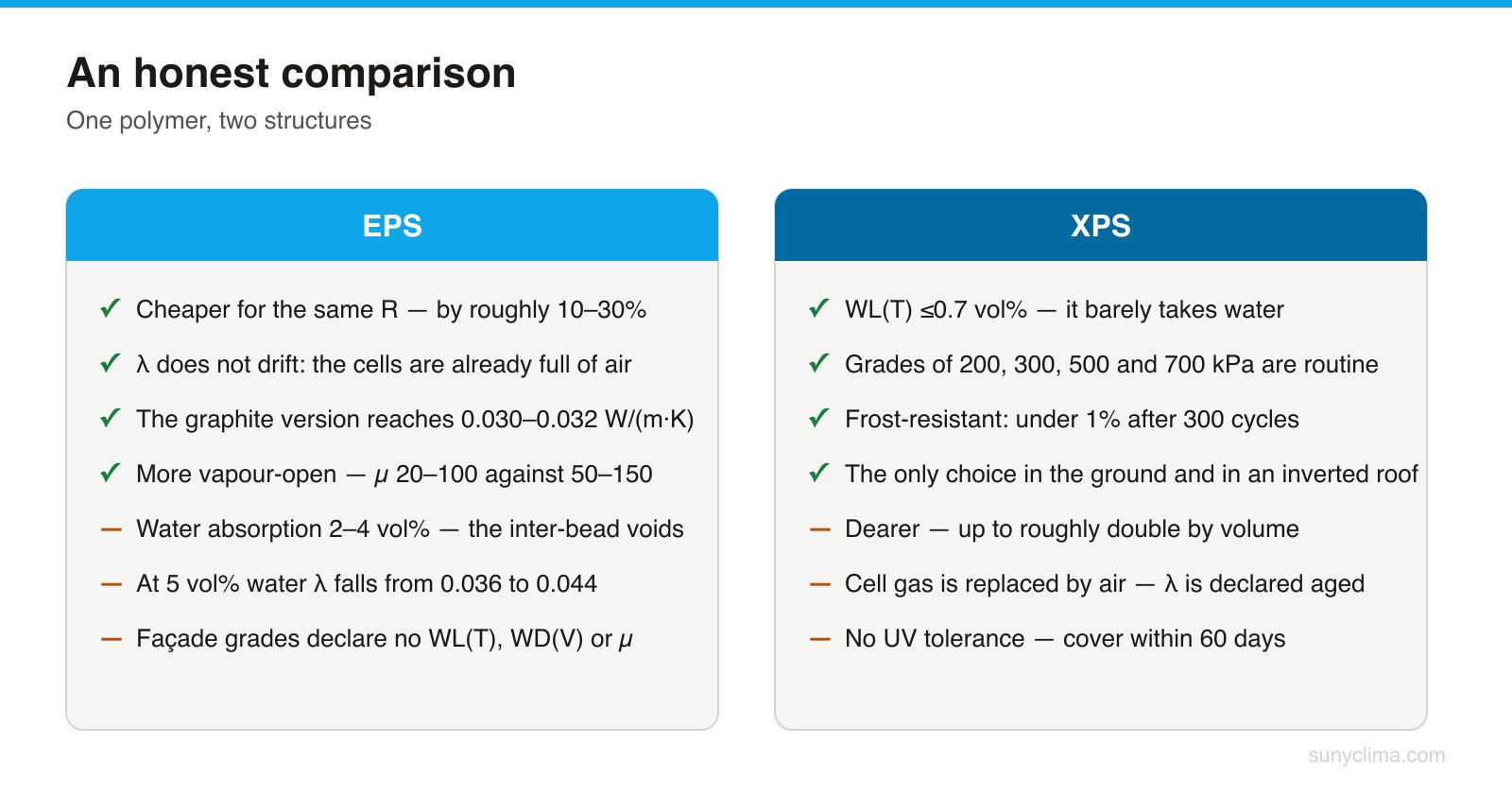
Notice what is missing from the first code. The façade EPS board declares neither WL(T) nor WD(V) nor µ — those rows say NPD, no performance determined. The XPS board declares all three. Free information: an empty water absorption row tells you the board was never meant to stand in water.
EPS 60, 80, 100, 150, 200: the number is not the density
The most persistent misunderstanding about EPS. The number in EPS 100 is not a density and not a thickness — it is the compressive stress at 10% deformation, in kilopascals. EPS 100 takes 100 kPa at 10% compression; EPS 200 twice that. Those numbers are a EUMEPS convention rather than EN 13163’s own designation, which is the full code string. EUMEPS defines five commodity types with no specific application — EPS 60, 100, 150, 200 and 250 — and intermediate types are in everyday use: EPS 30, 50, 70, 80, 90, 120, up to EPS 500.
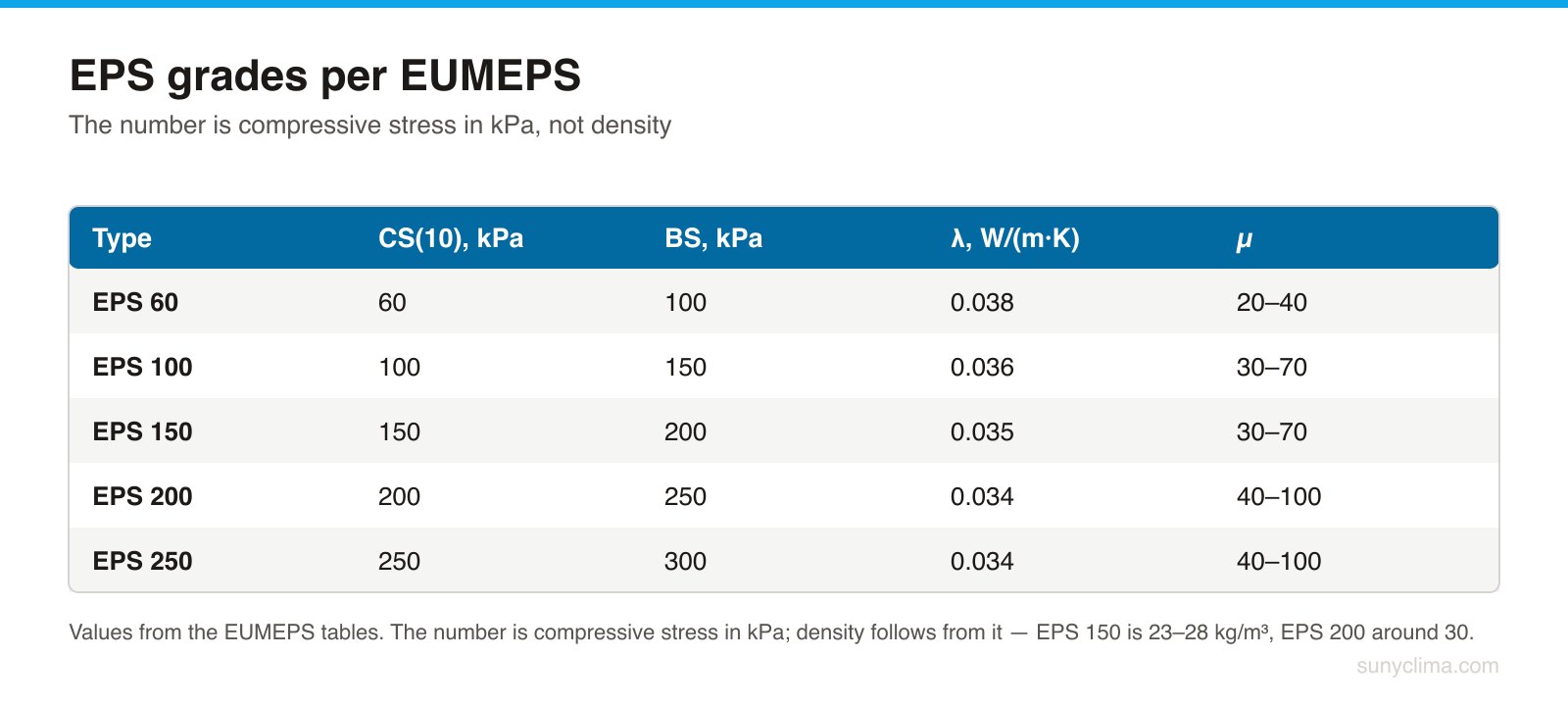
Density rises with the grade: real façade boards sit at 13.5–16 kg/m³ for CS(10) 70–80 kPa, EPS 150 runs 23–28 kg/m³, and 30 kg/m³ is already EPS 200. Many façade boards, incidentally, declare no CS(10) at all — only TR and BS — because nobody stands on a façade.
A useful site detail: EUMEPS has agreed a colour code, applied to at least one edge of the board — EPS 60 two blue stripes, EPS 80 orange, EPS 100 black, EPS 150 yellow, EPS 200 two black. An extra red stripe means a flame retardant — and EPS without one is Euroclass F without testing.
The classic floor mistake: CS(10) is not a permissible working load. It is the stress at 10% deformation in a short test. Sustained load is a separate declared property — compressive creep CC to EN 1606 — and that is exactly the line where façade EPS boards say NPD, while XPS boards for screeds declare it.
The λ of EPS depends on density
Thermal conductivity is not a constant here. On the EUMEPS figures the declared value runs from 0.038 W/(m·K) for EPS 60 down to 0.034 for EPS 200 and 250, and for white EPS there is an established relationship between λ and bulk density across 8–55 kg/m³. "The λ of styrofoam is 0.038" is an incomplete sentence until you name the grade.
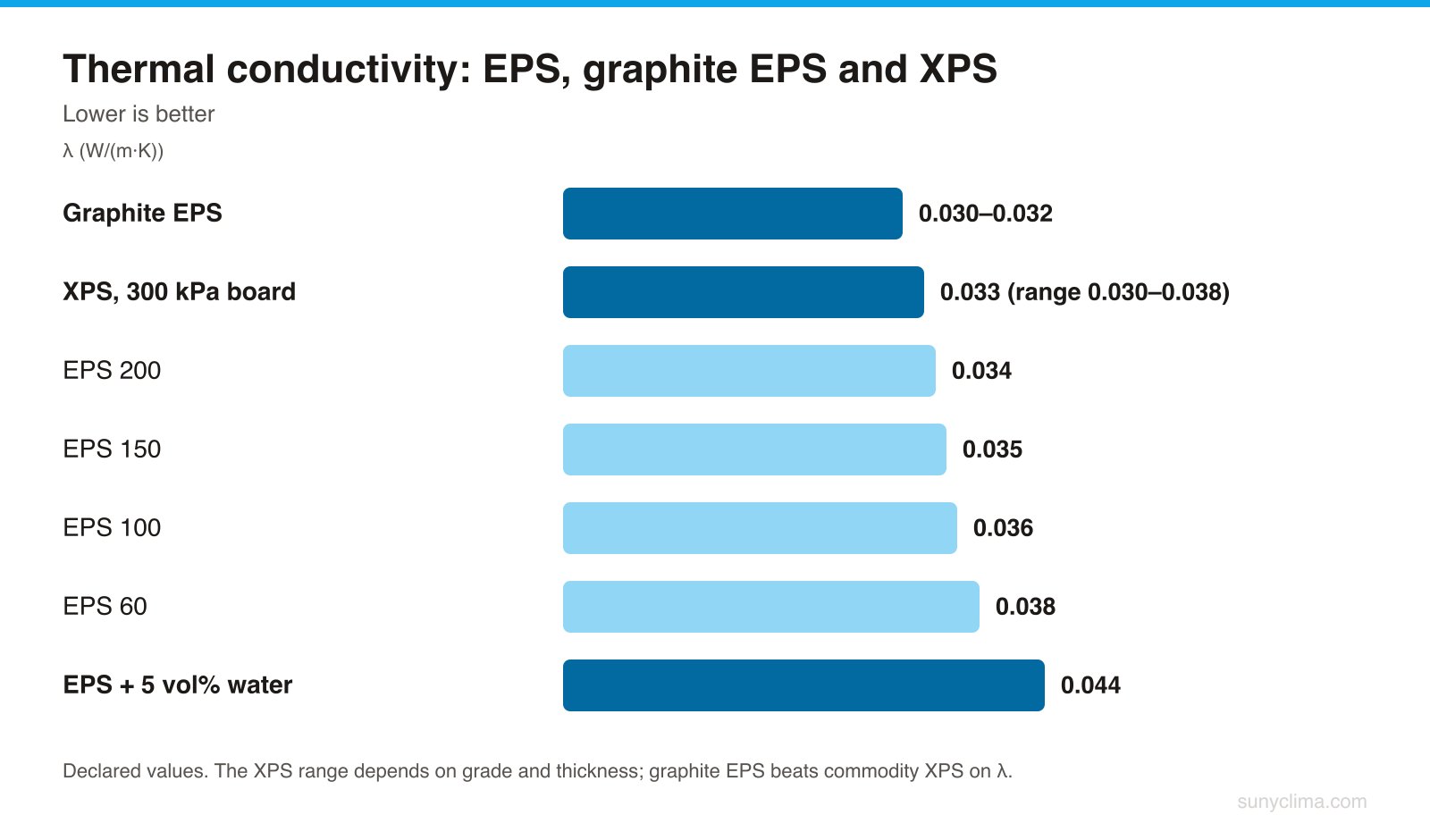
XPS is declared under EN 13164 anywhere from 0.030 to 0.038 W/(m·K) depending on grade and thickness, with commodity boards at 0.033–0.035. The real board quoted above declares 0.033 for 20–60 mm and 0.034 above 60 mm — and adds "after 25 years". XPS declares an aged value, because the blowing gas in its cells is gradually replaced by air; since 1 January 2020 the EU F-gas regulation has banned HFCs above 150 GWP in XPS, and makers moved to CO₂ and HFOs. EPS has nothing to lose: its cells have been air-filled since the maturing silo, so its λ does not drift. The two are compared not on day one but in year 25 — which is why the catalogue gap is smaller than you expect.
In millimetres: R = 1.0 m²·K/W needs 33 mm of XPS or 38 mm of white EPS 60 — and 0.033 is the thin-board figure, the most flattering one XPS has. Five millimetres — money across a whole façade, nothing at the plinth.
Grey (graphite) EPS
In a material this light, part of the heat transfer is neither through the polymer nor the air but by thermal radiation across the cells. Embedded graphite absorbs and reflects part of that infrared radiation, partly closing the channel — hence the grey colour. Manufacturers advertise "up to 20%" better insulation, but at equal density the gap is nearer 13–15%: at 15 kg/m³ graphite EPS gives ≤0.032 W/(m·K) against ≥0.037 for white. Declared values are 0.031 at CS(10) 70 kPa and 0.030 for EPS 100 and 150 — a range of 0.030–0.032.
Which means graphite EPS at 15 kg/m³ already beats XPS on λ — at an EPS price plus a premium, but with none of the XPS advantages under water and load. The graphite has its own cost: a grey board heats up hard in direct sun, and makers state it must not be exposed to UV and should be worked under shade, or boards distort and adhesion suffers.
Water: the real difference
The standards test water absorption two ways. EN 12087 (method 2A) immerses the specimen completely for 28 days and yields WL(T), absorption by immersion in percent by volume. EN 12088 measures uptake by diffusion under a humidity gradient and yields WD(V). Both were withdrawn in 2019 in favour of EN ISO 16535 and EN ISO 16536, though data sheets still quote the old numbers.
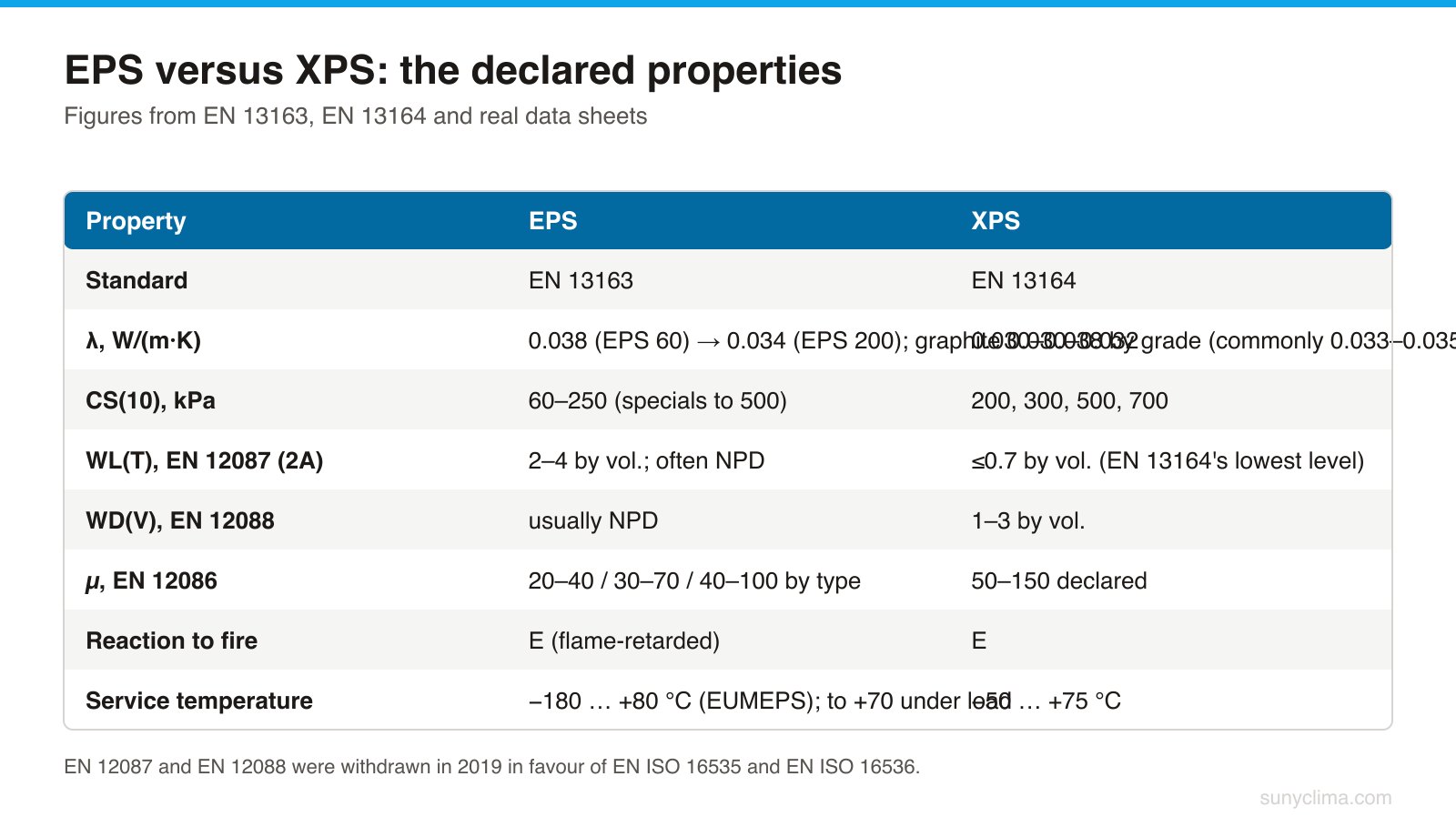
Real declarations: a 300 kPa XPS board states WL(T) 0.7 vol% and WD(V) 3 vol%. A façade EPS board that declares it at all states WL(T)4 — up to 4 vol%. Published comparisons give 2–4 vol% for EPS — and, against expectation, this does not track density: a measured EPS 100 took up more than an EPS 200. XPS declares ≤0.7 vol%, which is also the lowest level EN 13164 permits anyone to declare; measured values are lower. The cause is the inter-bead voids. Vapour permeability follows the same logic: tabulated µ is 20–40 for EPS 30 to EPS 80, 30–70 for EPS 90 to EPS 150 and 40–100 for EPS 200 upward, while XPS declares 50–150; ISO 10456 tabulates 150 for XPS and 60 for EPS, and the range reaching 250 comes from the industry EPD, not from ISO. EPS breathes more — an advantage for a façade that must dry outwards, a liability in the ground.
The figure that convinces a client is a third one. Under ISO 10456 thermal conductivity rises with moisture, and fast. For a material declared at 0.036 W/(m·K): 1 vol% water gives 0.037; 2%, 0.039; 3%, 0.041; 5%, 0.044; 10%, 0.054. Translated: EPS holding 5 percent water by volume works at λ 0.044 — over 20% worse than its dry self. XPS at 0.7% barely moves. EUMEPS also publishes conversion factors: a WL(T)5 board is multiplied by 1.11 drained and 1.22 undrained, a WL(T)1 board by only 1.02 and 1.04.
The conclusion: above ground, behind render, EPS takes no water and the question does not arise. In the ground, under a slab and in an inverted roof it does — and there EPS is the wrong material.
Load, frost and dimensional stability
Compression. The commodity EPS types cover 60–250 kPa, with specials to 500. Commodity XPS grades are 200, 300, 500 and 700 kPa. The ranges overlap — the difference is that in XPS the high grades are routine, while in EPS they are a special order.
Frost. Freeze-thaw resistance is tested to EN 12091 — 300 cycles from dry at −20 °C to wet at +20 °C — and is only needed where the material sits permanently in water while crossing zero. Measurements show EPS above 20 kg/m³ with a bending strength of at least 150 kPa is not degraded by such cycles, and 22 kg/m³ upward is recommended for frost insulation. So façade EPS 70 at 15 kg/m³ is not a board for that job — not because EPS fails in frost, but because that grade does.
Dimensions and temperature. The commodity types declare DS(N) 0.5%, plus DS(70,90) or DS(70,-) for 70 °C and high humidity; EPS keeps shrinking slightly after moulding, which is why maturing the blocks is not a wasted step. EUMEPS gives an application range of −180 °C to +80 °C, the lower figure coming from cryogenic mechanical testing — it describes survival, not optimal performance. The upper one is the real constraint: above 80 °C the material softens, shrinks and finally melts, and under load the ceiling drops further — makers declare DLT at 70 °C. XPS runs from −50 °C to +75 °C — the same bracket, so temperature is rarely the deciding criterion.
Where each one belongs
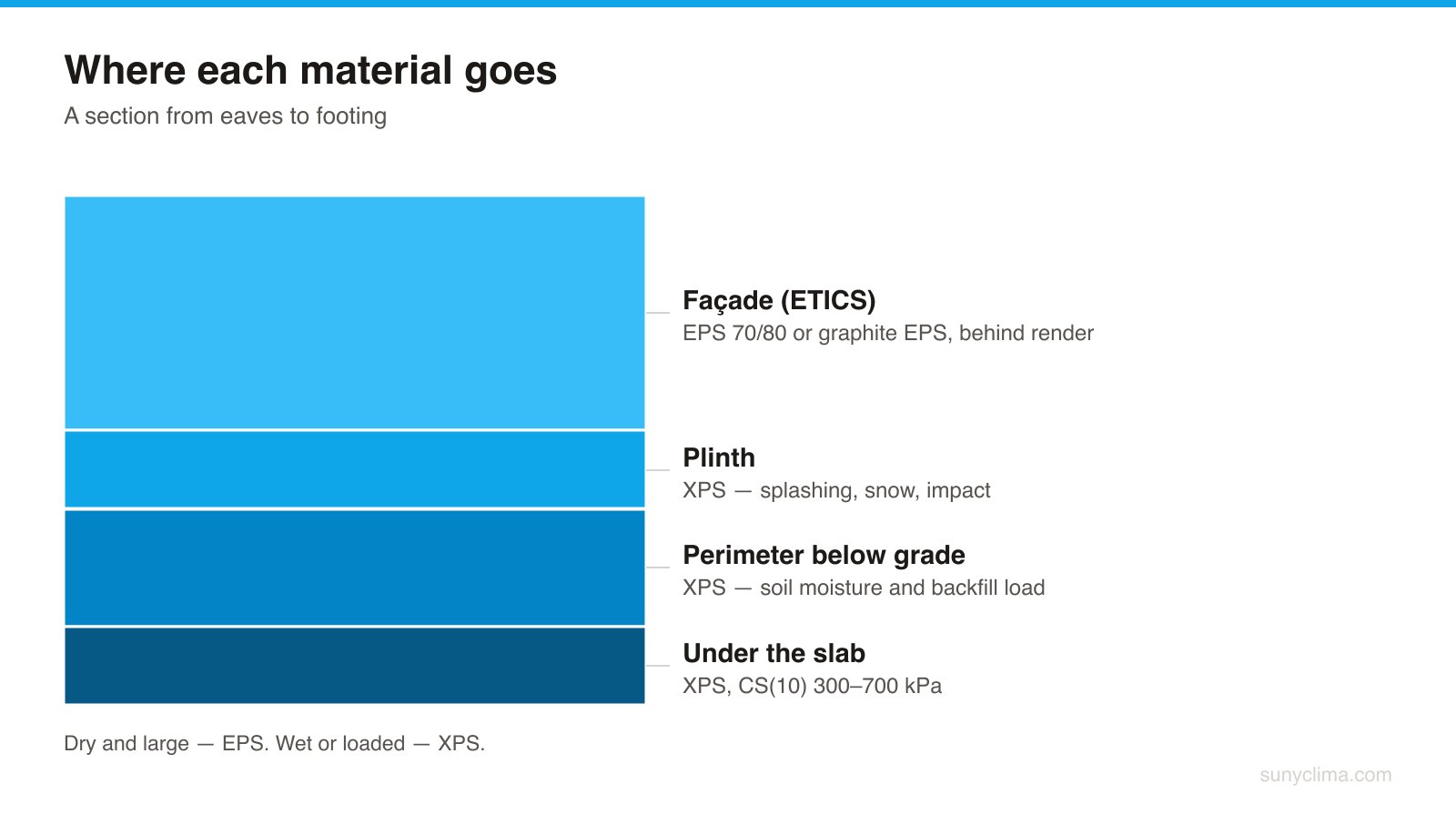
Around 75% of European EPS production goes into construction, mostly insulation: for large dry areas EPS wins on price and weight. EPS belongs in ETICS façades, roofs under a protective layer, internal insulation, masonry cavities and floors with the grade chosen for the load, plus everything outside construction — packaging, geofoam, moulded components, panel cores. XPS belongs in plinths, perimeter insulation below grade, inverted roofs, under screed and under slabs, parking decks, cold rooms and pools — anything loaded or wet.
In decorative door panels the logic is the same, but the core is encapsulated between two faces and sees neither rain nor ground moisture — so the choice there turns on other criteria: thickness, the profile rebate and fixing strength. That is covered in the article on core and panel thickness, and the coefficients for every material are in the technical parameters. Panels built to order by a Bulgarian manufacturer are assembled with exactly that distinction in mind.
Price: EPS wins per square metre of thermal resistance
The numbers depend on the market: published comparisons credit EPS with roughly 10–30% more thermal resistance for the same money, and in some markets the XPS board costs about twice as much by volume. The direction never changes — for the same R, EPS costs less. That is why whole blocks are insulated with EPS while XPS is reserved for the metres with no alternative: paying XPS prices for a dry façade is cost without return, and saving on XPS at the plinth is paid for in damp walls.
The mistakes that cost money
- EPS below ground level. The board takes up soil moisture, λ degrades along ISO 10456, and the insulation works 10–20% less well. And façade EPS never declares WL(T) — nobody promised it would hold up.
- EPS under a screed in the wrong grade. EPS 60 under a loaded floating screed crushes. More importantly, the choice is made on compressive creep CC, not CS(10) — and façade boards do not declare it.
- Confusing the number with density. EPS 100 is not "100 kg/m³" and not "10 cm" — it is 100 kPa at 10% deformation.
- Leaving the board in the sun. XPS should be covered within 60 days (90 per another source); under UV the surface fades and chalks. Graphite EPS needs shade from day one.
- Solvent-based adhesives and paints. Polystyrene dissolves in aromatic solvents — equally in EPS and XPS. EUMEPS recommends a field trial with any unknown product (faster at 50 °C than 20 °C), assessed on the DIN 53428 scale. Use only products declared polystyrene-compatible.
- Comparing λ without a grade. "EPS is 0.038, XPS is 0.033" holds only for white EPS 60. If it is graphite, the numbers reverse.
Fire: Euroclass E and the flame retardants
Polystyrene is organic and burns: heat of combustion is 40 MJ/kg, or 400–2,000 MJ/m³ by density. Its contribution to the fire load is limited because the material is so light. Above 80 °C EPS softens, shrinks and melts, and combustible gases come off the melt. Molten EPS is not normally ignited by a spark or glowing cigarette, but a small flame ignites standard non-retarded EPS immediately. On EUMEPS figures measured to ASTM D 1929, flash ignition with a pilot flame occurs at 360 °C for standard EPS, 370 °C for the flame-retarded type, and self-ignition of the melt at 450 °C.
With a flame retardant EPS achieves Class E under EN 13501-1 — the same class XPS declares. Until 2015 the retardant was HBCD, a cycloaliphatic organobromine compound; it was banned as a persistent organic pollutant under the Stockholm Convention and REACH from August 2015, replaced by the polymeric flame retardant PolyFR, a block copolymer of polystyrene and brominated polybutadiene. Two clarifications save arguments on site: Class E applies to the board, not the construction (the assembly is proven to EN 13823 and EN ISO 11925-2), and rules on building height and fire barriers are national.
Recycling
Because EPS is about 98% air, the main cost of recycling is transport, not material — which is why collected EPS is compacted on site. Clean EPS is recycled mechanically, the least energy-intensive route, and goes back into production. On the EUMEPS 2021 report the overall recycling rate for EPS waste in Europe is 30%, but two very different realities sit behind it: 38% for packaging and just 10% for construction EPS. In single streams such as fish boxes the Netherlands reaches 90%. Old boards containing HBCD are a separate problem, addressed by schemes such as PolyStyreneLoop. Since 3 July 2021 the EU has banned EPS food containers, cups and beverage containers — together with their caps and lids — from the market.
Reading a data sheet in one minute
- Which standard — EN 13163 means EPS, EN 13164 means XPS.
- λD, and at what thickness — for XPS, whether it is "after 25 years"; for EPS, which grade.
- CS(10) — and whether CC is declared for sustained load.
- WL(T) and WD(V) — NPD means the board is not for a wet environment.
- MU (µ) — for interstitial condensation in the wall.
- DS — dimensional stability, including at 70 °C.
- Reaction to fire — Class E, and whether it is flame-retarded (the red stripe).
- Density — the single best indicator of an EPS board's quality.
What should stay with you: EPS and XPS are the same polymer with different structures — beads versus a homogeneous foam — and the whole difference follows from that. EPS for a dry façade and a large area, XPS for anything loaded or wet. And never compare λ without naming the EPS grade.
Choosing for a specific construction? See the materials and the approach to choosing, browse the catalogue or send an enquiry — the answer to "EPS or XPS" is nearly always hidden in where the board will actually sit.