Çfarë është inoksi: shtresa pasive, markat dhe sipërfaqet
Inoks: pse fjala është frënge, si funksionon shtresa pasive, familjet 304, 316, 430 dhe dupleks, kodet sipas EN dhe sipërfaqet 2B, BA dhe No. 4.
Inoks vjen nga fjala frënge inoxydable — dhe metali e mban premtimin në mënyrë të kundërt: oksidohet menjëherë dhe pikërisht për këtë arsye nuk ndryshket. Ja e gjithë historia e shtresës pasive, familjeve, kodeve dhe sipërfaqeve.
The word "inox" gets attached to the kitchen sink, the balcony railing and the trim strip on a front door alike. In reality it names a whole family of steels with different compositions, different prices and very different behaviour once the air around them turns salty.
This article is about stainless steel as a material: what makes it stainless, why the whole story comes down to a film a few nanometres thick, how to read the designation on a spec sheet, and what happens when you cut, bend, weld and clean it. If what you need is the 304-versus-316 decision for a decorative door face, that is covered in bond and stainless panels. Here we go one level down, into the metallurgy.
The word is French, and it is a promise
"Inox" is short for the French inoxydable — "non-oxidisable". English promises something more modest: stainless, as in "does not stain". Both name the same material, but the French word promises more than the metal can deliver — which brings us to the first paradox.
Stainless steel does oxidise — instantly, the moment it meets air — and that is precisely what saves it. The real promise is not "does not react with oxygen" but "reacts so fast and so neatly that it seals itself". As language "inox" is wrong; as engineering it names the right mechanism with the sign reversed.
The history is short: Pierre Berthier noticed the acid resistance of iron-chromium alloys in 1821, and in 1913 Harry Brearley in Sheffield found that his high-chromium sample simply refused to rust.
The definition is a number: 10.5% chromium
"Stainless" is not a descriptive adjective; it is a defined threshold. Under EN 10088-1, a steel is stainless when it contains a minimum of 10.5% chromium by weight and a maximum of 1.2% carbon. Below that level the oxide film is discontinuous and porous — present in places, absent in others, with corrosion walking straight through the gaps. Above it the film becomes continuous.
So 10.5% is not a round catalogue number but a behavioural boundary. In practice the common grades start at 16–18% chromium.
The passive layer: a few nanometres that decide everything
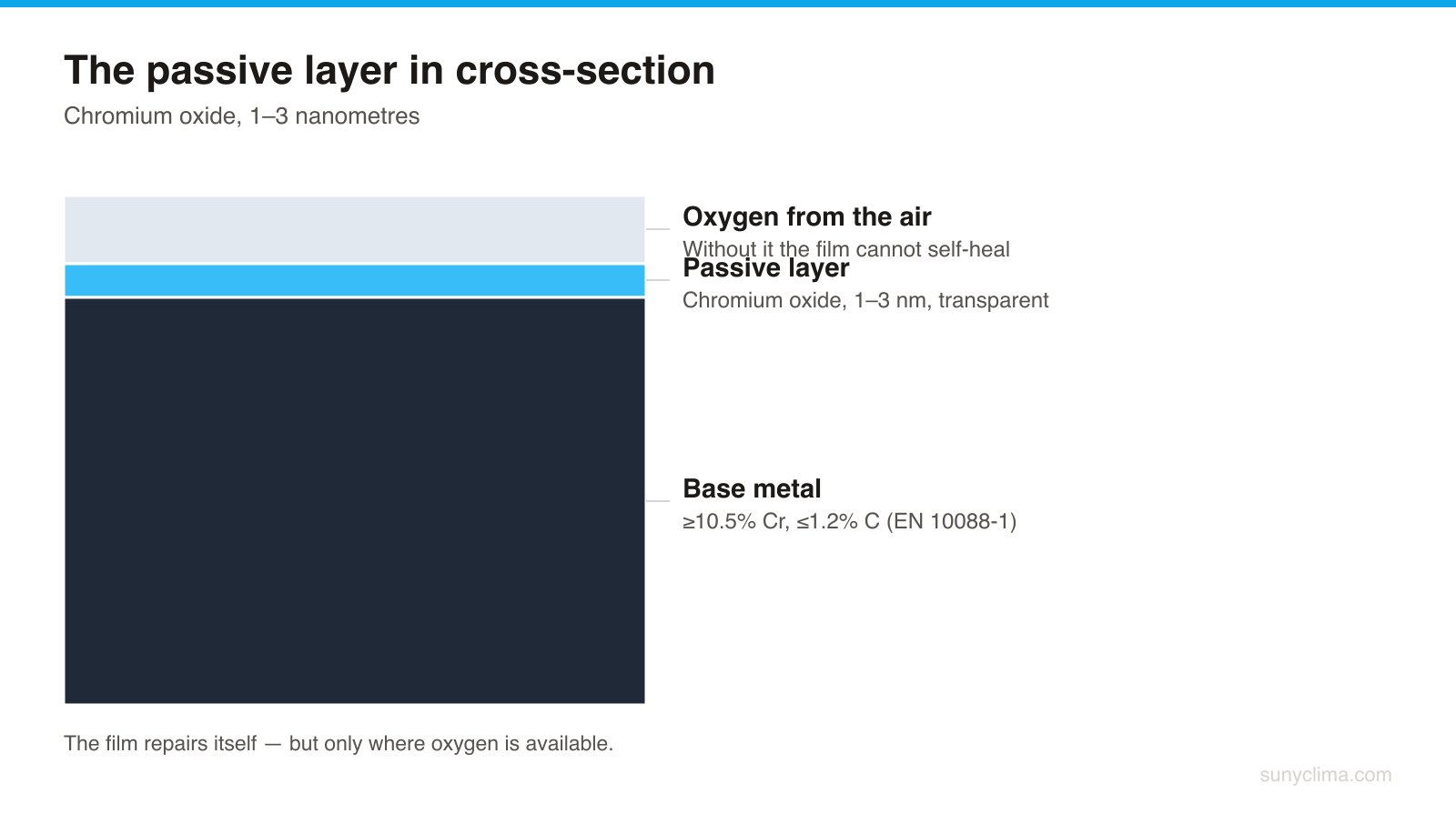
When the chromium in the steel meets oxygen it forms chromium oxide — a dense, strongly adherent, chemically stable film 1–3 nanometres thick (Outokumpu quotes 1–3 nm, ISSF 2–3 nm). For scale: a sheet of 0.1 mm paper is some 40,000 times thicker. The film is transparent and impossible to feel; the shine we call "inox" belongs to the metal beneath it. The British Stainless Steel Association describes the mechanism in detail.
The difference from paint is fundamental. Paint is a layer you put on: scratch it and the gap stays a gap. The passive layer is one the material makes out of itself — scratch it and the chromium on the freshly exposed surface reacts with the oxygen around it and the film closes again. It is the only "coating" that repairs itself.
There is one condition: oxygen has to be available. Self-healing is a chemical reaction and it needs a reactant. Stainless sitting under a deposit, behind a gasket or in stagnant water loses the ability to heal precisely where it most needs it.
What defeats the passive layer
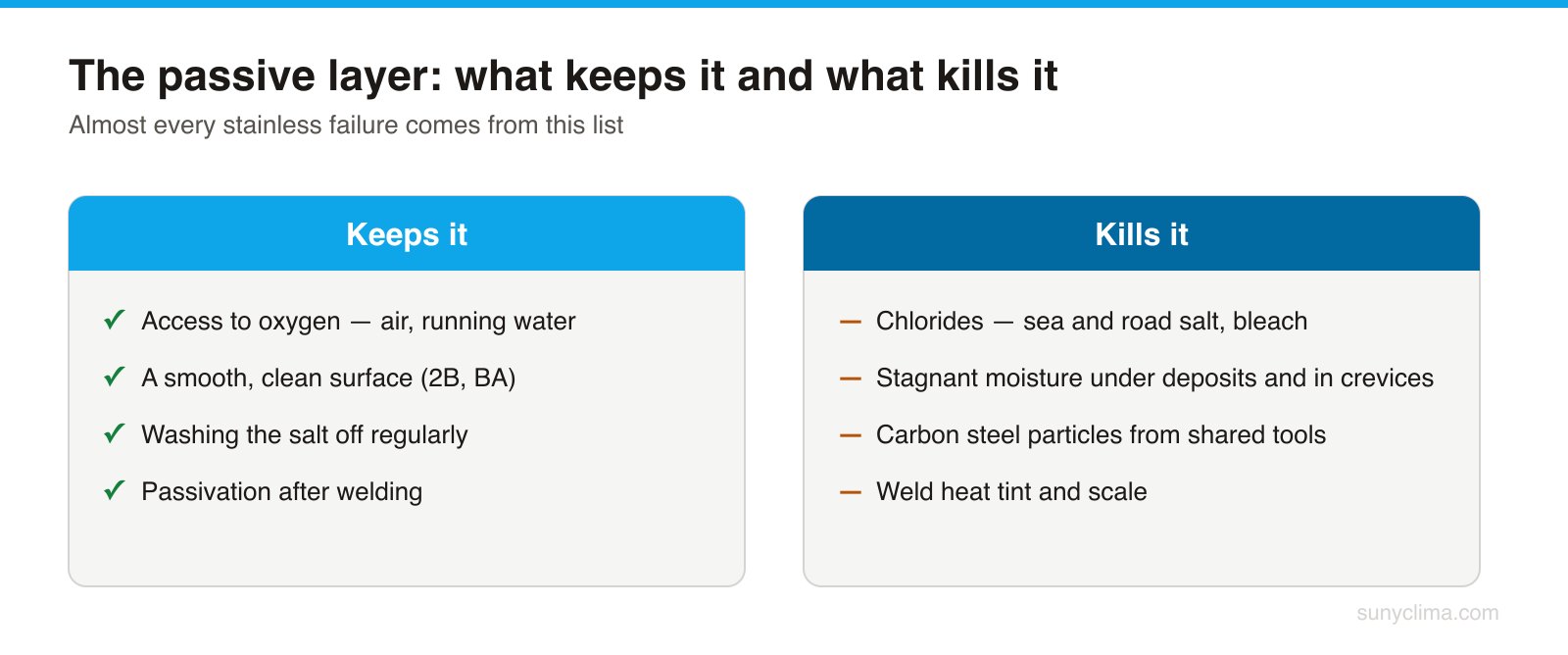
Practically every stainless problem is a problem with this film. Four mechanisms explain almost everything that goes wrong:
- Chlorides. The chloride ion is small and aggressive and punches through the film at points rather than evenly. The result is pitting — a dark cavity growing inwards while the surface around it looks fine. The sources: sea salt, road salt, pool water, bleach.
- Oxygen starvation. Under a deposit, under a washer, behind a gasket, moisture sits and oxygen is scarce, so the film cannot rebuild. This is crevice corrosion — why stainless so often fails where it looks most protected.
- Carbon steel contamination. Microscopic iron particles left by a wire brush, a grinding disc or a shared workbench rust on their own and start a local attack. The stain shows up days later and is blamed on "bad stainless".
- Weld heat tint. The blue-brown colours around a weld are an oxide scale with chromium-depleted steel underneath — left in place, the weakest point of the assembly.
The four families and why they differ
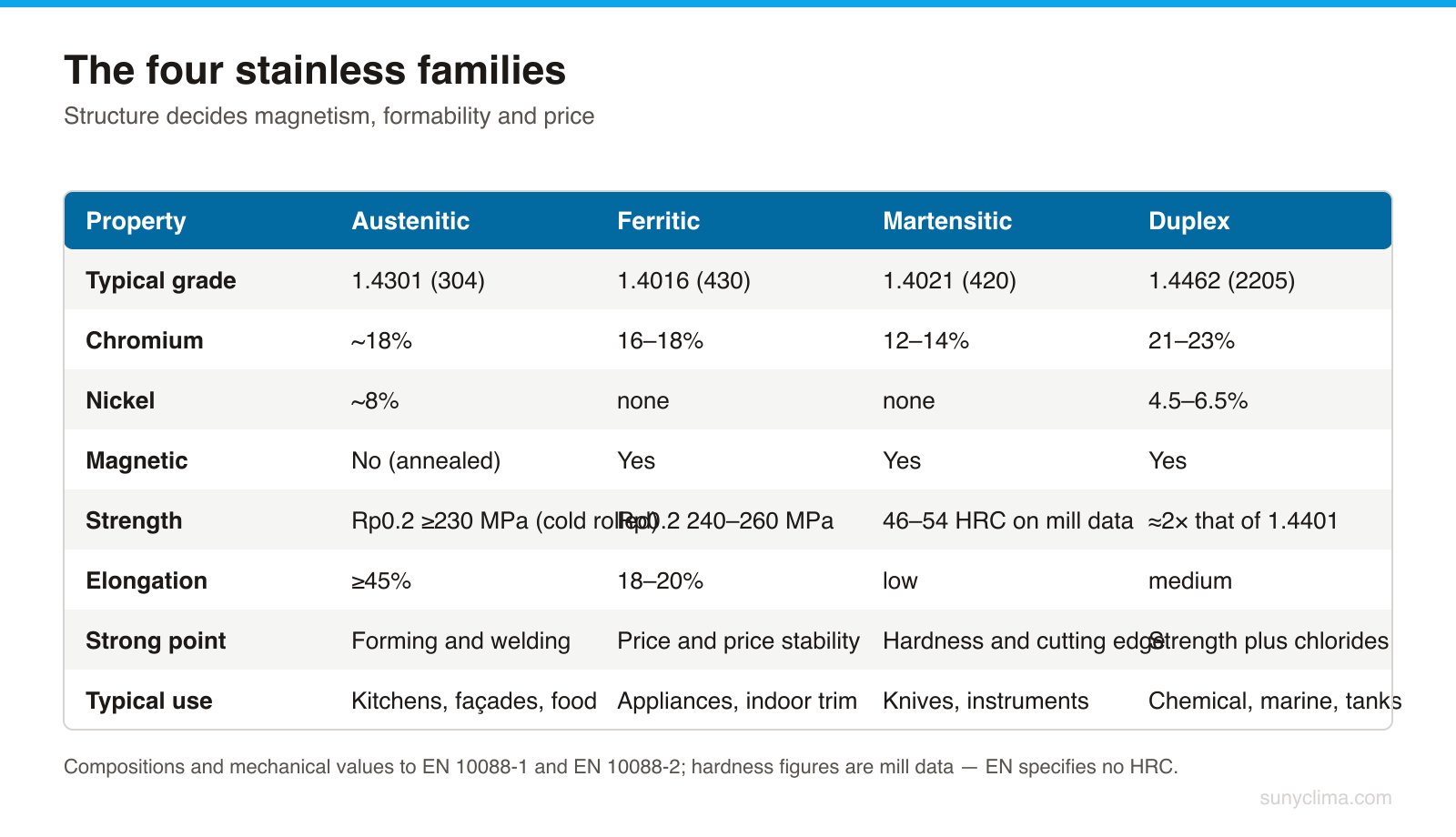
Stainless steels are grouped by crystal structure, which follows from the composition. The family decides whether the material is magnetic, how it forms, how it welds and what it costs.
Austenitic (300 series)
The most common family — home to 1.4301 (304) and 1.4401 (316). These contain chromium and nickel; the nickel stabilises the austenitic structure and brings excellent ductility, excellent weldability and, annealed, effectively no magnetism at all. EN 10088-2 declares Rp0.2 ≥ 230 MPa and Rm 540–750 MPa for cold-rolled 1.4301 strip (the hot-rolled row is 210 and 520–720 MPa), with elongation ≥ 45%. EN 10088-1 lists thermal conductivity at 20 °C as 15 W/(m·K) and mean expansion as 16 × 10⁻⁶ 1/K over 20–100 °C, rising to 18 × 10⁻⁶ by 500 °C. (US data sheets for 304 usually print 16 and 17.3, which is where half the confusion in specifications comes from.)
The flip side: it work-hardens sharply while you form it, and nickel is an exchange-traded commodity — so a 304 sheet gets dearer and cheaper for reasons unrelated to your project.
Ferritic (400 series)
The classic grade is 1.4016 (430): 16–18% chromium, up to 0.08% carbon and no nickel at all. No nickel means a lower and far steadier price. Ferritic stainless is magnetic, conducts heat better (≈25 W/(m·K)) and expands less (10.0–11.0 × 10⁻⁶ 1/K), so it distorts less when welded. Mechanically: Rp0.2 240–260 MPa, Rm 430–600 MPa (430–630 on plate) — but elongation of only 18–20%.
That low elongation is one limitation: 430 bends well but will not deep-draw. The bigger one is corrosion — 1.4016 belongs indoors or in mildly aggressive environments: white goods, catering equipment, decorative trim, flue ducts. Put it near the sea and the difference shows in the first year.
Martensitic
Here you find 1.4021 (X20Cr13, AISI 420) with 12–14% chromium and 0.16–0.25% carbon, and the higher-carbon 1.4028 (X30Cr13, 0.26–0.35% C). The carbon allows hardening. EN 10088 specifies no hardness, only quenched-and-tempered conditions in MPa; mill data put 1.4021 at roughly 46–50 HRC and 1.4028 at 50–54 HRC. Hence knives, surgical instruments, shafts, pump and valve parts.
Hardness is paid for in corrosion resistance: less chromium and more carbon mean a weaker passive layer — which is why a knife rusts if left wet in the sink while the sink does not.
Duplex
Duplex is roughly half austenite and half ferrite. To EN 10088, grade 1.4462 contains 21–23% chromium, 4.5–6.5% nickel, 2.5–3.5% molybdenum and 0.10–0.22% nitrogen. There is a trap here that costs money: the American UNS S32205 tightens the same bands to 22–23% Cr, 3.0–3.5% Mo and 0.14–0.20% N, so a plate certified to 1.4462 does not automatically meet S32205. The result is giving around double the yield strength of 316 with less nickel and very high chloride resistance: chemical plant, marine structures, tanks, bridges. It is not simply "better stainless" — it is harder to form and needs tighter control when welding.
A magnet is not a grade test
The most persistent workshop myth: "if a magnet sticks, it isn't real stainless." Annealed austenitic stainless is effectively non-magnetic, but cold work turns some austenite into martensite and the metal becomes weakly magnetic — along cut edges, in deep-drawn corners, around punched holes. Ferritic and martensitic grades are magnetic by definition and perfectly legitimate stainless. And no magnet can tell 304 from 316: the difference is molybdenum.
How to read the designation
A spec sheet uses two systems, and it pays to translate between them in your head:
| EN number | EN name | AISI | What it means |
|---|---|---|---|
| 1.4301 | X5CrNi18-10 | 304 | The baseline austenitic: ~18% Cr, ~8% Ni |
| 1.4307 | X2CrNi18-9 | 304L | The same, with low carbon |
| 1.4401 | X5CrNiMo17-12-2 | 316 | With molybdenum for chloride resistance |
| 1.4404 | X2CrNiMo17-12-2 | 316L | 316 with low carbon |
| 1.4016 | X6Cr17 | 430 | Ferritic, chromium only, no nickel |
| 1.4462 | X2CrNiMoN22-5-3 | 2205 | Duplex |
The European number goes on the certificate and the invoice; the American designation is what gets spoken in the workshop. If the paperwork says 1.4301, you bought 304, whatever was said verbally.
The EN name reads literally: X marks a high-alloy steel, the number is carbon × 100, then the alloying elements and their percentages. X5CrNi18-10 = 0.05% C, 18% Cr, 10% Ni.
What the "L" means
L stands for low carbon, and it is not a cosmetic suffix. Standard grades allow roughly 0.07–0.08% carbon; L grades cap it at 0.030% maximum. The reason is welding: held roughly in the 425–850 °C band — there is no single agreed range: BSSA quotes 370–815 °C, Outokumpu 550–850 °C — carbon migrates to the grain boundaries and locks up chromium as carbides, leaving a chromium-depleted zone that the passive layer can no longer cover. That is sensitisation, and the result is intergranular corrosion — weld decay.
316L removes the problem at source: below 0.030% carbon there is not enough to form significant carbides, and the weld stays resistant as welded. For anything welded, the L grade is the sensible specification rather than the expensive one.
PREN: a number you can actually compare
PREN — the Pitting Resistance Equivalent Number — puts two grades on one scale:
PREN = %Cr + 3.3 × %Mo + 16 × %N
It weights the three elements that genuinely work against pitting: chromium once, molybdenum 3.3 times, nitrogen 16 times. Substitute the compositions and you see why duplex sits in a different league and why 430 is no candidate for marine exposure. For a homeowner half a kilometre from the beach the whole calculation reduces to one sentence: ask for 316, not just for "stainless".
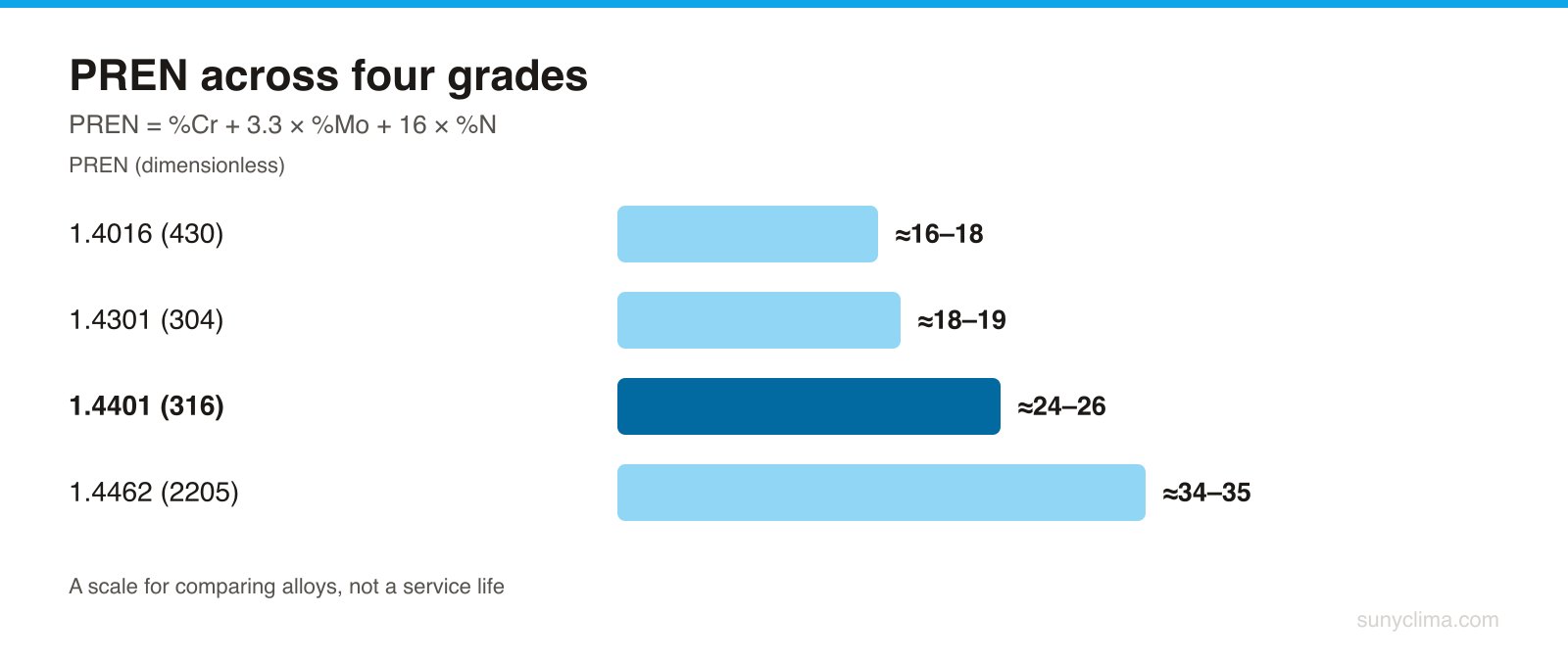
It matters just as much what PREN is not. It is not a service life, and it ignores finish, crevices, temperature and weld quality. PREN compares alloys, not objects.
Surface finishes to EN 10088-2
The surface is a separate specification with its own code: a digit for the rolling route (1 hot, 2 cold rolled) plus a letter for the treatment.
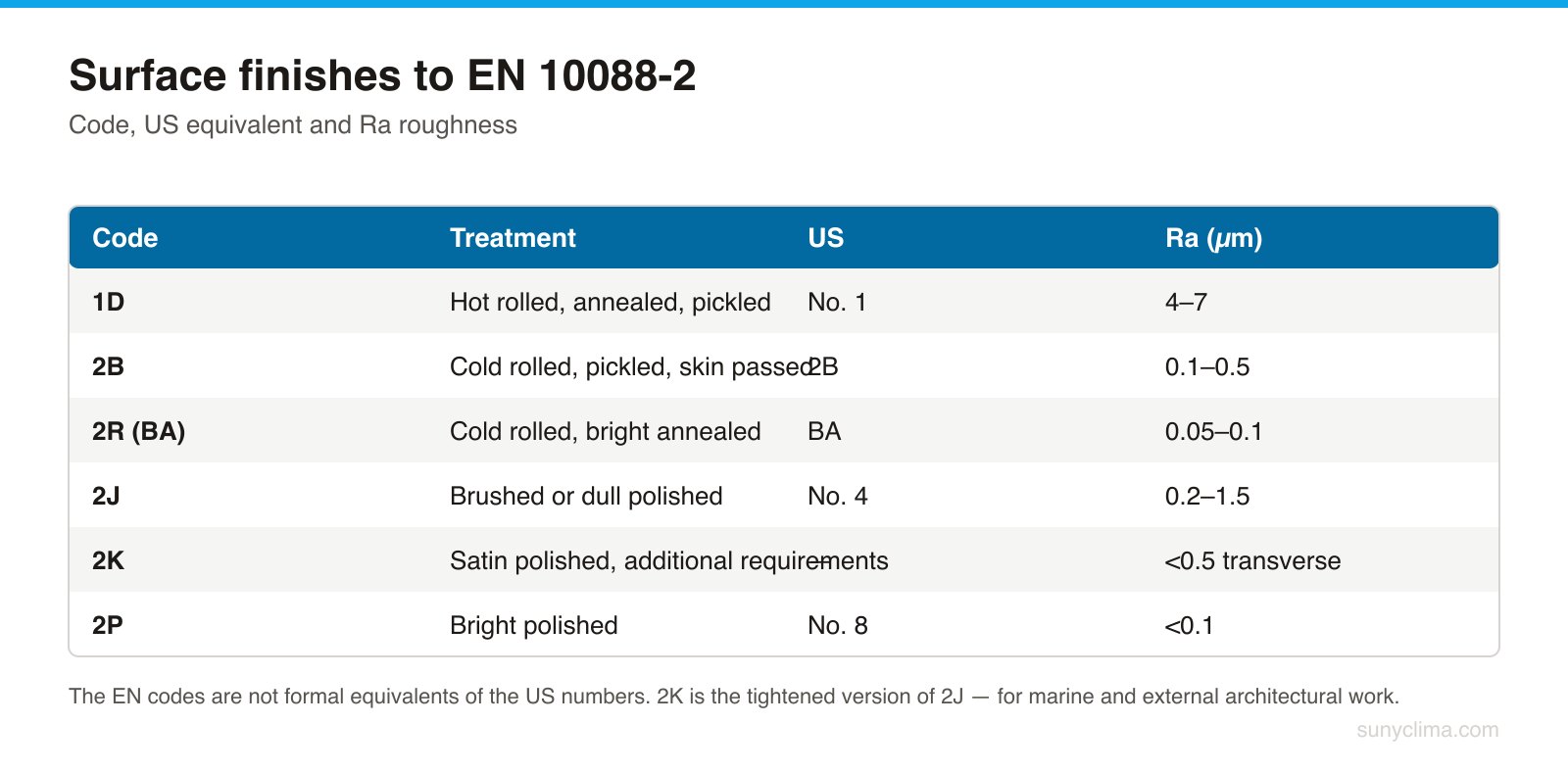
Four of them cover most work. 2B is the standard cold-rolled mill finish — slightly matt, most widely stocked. 2R (BA, bright annealed) is smooth and reflective without being polished. 2J is brushed — the familiar "satin stainless", US No. 4, with a visible grain. 2P is bright polished, US No. 8 mirror. The EN codes are not formal equivalents of the US numbers — the mapping is approximate.
Finish is not only appearance. The rougher the surface, the better it holds salt, dust and moisture, and the easier it is to end up with tea staining — a brownish bloom that is cosmetic but ruins the look. The Australian Stainless Steel Development Association describes it as typical within about 5 km of a surf beach and 1 km of still marine water, and recommends smoother finishes such as 2B and BA over a brushed No. 4; under less favourable conditions — wind, polluted air, a sheltered elevation — staining is seen 20 km inland. The same source treats 316 as the minimum within the five-kilometre band. For marine and external architectural work the standard offers the tighter code 2K: satin polish with an added requirement of transverse roughness below 0.5 µm.
So "brushed" is not a specification: two brushed surfaces made with different abrasives behave differently — ask for the code and, on demanding projects, the Ra value. And grain direction belongs in the order, because two panels with opposing grain look like two materials in raking light.
Forming, cutting, welding
Forming. Austenitic stainless work-hardens: the more you deform it, the harder it gets — higher press loads, more springback, sometimes intermediate annealing. Ferritic 1.4016 bends well but, at 18–20% elongation, is no deep-drawing material.
Cutting. Laser is fast and precise but cuts with heat: fabricator data put the heat-affected zone on a 10 mm 316L sheet at the order of 0.3 to 1 mm. That figure is strongly parameter-dependent and is not standardised — treat it as an order of magnitude, not a guarantee. Waterjet cuts cold — abrasive and water, no HAZ — so it is preferred when the edge stays exposed in an aggressive environment. Shearing and punching suit thin sheet, provided the tooling is sharp; blunt tooling smears the edge.
Welding. TIG and MIG with a matching filler, and back-purge the root with argon so the reverse side does not oxidise. Afterwards the heat tint must come off — by pickling, a stainless brush or electrochemically. Austenitic stainless expands at about 16 × 10⁻⁶ 1/K, and 18 × 10⁻⁶ by 500 °C, so welded assemblies distort more than anyone used to carbon steel expects. The matrix of materials and methods lives in the technical parameters of panel materials.
The golden rule: nothing made of carbon steel
This rule separates a workshop that works stainless from one that tried it once. Tools used on stainless are never used on carbon steel, and vice versa.
- Wire brushes in stainless only — 316L for demanding work — or non-woven abrasive pads.
- Separate discs, files, racks and benches.
- No steel strapping, no storage on rusty trestles.
- Sparks from carbon steel cutting nearby contaminate too — they are hot iron particles that embed in the surface.
What makes it treacherous is the delay: the surface looks clean leaving the workshop, and the rust spots appear after the first rain — on an installed job.
Pickling and passivation are two different things
Pickling is an acid treatment — typically nitric plus hydrofluoric — that removes a thin layer of metal along with scale, oxides, embedded iron and heat tint. It cleans.
Passivation is the follow-up with nitric or citric acid that removes free iron and encourages a uniform passive layer. It restores the protection. The procedures sit in ASTM A380 (cleaning, descaling, pickling and passivation) and ASTM A967 (chemical passivation); in food and pharma work citric acid is displacing nitric.
Order matters: passivation cannot deal with heat tint or scale, so pickle first. And it adds no coating — it clears the way for the metal to make its own.
Maintenance: "stainless" does not mean "no care"
Stainless never needs painting, but it does need washing. The passive layer handles everything, provided salt and dirt do not sit on it.
- Rain is free maintenance. Corrosion appears first under canopies, in door reveals and beneath handles — where rain does not reach but salt does.
- Water and a mild neutral detergent, a rinse, a wipe along the grain.
- Never chlorine-based cleaners or hydrochloric acid. Bleach and tile-grout cleaners are the commonest cause of domestic stainless stains.
- Frequency follows the environment: interiors rarely, urban air periodically, coastal and salted streets far more often.
Where the component is part of a door or a façade, installation and the maintenance that follows belong together — what each covers is set out under services.
Where stainless steel is used
- Food and pharmaceutical production. No coating to flake into the product, a surface that takes aggressive cleaning and heat, and smooth finishes (2B, BA) that hold no residue. Welds are ground flush and passivated so no crevices remain there.
- Marine work and architecture. 316 and duplex offshore; cladding, handrails and roofing that survive decades without repainting.
- Kitchens, appliances and medicine. Sinks and worktops in 304; drums and internal panels often 430, in a controlled environment; martensitic grades for cutting instruments.
- Construction and joinery. Fixings, anchors, flashings and decorative faces, including door inserts and strips.
Common misconceptions
- "Stainless doesn't rust." It does — under chlorides, in crevices, when contaminated with iron. Just not like carbon steel.
- "The dearer grade is always better." 316 in a dry interior buys nothing; 430 at the seaside is a mistake.
- "A scratch ruins stainless." The passive layer rebuilds itself; the problem is cosmetic.
- Mixing grades in one assembly. A 316 face with lower-grade fixings drops the assembly to its weakest element — right in the crevices.
How to read a stainless specification
- Grade by EN number (1.4301, 1.4401, 1.4404…), not just AISI and not just "stainless".
- Carbon level — L or standard grade, if the part is to be welded.
- Thickness and tolerance.
- Surface code to EN 10088-2 (2B, 2R/BA, 2J, 2P) plus grain direction if brushed.
- Protective film — applied or not, how long it stays on, whether it survives sunlight.
- Cutting method and edge finish.
- Post-weld treatment — pickling, passivation or both.
- An EN 10204 3.1 inspection certificate — ask for it explicitly: since the 2014 edition of EN 10088-2 the default document is a 2.2 test report.
In short. Stainless steel is steel with at least 10.5% chromium that builds its own chromium-oxide film 1–3 nanometres thick and repairs it by itself — as long as oxygen is present. Everything else follows: chlorides punch through the film locally, oxygen starvation under deposits and gaskets comes second, carbon steel particles from a shared tool third. The family decides magnetism, formability and price; PREN gives a comparable scale; the EN 10088-2 code describes the surface, which affects both looks and corrosion.
For grade and finish in a decorative panel see bond and stainless panels; for face materials generally, the materials page. Stock models are in the catalogue, and when grade, finish and insert layout have to be non-standard, panels are made to size by a Bulgarian manufacturer — see custom orders or the FAQ.