Mi az az inox: passzív réteg, típusok és felületek
Inox: miért francia eredetű a szó, hogyan működik a passzív réteg, a 304, 316, 430 és a duplex családok, az EN szerinti jelölések, valamint a 2B, BA és No. 4 felületek.
Az inox szó a francia inoxydable-ból ered — a fém pedig épp fordítva váltja be az ígéretét: azonnal oxidálódik, és éppen ezért nem rozsdásodik. Íme a passzív réteg, a családok, a jelölések és a felületek teljes története.
Az „inox” szóval jelöljük a konyhai mosogatót, a terasz korlátját és a bejárati ajtó díszcsíkját is. Valójában ez egy egész acélcsalád, eltérő összetétellel, eltérő árral és nagyon eltérő viselkedéssel, amikor a levegő sós.
Ez a cikk az inoxról mint anyagról szól: mitől lesz rozsdamentes, miért múlik minden egy néhány nanométer vastag rétegen, hogyan kell olvasni a jelölést, és mi történik a fémmel, amikor vágják, hajlítják, hegesztik és tisztítják. Ha a 304-et és a 316-ot mint egy dekorpanel felületét hasonlítja össze, azt itt találja: bond és inox panelek. Itt egy szinttel lejjebb megyünk — a kohászatba.
A szó francia eredetű, és egy ígéret
Az „inox” a francia inoxydable szóból ered — „nem oxidálódó”; a bolgár nyelvbe a kereskedelmen keresztül került be. Az angol stainless szerényebbet ígér: „nem foltosodik”. A francia szó többet ígér, mint amennyit a fém teljesíteni tud.
És itt jön az első paradoxon. Az inox oxidálódik — azonnal, abban a pillanatban, amikor levegővel érintkezik — és éppen ez menti meg. Az ígéret nem az, hogy „nem reagál az oxigénnel”, hanem az, hogy „olyan gyorsan és rendezetten reagál, hogy önmagát lezárja”. Nyelvileg az „inox” pontatlan szó; mechanikailag pontosan a helyes dolgot írja le, fordított előjellel.
A történet rövid: Pierre Berthier 1821-ben figyelt fel a vas-króm ötvözetek savállóságára, majd 1913-ban a brit Harry Brearley fedezte fel, hogy a magas krómtartalmú mintadarabja egyszerűen nem rozsdásodik.
A meghatározás egy szám: 10,5% króm
A „rozsdamentes” nem leíró fogalom, hanem egy értékkel meghatározott definíció. Az EN 10088-1 szerint egy acél akkor rozsdamentes, ha tömegre nézve legalább 10,5% krómot és legfeljebb 1,2% szenet tartalmaz. E küszöb alatt a felület oxidfilmje szakadozott és porózus — helyenként megvan, máshol hiányzik, és a korrózió a réseken keresztül halad. A küszöb felett a film folytonossá válik.
Ezért a 10,5% nem egy kerek szám valamelyik katalógusból, hanem egy viselkedési határérték. A gyakorlatban a legelterjedtebb minőségek jóval e minimum fölött kezdődnek — 16–18% krómnál.
A passzív réteg: néhány nanométer, amely mindent eldönt
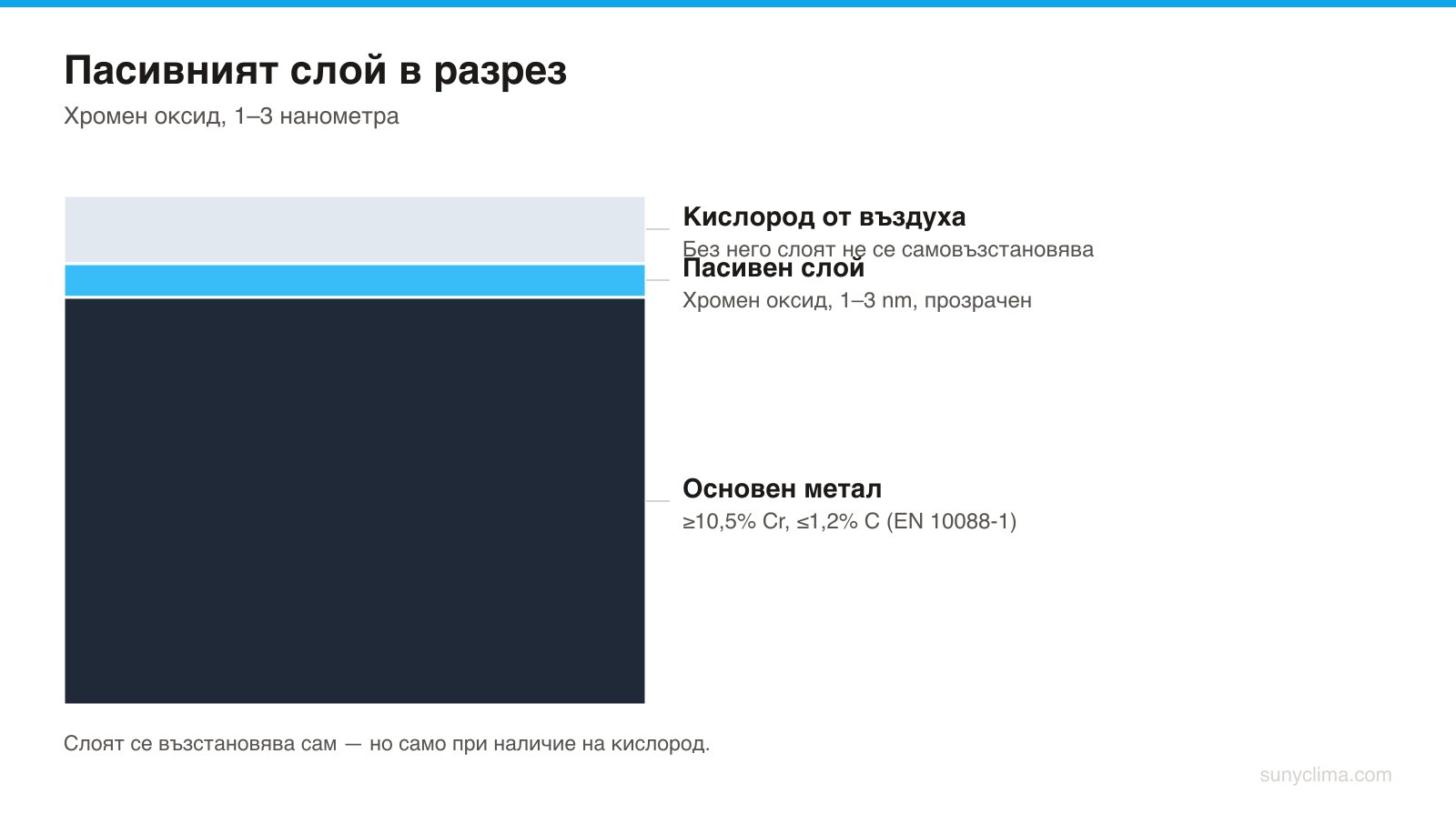
Amikor az acélban lévő króm oxigénnel találkozik, krómoxidot képez — egy tömör, szorosan tapadó és kémiailag stabil filmet, amelynek vastagsága 1–3 nanométer (az Outokumpu 1–3 nm-t, az ISSF 2–3 nm-t ad meg). Összehasonlításképpen: egy 0,1 mm vastag papírlap körülbelül 40 000-szer vastagabb ennél. A film átlátszó, nem látható és nem tapintható — a fényesség, amit „inox”-ként ismerünk, az alatta lévő fémé. A mechanizmust részletesen leírja a Brit Rozsdamentes Acél Szövetség.
A festékkel való különbség alapvető. A festék egy rárakott réteg: ha megkarcolják, a karcolás karcolás marad, és onnantól kezdve elindul a rozsdásodás. A passzív réteget az anyag maga termeli — ha megkarcolják, a frissen feltárt felületen lévő króm reagál a környező oxigénnel, és a film újra bezáródik. Ez az egyetlen „bevonat”, amely önmagát javítja.
A feltétel azonban egy, és lényeges: oxigénnek jelen kell lennie. Az öngyógyulás kémiai reakció, és reagensre van szüksége. Az az inox, amely lerakódás alatt, tömítés alatt vagy pangó vízben, levegő hozzáférése nélkül van, éppen ott veszíti el öngyógyító képességét, ahol a legnagyobb szükség lenne rá.
Mi rombolja le a passzívréteget
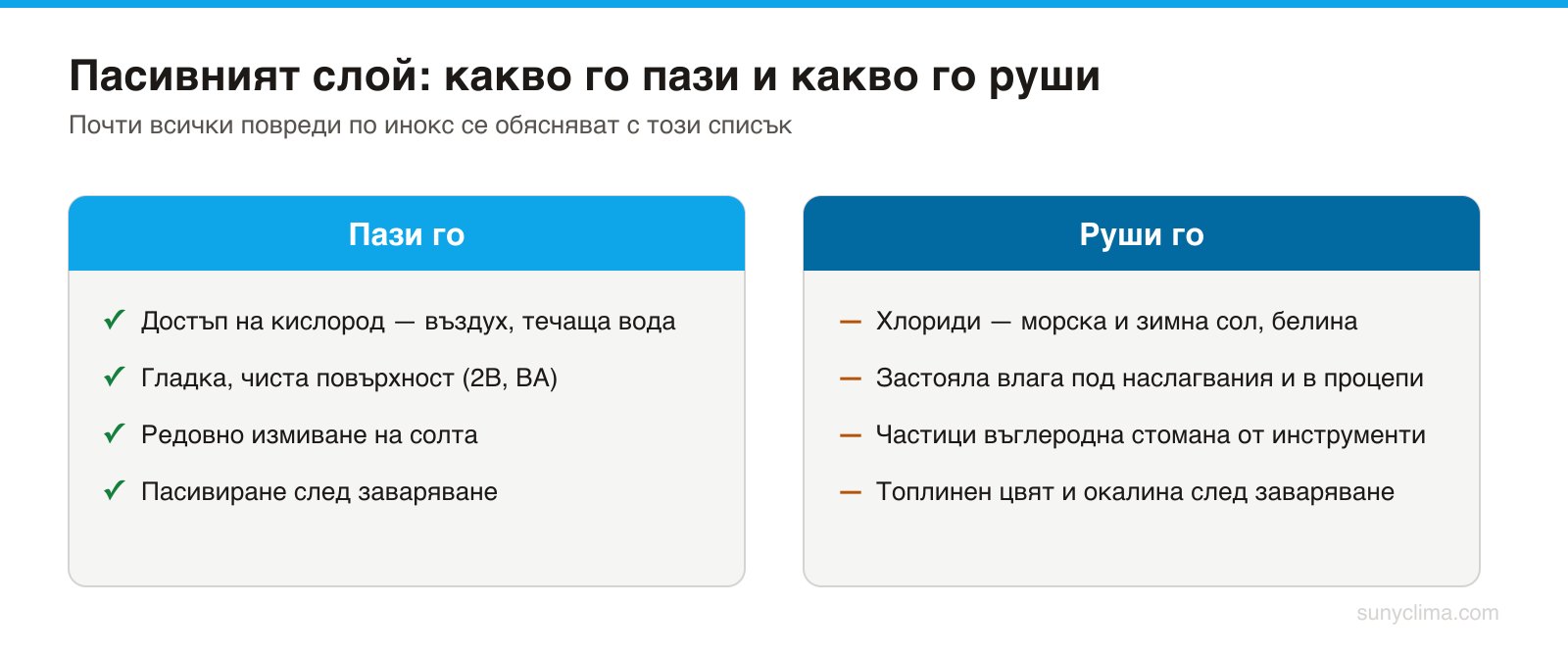
Gyakorlatilag minden inox-probléma ennek a rétegnek a problémája. Négy mechanizmus szinte mindent megmagyaráz, ami elromolhat:
- Kloridok. A klorid-ion kicsi és agresszív, és pontszerűen, nem egyenletesen töri át a réteget. Az eredmény lyukkorrózió — egy sötét mélyedés, amely befelé terjed, miközben a körülötte lévő felület rendben lévőnek tűnik. A források ismerősek: tengeri só a levegőben, téli útsó, klóros medencevíz, klórtartalmú fürdőszobai tisztítószerek.
- Oxigénhiány. Lerakódás alatt, alátét alatt, tömítés mögött a nedvesség megreked, kevés az oxigén, és a réteg nem tud regenerálódni. Ez a réskorrózió — ezért enged gyakran az inox pontosan ott, ahol a legvédettebbnek tűnik.
- Szénacél-szennyeződés. A drótkefétől, csiszolókorongtól vagy egy hétköznapi munkafelülettől származó mikroszkopikus, közönséges vasrészecskék önmagukban berozsdásodnak, és helyi támadást indítanak el. A folt napokkal később jelenik meg, és a hibát rendszerint a „rossz inoxra” fogják.
- Hegesztés utáni hőelszíneződés. A varrat körüli kékes-barnás elszíneződés egy oxidhártya, amely alatt az acél krómban elszegényedett — ha nem távolítják el, ez lesz a termék gyenge pontja.
A négy család és miért különböznek egymástól
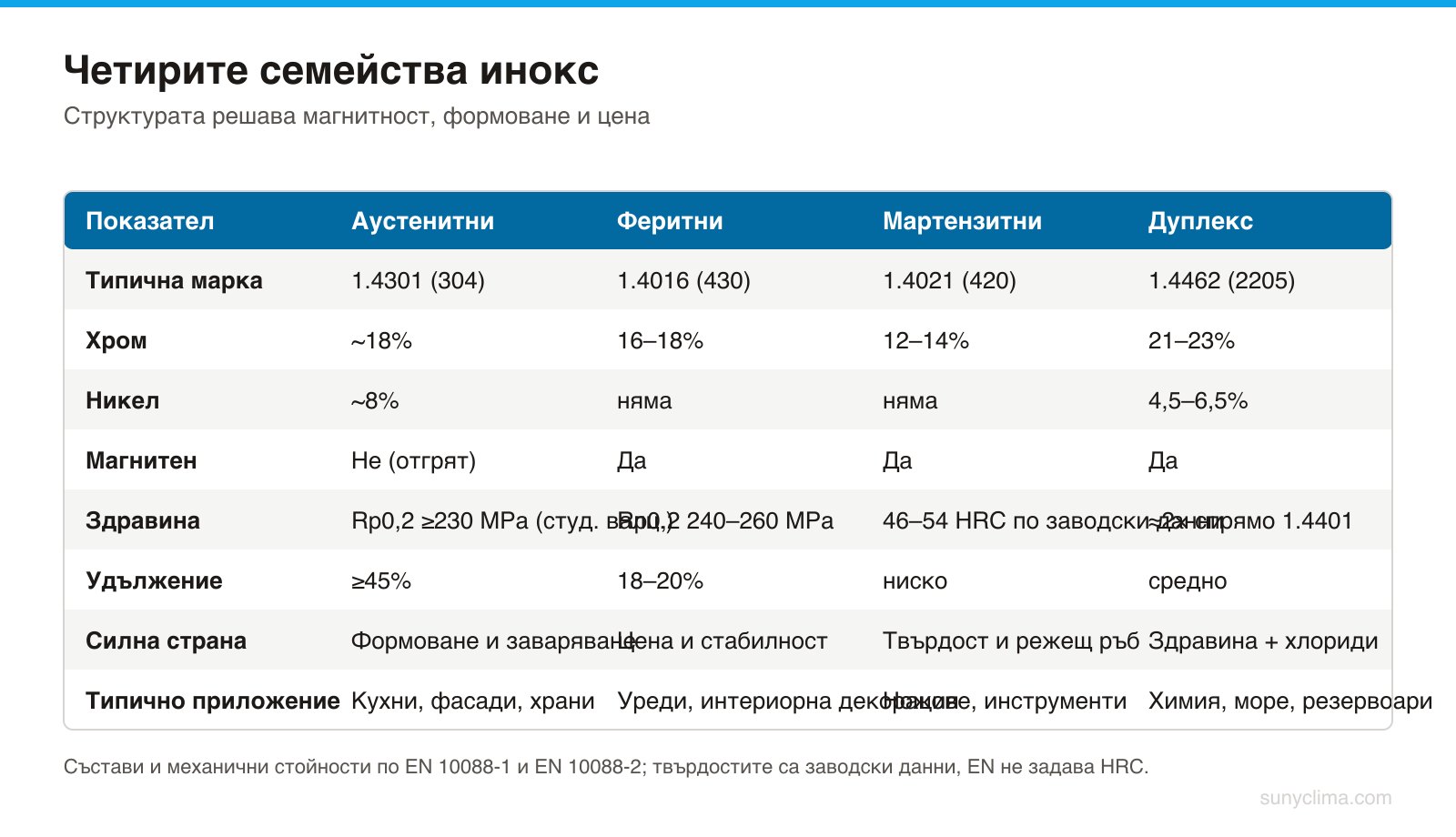
Az inoxot kristályszerkezete alapján családokba sorolják, ezt a szerkezetet pedig az összetétel határozza meg. A család dönti el a mágnesezhetőséget, a hajlíthatóságot, a hegeszthetőséget és az árat.
Ausztenites acélok (300-as sorozat)
A legelterjedtebb család — ide tartozik az 1.4301 (304) és az 1.4401 (316). Krómot és nikkelt is tartalmaznak; a nikkel stabilizálja az ausztenites szerkezetet, és ez adja a jellegzetes tulajdonságokat: kiváló alakíthatóság, kiváló hegeszthetőség, és lágyított állapotban gyakorlatilag mágnesezhetetlen. Az EN 10088-2 szerint az 1.4301 hidegen hengerelt szalag esetében Rp0,2 ≥ 230 MPa és Rm 540–750 MPa az előírt érték (a melegen hengerelt lemeznél 210, illetve 520–720 MPa), ≥ 45% nyúlás mellett. Az EN 10088-1 szerint a hővezető képesség 20 °C-on 15 W/(m·K), a hőtágulási együttható átlagos értéke pedig 16 × 10⁻⁶ 1/K 20–100 °C között, és 18 × 10⁻⁶ 500 °C-nál. (Az amerikai 304-es lemezek adatlapjain jellemzően 16 és 17,3 szerepel — innen ered a specifikációk körüli zavar fele.)
A visszája: hidegalakításnál erősen keményedik, a nikkel pedig tőzsdei árucikk — ezért a 304-es lemez ára a projekttől függetlenül is emelkedhet vagy csökkenhet.
Ferrites (400-as sorozat)
A klasszikus képviselő az 1.4016 (430): 16–18% króm, maximum 0,08% szén és nikkelmentes összetétel. A nikkel hiánya olcsóbbá teszi az ötvözetet, és jóval stabilabb árat biztosít. A ferrites inox mágnesezhető, jobban vezeti a hőt (≈25 W/(m·K)) és kevésbé tágul (10,0–11,0 × 10⁻⁶ 1/K) — ez előny hegesztésnél, mert kisebb a deformáció. Mechanikai jellemzők: Rp0,2 240–260 MPa, Rm 430–600 MPa (vastag lemeznél 430–630), de a nyúlás csak 18–20%.
Az alacsony nyúlás korlátozó tényező: a 430 jól hajlítható, de mélyhúzásra nem alkalmas. Fontosabb a korrózióállóság — az 1.4016 beltéri és enyhén agresszív környezetbe való: háztartási gépek, konyhai készülékek, dekorációs elemek, füstelvezetők. A tenger közelében a különbség már az első évben látszik.
Martenzites
Ide tartozik az 1.4021 (X20Cr13, AISI 420) 12–14% króm és 0,16–0,25% szén tartalommal, valamint a magasabb széntartalmú 1.4028 (X30Cr13, 0,26–0,35% C). A magas széntartalom lehetővé teszi az edzést. Az EN 10088 nem ír elő keménységet, csak állapotokat (+QT) MPa-ban; a gyártói adatok szerint az 1.4021 kb. 46–50 HRC-t, az 1.4028 pedig 50–54 HRC-t ér el. Innen erednek a felhasználási területek: kések, sebészeti eszközök, tengelyek, szivattyú- és szelepalkatrészek.
A keménység ára a korrózióállóság: kevesebb króm és több szén gyengébb passzív réteget jelent — ezért rozsdásodik meg a konyhakés, ha nedvesen marad a mosogatóban, míg a körülötte lévő mosogató nem.
Duplex
A duplex ausztenit és ferrit közel egyenlő arányú keveréke. Az EN 10088 szerint az 1.4462 jelű ötvözet 21–23% krómot, 4,5–6,5% nikkelt, 2,5–3,5% molibdént és 0,10–0,22% nitrogént tartalmaz. Itt van egy buktató, ami pénzbe kerülhet: az amerikai UNS S32205 szűkebb határok közé szorítja ugyanezt: 22–23% Cr, 3,0–3,5% Mo és 0,14–0,20% N, így az 1.4462 szerint tanúsított lemez nem fedi le automatikusan az S32205-öt. Az eredmény a 316-oshoz képest kb. kétszer nagyobb folyáshatár, kevesebb nikkellel és nagyon magas klorid-ellenállással — vegyipar, tengeri szerkezetek, tartályok, hidak. Nem „jobb inox” minden célra: nehezebben alakítható, és szigorúbb hegesztési kontrollt igényel.
A mágnes nem márkateszt
A leggyakoribb műhelyi tévhit: „ha vonzza a mágnes, akkor nem valódi inox”. A lágyított ausztenites inox valóban gyakorlatilag nem mágneses, de hidegalakítás után az ausztenit egy része martenzitté alakul, és az anyag enyhén mágnesessé válik — a vágott éleken, a mélyhúzott sarkokban, a stancolt furatok körül. A ferrites és martenzites minőségek pedig definíció szerint mágnesesek, mégis teljesen jogos inox anyagok. És ami a legfontosabb: a mágnes nem tesz különbséget 304 és 316 között, mert a különbség a molibdén.
Hogyan olvassuk a jelölést
Egy specifikációban két rendszerrel is találkozhatunk, és érdemes fejben átfordítani őket:
| EN szám | EN név | AISI | Mit jelent |
|---|---|---|---|
| 1.4301 | X5CrNi18-10 | 304 | Az alap ausztenites: ~18% Cr, ~8% Ni |
| 1.4307 | X2CrNi18-9 | 304L | Ugyanaz, alacsony szén-tartalommal |
| 1.4401 | X5CrNiMo17-12-2 | 316 | Molibdénnel a kloridokkal szembeni ellenállásért |
| 1.4404 | X2CrNiMo17-12-2 | 316L | 316, alacsony szén-tartalommal |
| 1.4016 | X6Cr17 | 430 | Ferrites, csak króm, nikkel nélkül |
| 1.4462 | X2CrNiMoN22-5-3 | 2205 | Duplex |
Az európai szám (1.43xx, 1.44xx) az, ami a bizonylatba és a számlába kerül; az amerikai jelölés (304, 316, 430) az, amit a műhelyben mondanak. Ha a dokumentumban 1.4301 szerepel, akkor 304-et vásárolt — függetlenül attól, mit mondtak szóban.
Az EN szerinti nevet szó szerint kell olvasni: az X magasan ötvözött acélt jelent, az utána következő szám a szén-tartalom 100-szorosa, ezt követik az ötvözőelemek és azok százalékos aránya. X5CrNi18-10 = 0,05% szén, 18% króm, 10% nikkel.
Mit jelent az „L”
Az L a low carbon rövidítése, és nem kozmetikai kiegészítés. A standard minőségek körülbelül 0,07–0,08% szenet engednek meg; az L-minőségek ezt legfeljebb 0,030%-ra korlátozzák. Az ok a hegesztés: nagyjából a 425–850 °C tartományban való tartózkodás során — egységes határérték nincs, a BSSA 370–815 °C-ot, az Outokumpu 550–850 °C-ot ad meg — a szén a szemcsehatárokhoz vándorol, és krómkarbidok formájában kötődik meg a krómmal. Ez a króm ezután már nem vesz részt a passzív réteg kialakításában, és a szemcsehatárok mentén krómban elszegényedett zóna marad. A jelenséget szenzitizációnak nevezik, a következménye pedig szemcsehatár menti korrózió — a „varrat korróziója”.
A 316L a probléma gyökerét oldja meg: 0,030% szén alatt nincs elég anyag karbidok képződéséhez, így a varrat további hőkezelés nélkül is korrózióálló marad. Éppen ezért minden hegesztett szerkezetnél — tartályok, korlátok, csővezetékek, keretek — az L-minőség az ésszerű választás, nem pedig egy drágább szeszély.
PREN: egy szám, amit össze lehet hasonlítani
A PREN (Pitting Resistance Equivalent Number) egy skálára helyezi a két minőséget:
PREN = %Cr + 3,3 × %Mo + 16 × %N
A képlet azt a három tényezőt súlyozza, amely ténylegesen a lyukkorrózió ellen dolgozik: a króm 1-es együtthatóval szerepel, a molibdén 3,3-mal, a nitrogén 16-tal. Ha behelyettesítjük az egyes minőségek összetételét, azonnal látszik, miért van a duplex egy egészen más kategóriában, és miért nem jöhet szóba a 430-as minőség tengerparti környezetben. Egy tengerparttól fél kilométerre lévő ház tulajdonosa számára ez a matematika egyetlen mondatra egyszerűsödik: 316-os minőséget kérjen, ne csak „rozsdamentes acélt”.
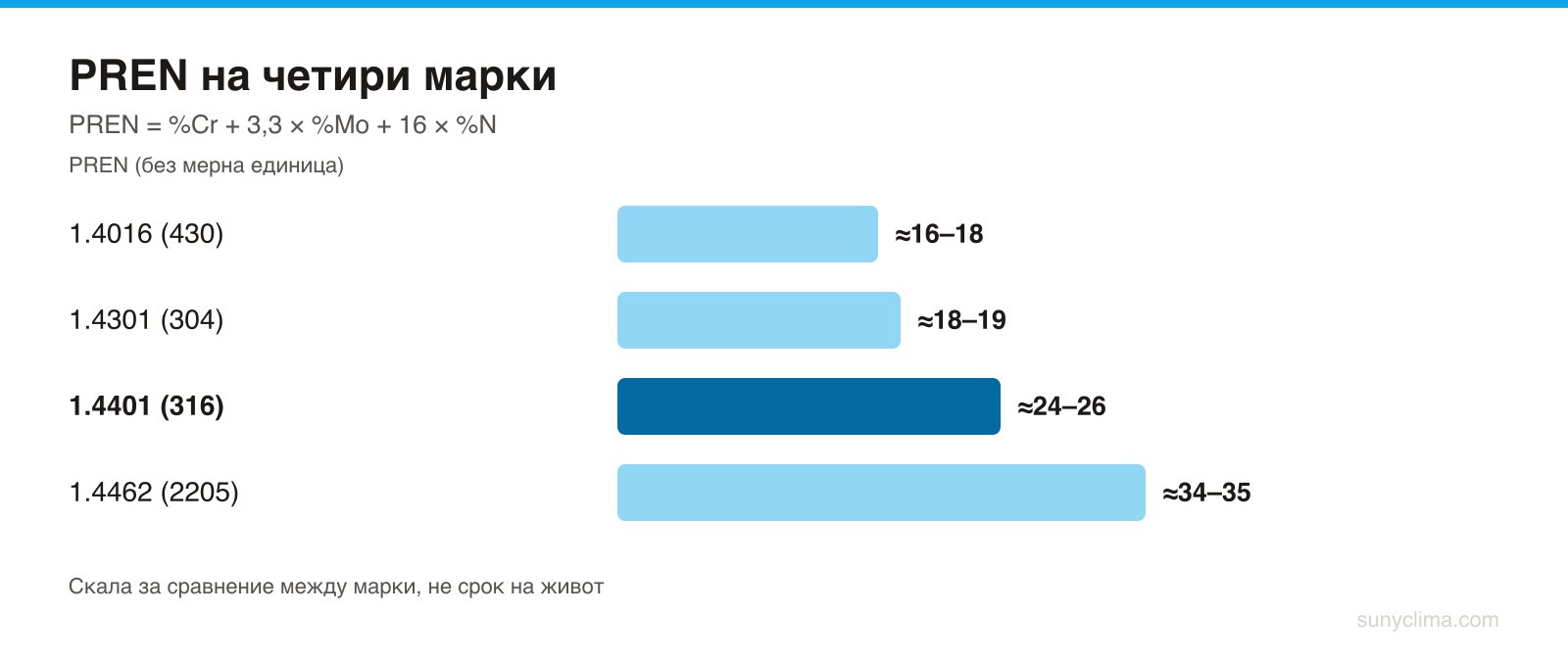
Az is fontos, hogy mi nem a PREN. Nem élettartamot jelent, és nem veszi figyelembe sem a felületet, sem a réseket, sem a hőmérsékletet, sem a hegesztést. A PREN minőségeket hasonlít össze, nem kész termékeket.
Felületek az EN 10088-2 szerint
A felület önálló, kóddal jelölt specifikáció: egy szám a hengerlésre (1 — melegen hengerelt, 2 — hidegen hengerelt) plusz egy betű a megmunkálásra.
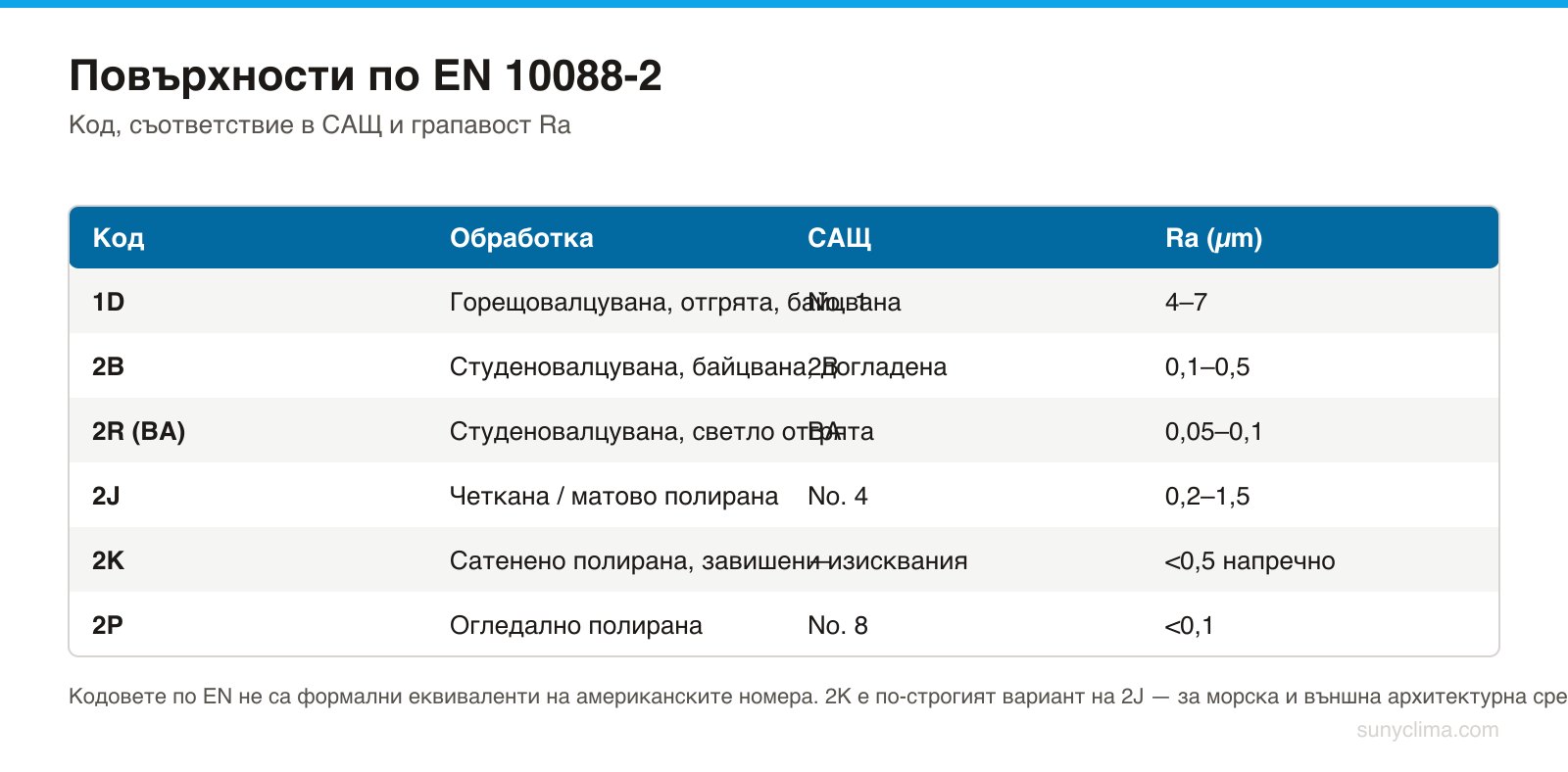
Négy típus szinte mindent lefed. A 2B a standard hidegen hengerelt felület — enyhén matt és a legszélesebb körben elérhető. A 2R (BA, bright annealed) fényesen izzított: nagyon sima és fényvisszaverő, anélkül hogy polírozott lenne. A 2J a szálcsiszolt felület — a jól ismert „csiszolt inox”, US No. 4, jól látható csiszolási iránnyal. A 2P a tükörfényes polírozás, US No. 8. Az EN-kódok nem formálisan egyenértékűek az amerikai jelölésekkel — az összevetés csak közelítő.
A felület nem csupán megjelenés kérdése. Minél durvább, annál jobban megköti a sót, a port és a nedvességet, és annál könnyebben alakul ki az úgynevezett tea staining (teabarna elszíneződés) — egy barnás lepedék, amely kozmetikai jellegű, de tönkreteszi az összképet. Az Ausztrál Rozsdamentesacél-szövetség ezt tipikus problémaként írja le hullámzó tengerparttól számított kb. 5 km-es, illetve nyugodt tengervíztől 1 km-es távolságon belül, és a szálcsiszolt No. 4 helyett a simább felületeket, például a 2B-t és a BA-t ajánlja; kedvezőtlenebb körülmények — szél, szennyezett levegő, védett fekvés — esetén az elszíneződés akár a parttól 20 km-re is megfigyelhető. Ugyanez a forrás az öt kilométeres sávban a 316-os minőséget tekinti minimumnak. Tengeri és kültéri építészeti alkalmazásokhoz a szabvány egy még szigorúbb kódot is kínál, a 2K-t — ez szatinpolírozott felület, amelynél a keresztirányú érdesség 0,5 µm alatt kell maradjon.
Ebből két következmény adódik. A „csiszolt inox” önmagában nem specifikáció — két csiszolt felület eltérő szemcseméretű csiszolóanyaggal teljesen másképp viselkedik, ezért mindig kérje a kódot, igényesebb projekteknél pedig az Ra-értéket is. És a csiszolás iránya szintén a megrendelés része: két panel, amelynek szálcsiszolása eltérő irányú, oldalfényben egészen más anyagnak tűnik.
Alakítás, vágás, hegesztés
Alakítás. Az ausztenites inox erősen munkakeményedik: minél jobban deformálja, annál keményebbé válik — nagyobb sajtolóerő, erősebb rugalmas visszapattanás, néha közbenső izzítás szükséges. A ferrites 1.4016 jól hajlítható, de 18–20%-os nyúlásával nem alkalmas mélyhúzásra.
Vágás. A lézer gyors és pontos, de hővel vág: feldolgozók adatai szerint 10 mm vastag 316L lemeznél a vágás körül körülbelül 0,3–1 mm nagyságrendű hőhatásövezet marad. Ez az érték erősen függ a beállításoktól, nincs szabványosítva — inkább nagyságrendként, mintsem garantált értékként kezelje. A vízsugaras vágás hidegen vág — csiszolóanyag és víz, hőhatásövezet nélkül —, ezért ott részesítik előnyben, ahol az él agresszív környezetben marad látható. A lyukasztás és a nyírás kiváló eredményt ad vékony lemezeknél, feltéve, hogy a szerszám éles: a tompa szerszám „elkeni” az élt, és mikrorepedéseket hagy hátra.
Hegesztés. TIG és MIG megfelelő hozaganyaggal, argonos gyökvédelemmel, hogy a varrat hátoldala ne oxidálódjon. Hegesztés után a hőszínt mindenképpen el kell távolítani — pácolással, rozsdamentes drótkefével vagy elektrokémiai úton. Az ausztenites inox hőtágulási együtthatója körülbelül 16 × 10⁻⁶ 1/K, 500 °C-on pedig már 18 × 10⁻⁶, ezért a hegesztett szerkezetek jobban összehúzódnak és deformálódnak, mint azt egy szénacélhoz szokott szakember várná. Az anyagok és eljárások összefoglaló táblázata a anyagok műszaki paraméterei oldalon található.
Az aranyszabály: semmi szénacél
Ez az a szabály, amely megkülönbözteti az inoxszal ténylegesen dolgozó üzemet attól, amelyik csak egyszer próbálta ki. Az inoxhoz használt szerszámokat sosem szabad szénacélhoz használni, és fordítva.
- Drótkefék — kizárólag rozsdamentes acélból (igényesebb feladatoknál 316L minőségből), vagy nem szőtt anyagú csiszolókorongok.
- Külön tárcsák, reszelők, állványok és munkaasztalok.
- Nincs acél kötözőszalag a csomagoláshoz, és nincs tárolás rozsdás rácsokon.
- A közelben végzett szénacél-vágás szikrái szintén szennyeznek: forró vasrészecskék, amelyek beleégnek a felületbe.
A veszélye éppen a késleltetettségben rejlik: a felület az üzemben még tisztának tűnik, a rozsdafoltok csak az első eső után jelennek meg — már a beépített terméken.
Pácolás és passziválás: két különböző folyamat
A pácolás (pickling) savas kezelés — általában salétromsav és fluorhidrogénsav segítségével —, amely a fém vékony rétegével együtt eltávolítja a reveréteget, az oxidokat, a beágyazódott vasrészecskéket és a hegesztési hőszínt. Ez megtisztítja a felületet.
A passziválás egy utólagos kezelés salétromsavval vagy citromsavval, amely eltávolítja a szabad vasat, és elősegíti az egyenletes passzív réteg kialakulását. Ez helyreállítja a védelmet. Az eljárásokat az ASTM A380 (tisztítás, oxidmentesítés, pácolás és passziválás) és az ASTM A967 (kémiai passziválás) szabvány írja le; az élelmiszer- és gyógyszeriparban a citromsav egyre inkább kiszorítja a salétromsavat.
A sorrend fontos: a passziválás nem old meg hőszínt vagy reveréteget — előbb pácolni kell. És nem „hozzáad” egy bevonatot, hanem megnyitja az utat, hogy az anyag elvégezhesse a saját feladatát.
Karbantartás: a „rozsdamentes” nem jelenti azt, hogy „gondozásmentes”
A rozsdamentes acélnak nincs szüksége festésre, de tisztításra igen. A passzív réteg mindennel megbirkózik, amíg a só és a szennyeződés nem marad rajta huzamosabb ideig.
- Az eső ingyenes karbantartás. A korrózió elsőként az eresz alatt, az ajtó beugróiban, a kilincsek és profilok alsó részén jelenik meg — ott, ahová az eső nem ér el, de a só igen.
- Víz és enyhe, semleges tisztítószer, öblítés, majd szálirányban történő áttörlés.
- Soha ne használjunk klórtartalmú szereket és sósavat. A fehérítő és a fugatisztítók a leggyakoribb okai a rozsdamentes acélon háztartási körülmények között megjelenő foltoknak.
- A gyakoriság a környezettől függ: beltérben — ritkán; városi környezetben — időszakosan; tengerparton és télen sózott utcákon — jelentősen gyakrabban.
Amikor az elem egy ajtó vagy homlokzat része, a beépítés és a karbantartás kéz a kézben jár — hogy mi tartozik az egyikhez, és mi marad a tulajdonosra, azt a szolgáltatások oldal írja le.
Hol használják a rozsdamentes acélt
- Élelmiszer- és gyógyszeripar. Nincs olyan bevonat, amely lepattanhatna a termékbe, a felületet agresszív tisztítószerekkel és magas hőmérsékleten mossák, a sima felületek (2B, BA) pedig nem tartanak vissza szennyeződést. A varratokat éppen ezért csiszolják és passziválják, hogy ne maradjanak rések.
- Tengeri környezet és építészet. 316-os és duplex minőség tengeri (offshore) szerkezetekhez; homlokzatburkolatok, korlátok és tetőfedések, amelyek évtizedekig kibírják újrafestés nélkül.
- Konyhák, háztartási gépek és orvostechnika. Mosogatók és munkalapok 304-es minőségből; dobok és belső panelek gyakran 430-asból, mivel a környezet szabályozott; martenzites minőségek vágóeszközökhöz.
- Építőipar és nyílászárók. Rögzítőelemek, dűbelek, burkolatok és dekorpanelek — beleértve a bejárati ajtókra kerülő betéteket és csíkokat is.
Gyakori tévhitek
- „A rozsdamentes acél nem rozsdásodik.“ Rozsdásodik — kloridok hatására, résekben és vasszennyeződés esetén. Csak nem ugyanúgy, mint a szénacél.
- „A drágább minőség mindig jobb.“ A 316-os száraz beltérben elpazarolt erőforrás, hatás nélkül; a 430-as pedig tengerparton hiba.
- „A karcolás tönkreteszi a rozsdamentes acélt.“ A passzív réteg helyreáll; a probléma esztétikai jellegű, különösen a szálirányra merőlegesen szembetűnő.
- Vegyes minőségek egy csomóponton belül. A 316-os felület alacsonyabb minőségű rögzítőelemekkel a teljes terméket a gyengébb elem szintjére húzza le — pontosan a réseknél.
Hogyan olvassunk egy inox anyagminőségi specifikációt
- Minőségjelölés EN szám szerint (1.4301, 1.4401, 1.4404…), ne csak AISI és ne csak „inox”.
- Széntartalom szintje — L jelölésű vagy standard minőség, ha a terméket hegesztik.
- Vastagság és tűrés.
- Felületi kód az EN 10088-2 szerint (2B, 2R/BA, 2J, 2P) és a csiszolási irány szálcsiszolt kivitelnél.
- Védőfólia — van-e, meddig marad rajta, bírja-e a napfényt.
- Vágási módszer és élmegmunkálás.
- Hegesztés utáni kezelés — pácolás és/vagy passziválás.
- 3.1-es vizsgálati bizonyítvány az EN 10204 szerint — kifejezetten kérje: az EN 10088-2 2014-es kiadása óta az alapértelmezett dokumentum a 2.2-es jegyzőkönyv.
Röviden. Az inox olyan acél, amely legalább 10,5% krómot tartalmaz, és amely saját maga hoz létre egy 1–3 nanométer vastagságú króm-oxid réteget, majd ezt saját maga is javítja — amíg van jelen oxigén. A többi ennek a következménye: a kloridok pontszerűen áttörik a védőréteget, az oxigénhiány a lerakódások és tömítések alatt a korrózió második oka, a szénacél-részecskék pedig a harmadik. A minőségi család határozza meg a mágnesességet, a formázhatóságot és az árat; a PREN összehasonlítható skálát ad; az EN 10088-2 szerinti kód pedig azt a felületet írja le, amely mind a megjelenést, mind a korrózióállóságot befolyásolja.
A dekorpanelekhez választható minőség és felület kapcsán olvassa el a bond és inox panelekről szóló cikkünket, a felületi anyagokról pedig itt talál bővebb információt: anyagok. A kész modellek a katalógusban érhetők el; amikor a minőség, a felület és a betétek kombinációja egyedi kivitelt igényel, a paneleket egy bolgár gyártó méretre készíti — nézze meg az egyedi megrendelés lehetőséget, vagy tekintse át a gyakran ismételt kérdéseket.