Sunyclima
Bugarski proizvođač dekorativnih panela za ulazna vrata i stolariju
A reference sheet in tables: λ for XPS, wood, PVC, HPL, glass and aluminium, U-values under EN 14351-1, temperature limits, UV and moisture behaviour, and the rarely published material-by-process matrix — CNC, thermoforming, laser, waterjet and toughening.
This article is built to be bookmarked. If you fit doors for a living, these are the tables you can open in front of a customer or an architect without hunting through datasheets. If you are the customer, every table has a short paragraph above it that translates the numbers into plain language — because “λ 0.033” means nothing until someone says what it does to your door in January.
All values below are typical figures declared under European standards, and where sources disagree we publish the range and say so. For the wider picture on panel types, start with the guide to decorative door panels; here we deal only with physics and machining.
How to read these numbers: λ, R and U
The three quantities describe different things, which is exactly why they cannot be compared with each other.
- λ (lambda), W/(m·K) — the thermal conductivity of the material itself, regardless of thickness. Lower is better. It is a property of the substance, not of the product.
- R, m²·K/W — the thermal resistance of a specific layer: thickness divided by λ. Here thickness finally matters.
- U, W/(m²·K) — heat transfer through the finished product, including every layer, frame and bridge. Lower is better. This is the number that gets declared and that goes into the specification.
The practical consequence: a material with an excellent λ can sit inside a door with a mediocre U if the frame, the edge or the fixing creates a thermal bridge. The reverse is also true — a well-engineered profile rescues an average core. So the λ table below is for choosing a material, and the U table is for judging a finished door.
Declared design values are derived under EN 12664 — heat flow meter measurement. That is why one material appears with slightly different λ figures on different datasheets: what matters is the temperature and moisture content at which it was measured.
Table 1: thermal conductivity λ by material
Read the table like this: aluminium passes heat roughly 5,000 times more readily than XPS. An aluminium panel with no insulating core is effectively a radiator facing outwards; the same panel with an XPS core behaves like part of the wall. Softwood is about four times more conductive than XPS, but far better than glass and in a completely different universe from metal.
| Material | λ, W/(m·K) | Standard / note | What it means for the door |
|---|---|---|---|
| XPS (extruded polystyrene) | 0.033–0.035 | at 10 °C, EN 13164 | The best insulator on the list; the typical panel core |
| Softwood | ≈0.12–0.13 | HFM measurement | Decent insulation, but sensitive to moisture |
| uPVC | ≈0.17 | rigid PVC profile | The profile material insulates on its own |
| HPL (compact laminate) | 0.3 | EN 12664; fire-rated CGF — 0.5 | A facing, not insulation; it works as a face, not a core |
| PA66 GF polyamide strip | ≈0.30 | thermal break in aluminium profiles | Breaks the bridge in aluminium — which takes Uf from above 6.0 to below 2.0 |
| Float glass | ≈0.9–1.0 | single pane, the material itself | A sealed unit insulates through gas and coatings, not glass |
| Aluminium | ≈170–200 | structural alloys | An excellent conductor — always needs a thermal break |
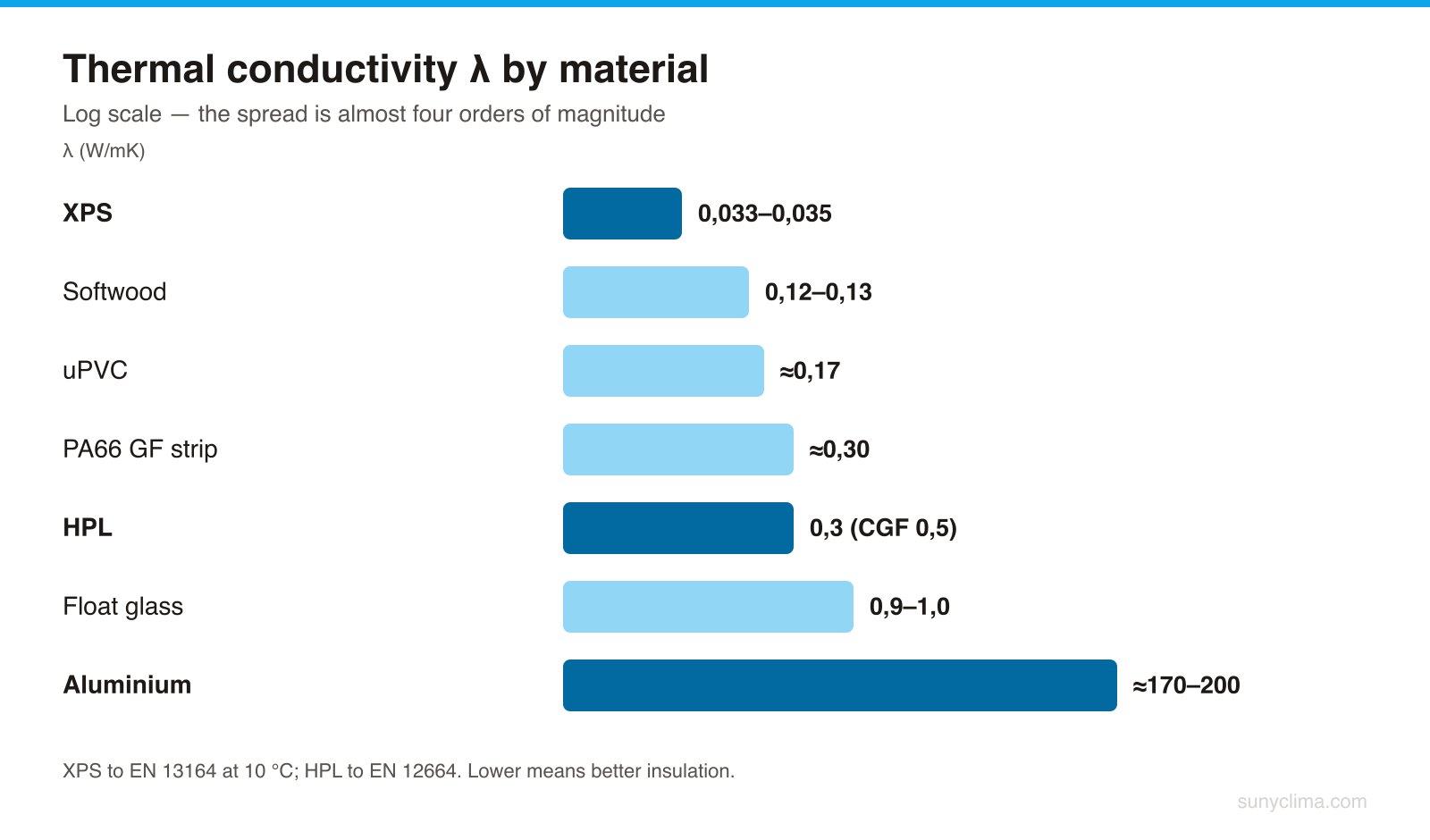
Note HPL: λ 0.3 looks modest next to XPS, but HPL is not an insulation material and is never chosen for that. It is a wear-resistant face a few millimetres thick — its job is mechanical and climatic, while the insulation comes from the core behind it. The material is covered in the HPL article, and XPS versus a timber core is discussed here.
Table 2: profile U-values and what EN 14351-1 requires
A U-value tells you how many watts escape through a square metre for each degree of difference. The number is meaningless without context, so here is the context: an aluminium profile with no thermal break is above 6.0 W/(m²·K), while the same profile with a polyamide strip inside drops below 2.0. That is not a marketing difference — it is the difference between a frame that runs with condensation in winter and a frame that stays dry.
| Element | Typical value | Comment |
|---|---|---|
| Uf — aluminium profile, no thermal break | above 6.0 W/(m²·K) | The whole profile is one thermal bridge |
| Uf — aluminium with thermal break | below 2.0 W/(m²·K) | PA66 GF polyamide strip, λ ≈0.30 |
| Uf — good aluminium systems | 1.2–1.8 W/(m²·K) | Today’s level for a quality entrance door |
| U_D — the complete door | declaration mandatory | EN 14351-1:2006+A2:2016 for external doors |
EN 14351-1 is the harmonised standard for windows and external pedestrian doorsets. It requires the manufacturer to declare U_D for the product — not the profile, not the panel, but the whole door as an assembly. So a quoted λ for the core is half the information; the full information is the U_D figure in the declaration of performance.
Rule of thumb for a sales conversation: λ describes the material, U describes the door. If a seller blurs the two, ask for the declared U_D — it is the only number that is comparable across quotations.
Table 3: temperature limits
South-facing, dark colour, summer sun — a panel surface climbs far above air temperature. So temperature limits are not academic. Here is what each material tolerates and where it starts to change irreversibly.
| Material | Service range | Decomposition / critical point | Note |
|---|---|---|---|
| XPS | −50 to +75 °C | – | Another manufacturer declares up to +70 °C; design to the lower limit |
| HPL | – | decomposes above 250 °C; ignites at ≈400 °C | Does not melt — a thermoset resin, not a thermoplastic |
| ABS (thermoforming) | 150–180 °C process | above 180 °C the butadiene phase degrades | A narrow window — which is why forming is a controlled process |
| PVC (thermoforming) | ≈124–179 °C process | PVC degrades at 180 °C | The process ceiling and the degradation point almost coincide |
The ABS and PVC rows are process temperatures, not service temperatures — they show at what heat the material forms. They explain why thermoformed elements have limited depth and radii: the window between “soft enough” and “already degrading” is around 30 degrees for ABS, and under a degree of headroom for PVC if you aim at 179 °C.
For HPL, the practical consequence is that the material has no melting point. Under fire, or against a hot object, it chars but does not deform and does not drip. That is the difference between a thermoset resin cured under high pressure and an ordinary thermoplastic.
Behaviour under UV
There is one number here every fitter should know by heart: XPS must be protected from UV within 60 days (one source allows up to 90). After that the board surface starts to dust off and lose performance. In practice this means an XPS core is never left exposed — not on site, not in the finished panel. It always sits behind a face of HPL, aluminium composite, stainless steel or laminated PVC.
The flip side of the same coin: the face covering the XPS absorbs the entire UV load. So when choosing a facing, colour stability matters more than hardness. HPL for external use is classified under EN 438, which has dedicated parts for exterior-exposed compact grades — when you buy a panel, that is the class to ask about, not a generic “laminate”.
Behaviour in moisture
Moisture decides how long a panel stays flat. XPS is closed-cell and takes on essentially no water, which is why it is used as a core in elements exposed to rain and condensation. A timber core is the opposite: it works with the humidity of the air, swelling and shrinking, and that movement opens joints over time and leads to bowing if the edge sealing is not airtight.
HPL, thanks to its density and cured resin, is barely sensitive to moisture and can be wet-cleaned without consequence — hence its place as the preferred face for street-facing doors. Glass is inert, but the joint around it is not: sealant and gaskets are where water finds its way in. Glazed solutions are covered in the article on glass, and upkeep advice in the care section.
Table 4: how each material is machined
This table is rarely published, and it is the most useful of them all, because the material you choose decides what detail is possible at all. You cannot ask for a milled 3D coffer in stainless steel, or a drilled hole in toughened glass — not because nobody wants to, but because the physics of the process forbid it. Here is what is done with what.
| Material | Primary process | Possible | Not done |
|---|---|---|---|
| XPS core | Sawing and CNC milling | Sizing, pockets for locks and hinges, grooves | Never left exposed — UV protection within 60 days |
| HPL / compact laminate | CNC milling, carbide saw cutting | Milled motifs, V-chamfers, precise cut-outs, drilling | Cannot be heat-formed — it is a thermoset |
| ABS shell | Thermoforming at 150–180 °C | Three-dimensional reliefs, coffers, rounded edges | Above 180 °C the butadiene phase degrades |
| PVC foil / sheet | Thermoforming at ≈124–179 °C | Contoured facings, laminating over relief | Degradation begins at 180 °C |
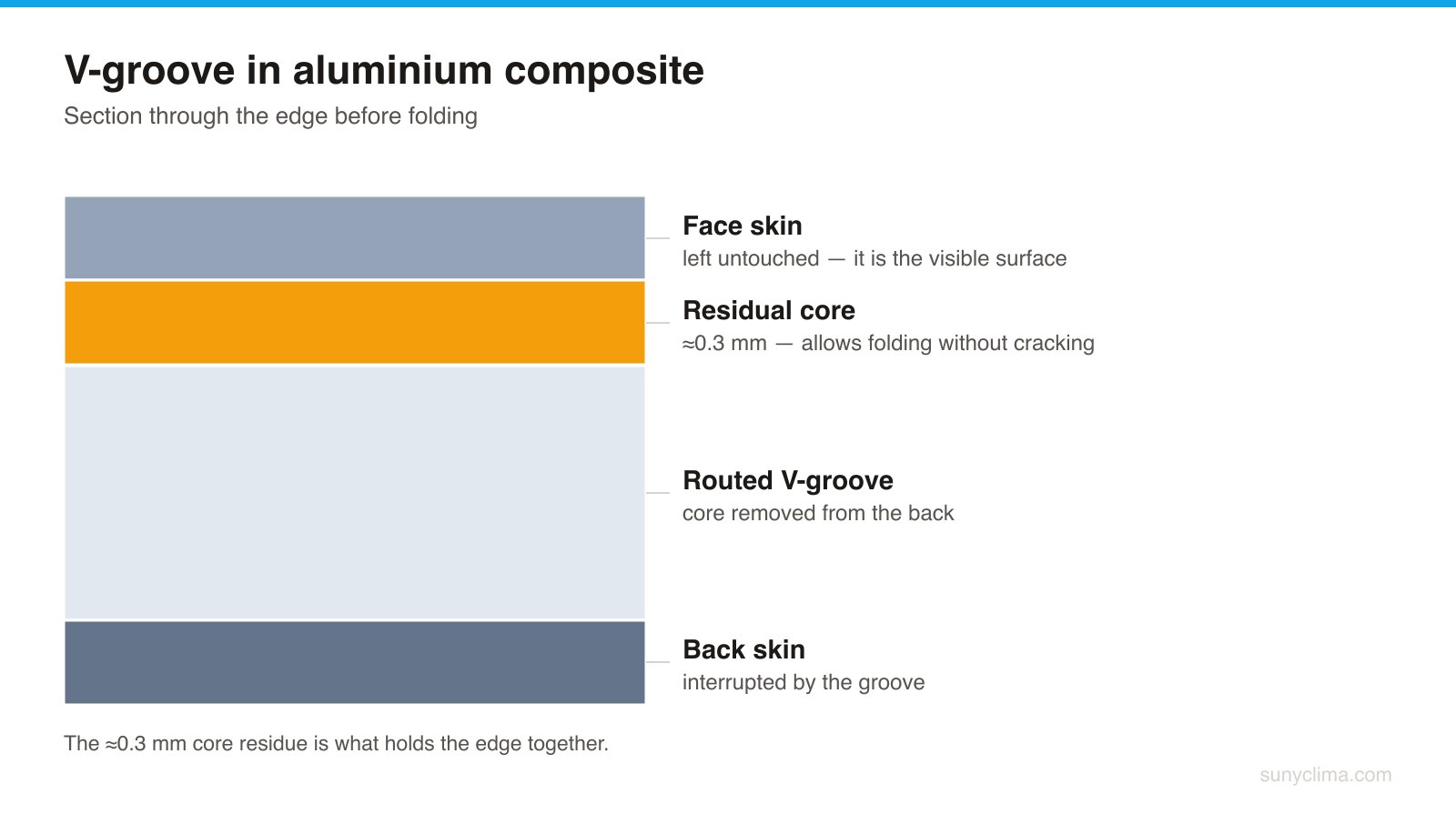
| Aluminium composite (bond) | V-groove routing from the back, then folding | Crisp edges, boxes, clean 90° returns | Never folded without a routed groove — the face cracks |
| Stainless steel 304 / 316 | Laser or waterjet | Cut motifs, perforations, lettering | Not thermoformed like a plastic |
| Glass | Cutting, drilling and grinding before toughening | Any geometry — but only in the annealed state | After toughening to EN 12150 — no cutting, no drilling |
Routing and folding aluminium composite
Bond is folded by routing a V-groove from the back and leaving a thin residue — about 0.3 mm of core behind the face skin. That residue is everything the edge depends on: thin enough to fold without cracking the face, thick enough not to tear. Route too deep and the edge splits; too shallow and the face wrinkles. The quality of bond edges is a direct read-out of the quality of the routing.
Laser or waterjet on stainless steel
The two methods produce different edges. A laser cuts with heat and leaves a heat-affected zone — on 10 mm 316L it runs roughly 0.3–1 mm wide. Within that zone the metal structure has been altered by heating, which for stainless steel matters for corrosion resistance right along the cut. A waterjet cuts cold: no heat-affected zone at all, and the edge stays metal with the same properties as the sheet.
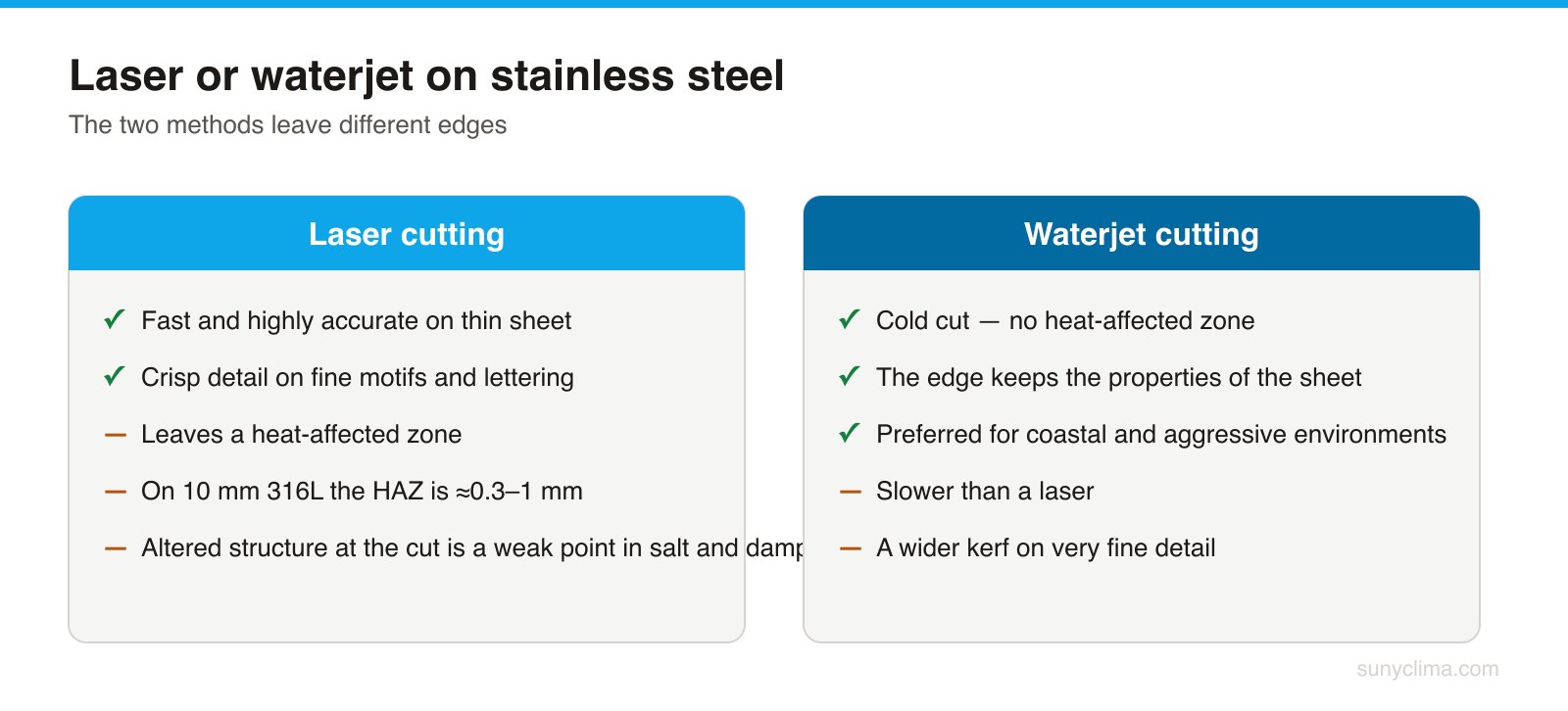
In practice: for decorative motifs in a sheltered position, the laser is the fast and precise choice. For elements exposed to salt, rain and grime, the cold cut of a waterjet — or post-treatment of the cut edge — is the wiser answer. The 304 versus 316 question is covered in the article on bond and stainless panels.
Why glass is worked only before toughening
Toughening to EN 12150 locks the glass into permanent stress: a compressed surface over a tensioned core. That is what makes it far stronger and what makes it break into small, blunt fragments. But the same stress means any later cut or drilled hole releases the energy and the pane disintegrates where it stands. So the entire geometry — size, handle holes, hinge cut-outs, edge finish — is executed in annealed glass, and only then does it enter the furnace. Resizing after toughening is not an operation; a new pane is made instead.
Thermal expansion, and why gaps are not sloppiness
Every material moves with temperature, and because a panel is an assembly of several materials, they all move differently. Under testing to DIN 53752, HPL has a coefficient of 0.9 × 10⁻⁵ 1/K lengthwise and 1.6 × 10⁻⁵ 1/K crosswise — the board moves almost twice as much in one direction as in the other.
Here is the arithmetic, so it is clear why this is not a footnote. A board 2000 mm long, across a 60 K swing between a winter night and a summer surface:
- crosswise: 2000 × 1.6 × 10⁻⁵ × 60 = about 1.9 mm
- lengthwise: 2000 × 0.9 × 10⁻⁵ × 60 = about 1.1 mm
Nearly two millimetres of travel on a two-metre board. If the panel is fixed rigidly with no clearance, that movement has nowhere to go and turns into bowing, bulging or a torn fixing. So the perimeter gap and the slotted fixing holes are not carelessness — they are calculated travel. A panel installed “tight, with no play” is a panel that will bow in its first summer.
In short: XPS insulates roughly 5,000 times better than aluminium, but tolerates no more than 60 days of UV, which is why it always sits behind a face. An aluminium profile without a thermal break is above 6.0 W/(m²·K); with a polyamide strip it drops below 2.0. HPL does not melt and starts decomposing above 250 °C. Glass is fully worked before toughening. And every panel needs a gap, because 2 metres of HPL moves close to 2 mm.
Panels are made to order in Bulgaria, so the size, the core and the face are set by the specification rather than picked off a shelf. For the right combination for a particular orientation and profile, browse the materials and the catalogue, work through the selection guidance, and check the frequently asked questions. Notes on machining are in the services section.