Sunyclima
Болгарський виробник декоративних панелей для вхідних дверей та віконних рам
The core decides the thermal performance, the rebate decides the thickness, and a cold profile decides everything else. The numbers for XPS, timber, PVC, aluminium, HPL and glass, set side by side.
A door panel looks like one object. Thermally it is a sandwich: face, core, back. The face decides how the door looks and how it survives the weather. The core decides how much heat walks through it. And the thickness of the whole sandwich is not really yours to choose — it is set by the glazing rebate of the profile the panel has to sit in.
Which is why the three decisions belong in this order: profile first, thickness second, core last. Taken the other way round, they produce the classic disappointment — an excellent core inside a cold aluminium profile, and a door that is still cold.
Two sentences worth keeping: the rebate dictates what thickness of panel is possible, not the customer's preference. And no panel rescues a cold profile — an aluminium system without a thermal break sits above Uf 6.0 W/(m²·K), and that number swallows everything the core gains.
What the core actually does
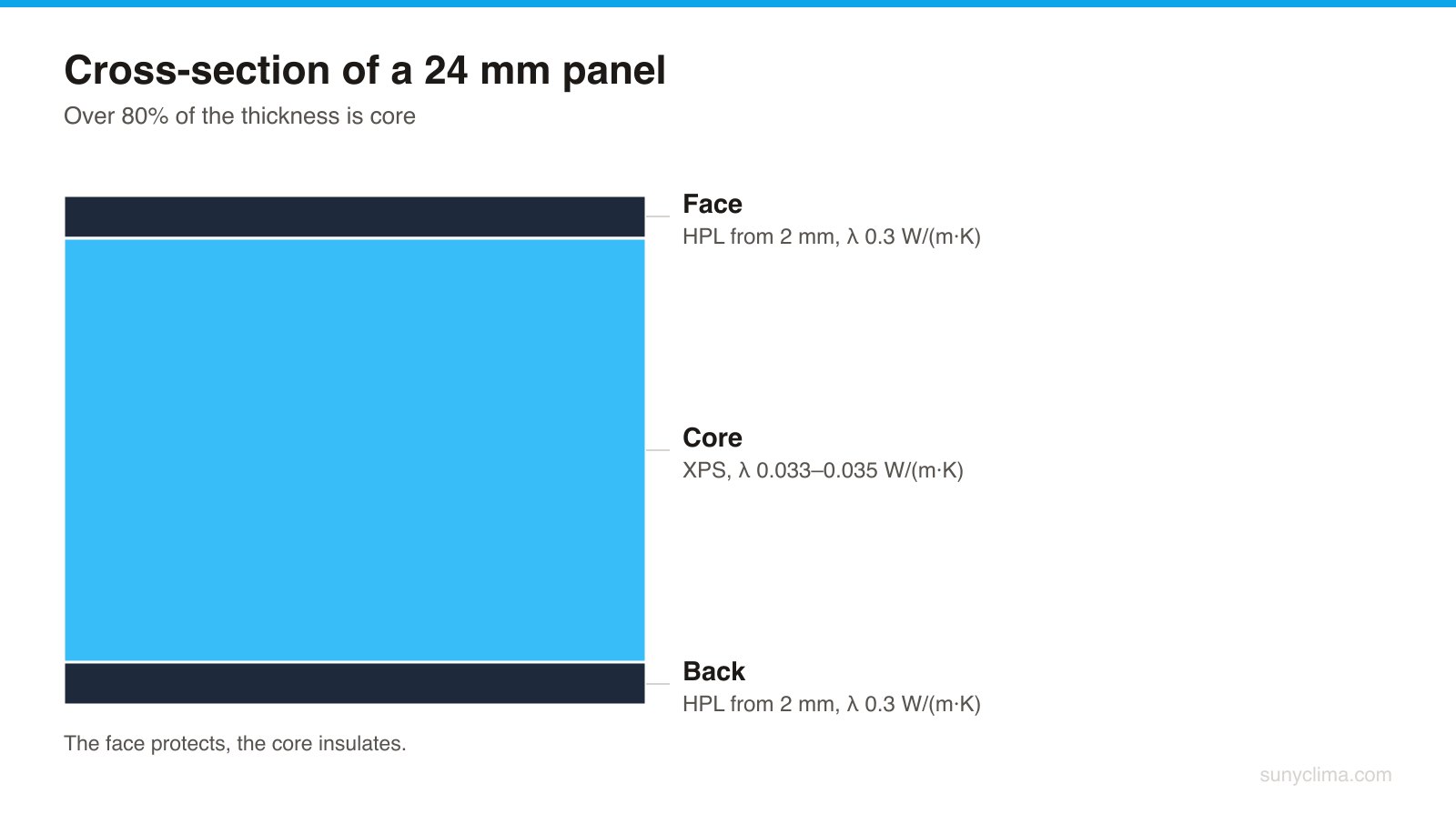
Face materials are thin. Exterior compact HPL to EN 438-6 starts at 2 mm; aluminium composite is two 0.5 mm skins bonded to a 3 mm core. In a 24 mm panel that leaves more than 80% of the cross-section as filling. So the thermal behaviour of a panel is, for all practical purposes, the thermal behaviour of its core. The face gives you appearance, weather resistance and impact protection — it does not insulate.
That gives you a rule for comparing products: if two panels of the same thickness behave differently in January, look at the filling, not at the face. What the face can and cannot do on its own is covered in the article on HPL; the consolidated table of coefficients sits in the technical parameters of panel materials.
XPS: the numbers, and where they run out
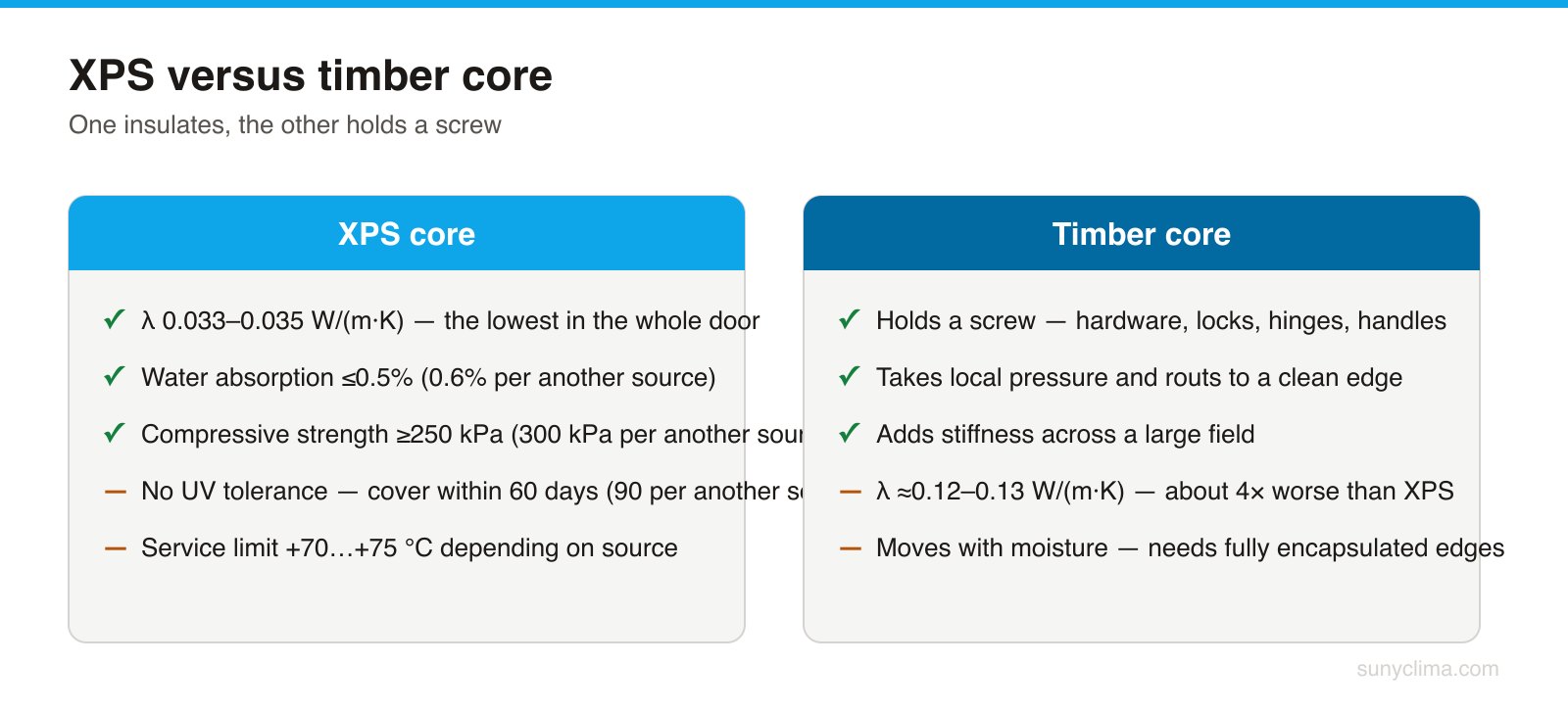
Extruded polystyrene (XPS) to EN 13164 has a thermal conductivity of λ ≈ 0.033–0.035 W/(m·K), dry material at 10 °C. Nothing else that goes into an entrance door comes close — not the profiles, not the glass. For a homeowner that translates into one sentence: at equal thickness, no other filling lets less heat through.
Three further properties matter once the material lives in an external door:
- Water absorption ≤0.5% by volume. The closed-cell structure takes up almost no water, so λ does not quietly degrade over a wet winter. A second manufacturer declares 0.6% by volume; the sources disagree, but either figure is negligible beside any fibrous insulation.
- Compressive strength at 10% deformation ≥250 kPa (300 kPa according to another manufacturer). A panel carries no structure, but it does take knocks, bead pressure and handling loads in transport. This is the number behind the fact that XPS does not crush inside a tight rebate.
- Service range −50 to +75 °C. The sources part company here too: one manufacturer publishes −50…+75 °C, another a continuous service temperature of +70 °C. The gap is narrow but real, so it belongs in print as a range rather than as one convenient figure.
One limit, however, is absolute: XPS must never be left in direct sunlight. Manufacturers ask for it to be covered within 60 days — another source stretches that to 90 — because prolonged UV fades the surface, chalks it and crumbles it away. In a finished panel this is a non-issue: the core is sealed between two faces. It matters in the yard and at the saw. A board propped against a wall “for later” is no longer the board you costed.
Timber core: where XPS gives out
Softwood conducts at ≈0.12–0.13 W/(m·K), roughly four times more than XPS. As an insulator, timber simply loses; there is nothing to debate. But insulation is not the only job a panel has.
Timber holds a screw. It takes hardware, handles, locks and hinges, absorbs local pressure without crushing, and routs to a clean, stable edge. On a panel with a full-height pull handle, or a lock that gets used forty times a day, the timber is what stops the fixing from working loose in its first year.
Its weakness is moisture. Timber moves: it swells, shrinks and cups as humidity swings, and it loses strength outright if it stays wet. A timber core in an external panel therefore has to be completely encapsulated — no exposed edge, no bare cut, no path for water to reach it.
The combination that settles most jobs
The real question is rarely “XPS or timber”. Panels are available with an XPS core, with a timber core, and with the two combined — and it is the combination that answers the most common brief: XPS across the field, where low λ is what counts, and timber where hardware is fixed or extra stiffness is wanted.
- Pure XPS — no penetrations, no hardware passing through, insulation as the priority.
- Timber core — heavy mechanical load, in a profile that is already properly thermally broken.
- Combination — the standard answer for a solid entrance panel with a handle: an insulating field plus reinforced zones exactly where the screws land.
Panels are made to order in Bulgaria, so those reinforcement zones follow the actual drawing and the chosen hardware rather than a universal template — see made-to-measure orders.
λ for every material in one door
These figures only make sense side by side. They span four orders of magnitude — from 0.033 to around 200 — so the chart below is plotted on a logarithmic scale. On a linear one, everything except the aluminium would be an invisible line along zero.
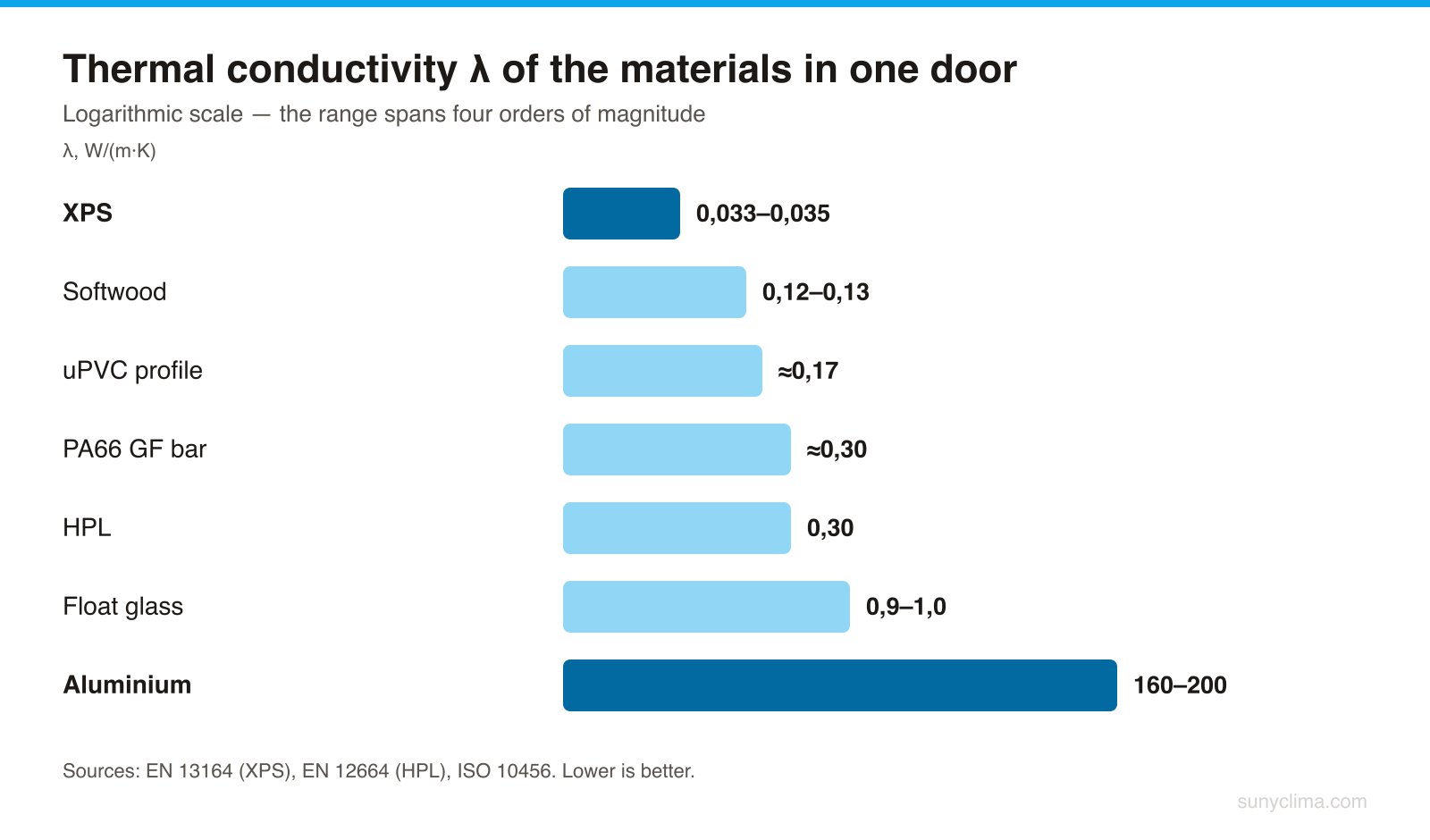
The conclusion is blunt and useful: aluminium is not “slightly worse” than XPS, it is about five thousand times the better conductor. Profile geometry and the presence of a thermal break therefore outweigh a few millimetres of core by a margin no core can close. The tabulated design values used to make such comparisons properly live in ISO 10456:2007; the λ of HPL is measured to EN 12664.
The rebate dictates the thickness
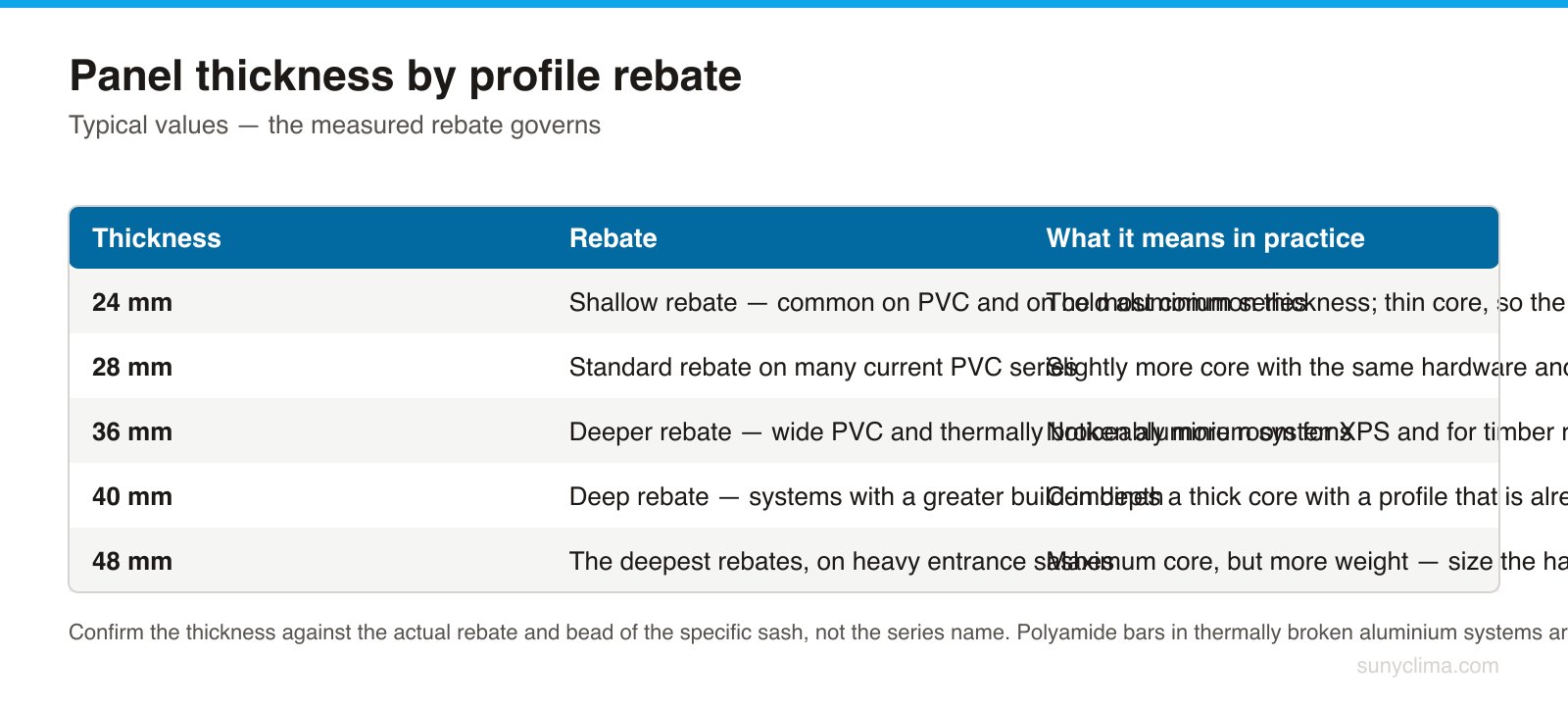
A panel goes where the sealed unit would have gone — into the glazing rebate of the sash. Rebate depth, available support and bead height between them decide what thickness can be sealed and clamped at all. The profile series therefore sets the panel thickness, never the reverse. Any conversation that opens with “I want 48 mm” before anyone has measured the rebate is a conversation wasted.
Measure the actual rebate — do not trust the catalogue name of the system. One commercial series often ships sashes with different rebate depths, and a change of beads moves the goalposts again. Confirm the thickness with a caliper on the sash in front of you before anything is ordered. A panel ordered against a series name is a panel that may not fit.
And the misconception every homeowner arrives with: a thicker panel does not automatically mean a warmer door. Yes, 48 mm of XPS insulates better than 24 mm across the field. But the field is only part of the door; the rest is frame, sash, hardware and edges — and if heat is leaving freely there, the extra core is never felt.
Why a panel cannot rescue a cold profile
There is no arguing with the numbers. An aluminium profile with no thermal break sits above Uf 6.0 W/(m²·K). The same profile with 24–34 mm PA66 polyamide bars drops below 2.0 W/(m²·K), and the better systems land between 1.2 and 1.8 W/(m²·K).
The whole mechanism condenses into one coefficient: glass-filled PA66 conducts at ≈0.30 W/(m·K), aluminium at ≈170–200–200 W/(m·K). The polyamide bar cuts the metal bridge between the outer and inner shells of the profile and forces heat through a material that resists it hundreds of times harder.
For anyone spending money, that settles the priority: the gap between Uf 6.0 and Uf 1.5 in the frame dwarfs the gap between 24 and 48 mm of XPS in the field. If the budget covers only one, it goes into the profile. A panel in cold aluminium looks perfect on installation day and streams condensation down the frame on the first cold morning. External doors have to declare a U-value in any case under EN 14351-1 (symbol U_D) — ask the profile supplier for it before the argument about cores begins.
How this decision meshes with the rest of the door is covered in the general guide to decorative panels, and the choice between a panel and a finished leaf in panel or ready-made decorative door.
Moisture, condensation and edges
Most panel failures begin at the edge, not in the core. Four mistakes come round again and again:
- Trimmed on site, edge left open. A panel cut on the job and fitted without its encapsulation restored leaves the core bare inside the rebate. With timber that is a matter of time; with XPS it is UV and mechanical break-up of the cut face.
- No drainage in the rebate. Water that works its way between gasket and panel needs a way back out. Blocked drainage slots turn the rebate into a bathtub.
- Unevenly clamped gasket. Setting blocks bunched in the middle, or a panel shoved into one corner, and the gasket stops sealing along its full length.
- Timber carried out to the outer edge. If the timber reaches into the rebate, whatever moisture sits in the rebate goes straight into it.
Condensation on the frame around an otherwise warm panel is not a panel fault. It says the internal surface temperature has fallen below the dew point — which puts the bridge in the profile or in the installation joint. The fitting detail is in the installation section.
A working order of decisions
- Get the Uf of the profile. Above 6.0 W/(m²·K), change the profile first and talk about panels afterwards.
- Measure the actual rebate and accept the thickness the system allows — 24, 28, 36, 40 or 48 mm.
- Choose the core: pure XPS for maximum insulation, timber for fixing and stiffness, a combination for most real entrance doors.
- Choose the face for the exposure and the expected load — see the materials.
- At installation, check the edges, the drainage and the evenness of the clamping.
If you are unsure what thickness your series allows, the quickest route is to send an enquiry with the profile, the sizes and the chosen hardware. The answer to “24 or 36” comes off the rebate, not out of a catalogue.