Sunyclima
Prodhues bullgar i paneleve dekorative për dyer hyrëse dhe dogramë
A complete account of extruded polystyrene: how it is made, why the closed cell explains every one of its properties, what a manufacturer actually declares under EN 13164, where the material is irreplaceable and which solvents destroy it.
XPS is extruded polystyrene — a rigid foam board made from the same polymer as the white packaging foam everyone knows, but with a completely different internal structure and behaviour. If you have seen pink, blue or green boards on a site — under a screed, against a plinth, on a roof terrace — that was XPS.
This article is about the material itself: how it is made, why the process explains its properties, what a CE declaration actually lists, and where XPS is irreplaceable. If what you need is which core to specify for an entrance door panel, that is the article on XPS versus a timber core and panel thickness.
In short: XPS is polystyrene foamed inside an extruder and cast as one continuous board with closed cells and a smooth surface skin. That structure produces the low thermal conductivity (λD 0.027–0.038 W/(m·K)), the near-zero water absorption, the high compressive strength (typically 200–700 kPa) and the frost resistance. It also produces the two hard limits: nothing above +70…+75 °C, and no solvents.
What the name means, and what it is not
Polystyrene is an amorphous thermoplastic made from styrene monomers — clear, hard and brittle in solid form, the material of CD cases and disposable cups. As insulation it is never used solid but foamed, so 95% or more of a finished board is gas trapped in millions of tiny cells, the polymer only a thin network of walls between them. A finished board weighs roughly 28–40 kg/m³ to ISO 845, typically 30–38.
The X stands for extruded, separating the material from EPS — expanded polystyrene, the familiar white bead board. Same chemistry, different route: EPS is made from pre-expanded beads fused in a mould with steam, XPS is poured as one continuous body. That is why EPS shows beads and crumbles while XPS breaks with a smooth edge. The full comparison lives in the article on EPS and how it differs from XPS.
As with most building materials, the trade name has swallowed the generic one. "Styrofoam" is a brand applied in speech to any polystyrene foam; in Bulgaria XPS is often named after one Greek manufacturer, as though the brand were the material. In front of a supplier that costs time. The unambiguous way to ask is by standard and class: "XPS to EN 13164, CS(10\Y)300, 50 mm."
One more clarification that settles a lot of arguments: colour is not a classification. Pink, blue, green and grey are factory markers, not properties declared under any standard. Two boards of one colour can differ in strength; two of different colours can be identical. The label decides, not the shade.
How it is made: extrusion, step by step
The whole character of XPS is created in one continuous process:
- Blending. Polystyrene granules enter the extruder with additives — flame retardant, nucleating agents that set how fine the cells will be, and pigment.
- Melting. A twin-screw extruder melts and homogenises the blend under heat and pressure. At this stage it is a thick viscous melt with no bubbles at all.
- Blowing agent injection. The gas that will create the foam is injected into the melt under pressure, which keeps it dissolved — it cannot expand yet.
- Cooling and extrusion. The melt is cooled precisely and pushed out through a wide flat die.
- Foaming. The instant the mix leaves the die, pressure drops to atmospheric: the gas expands into millions of cells and the cooling polymer sets around them. The board is calibrated between rollers and trimmed.
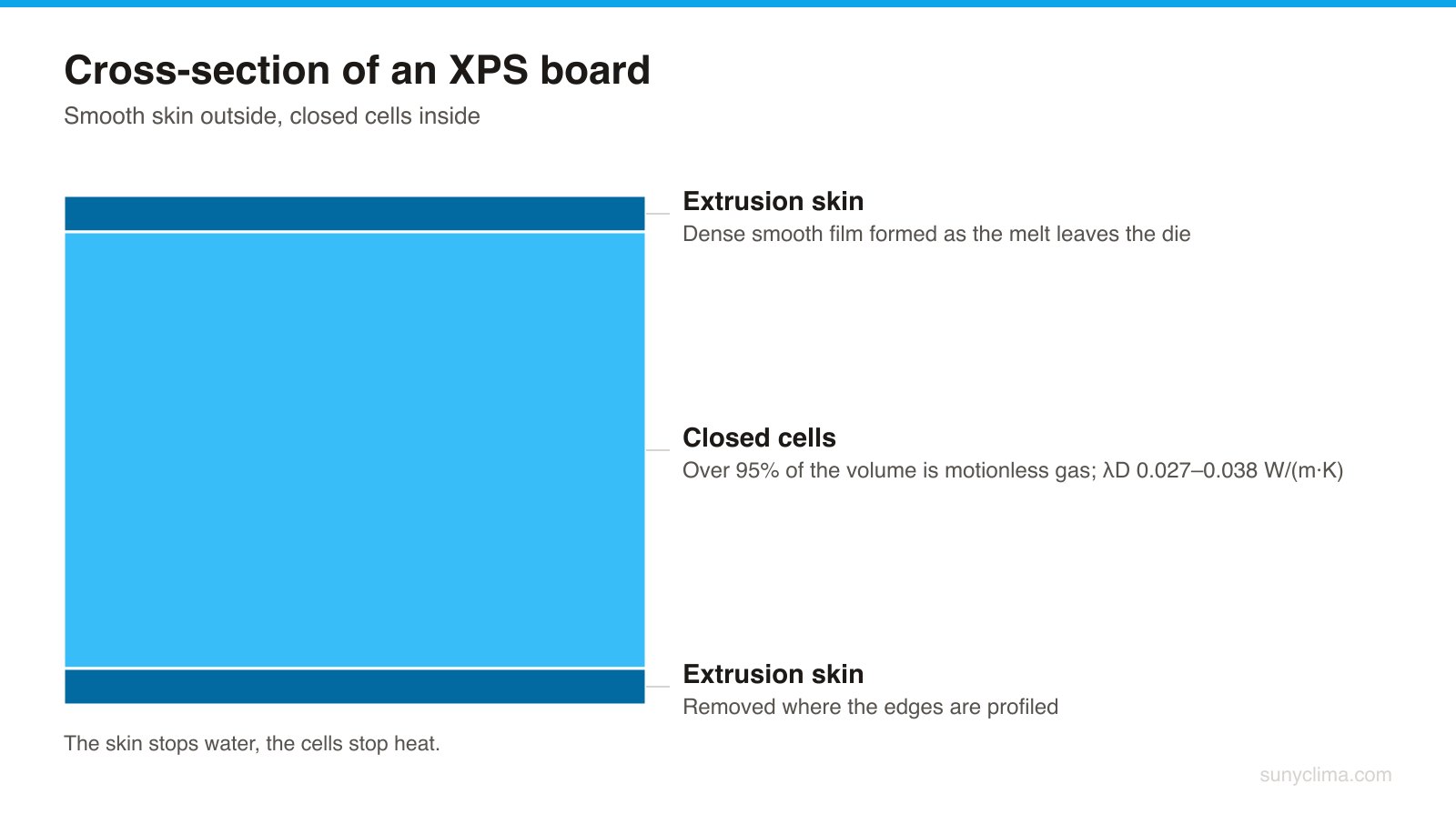
First, the cells are closed. Each is fully enclosed by a polystyrene wall with no connection to its neighbours: no capillary paths for water, no interconnected voids for air to circulate in.
Second, the board has a skin. The outer layer of the melt cools first and sets as a dense, smooth film over the foam. This extrusion skin is denser than the core and acts as an extra water barrier — which is why datasheets state whether the surface is smooth (skin intact) or planed. Planed boards absorb more, and makers declare different values for each.
A practical consequence: edges are profiled after extrusion — square (I), shiplap (L) or tongue-and-groove — and it is precisely there that the skin is gone. Never leave a cut edge where standing water will sit.
The closed cell explains every property that follows
One sentence to keep: every good number on an XPS datasheet follows from the closed-cell structure, and every bad one from the fact that it is polystyrene.
Thermal conductivity λ
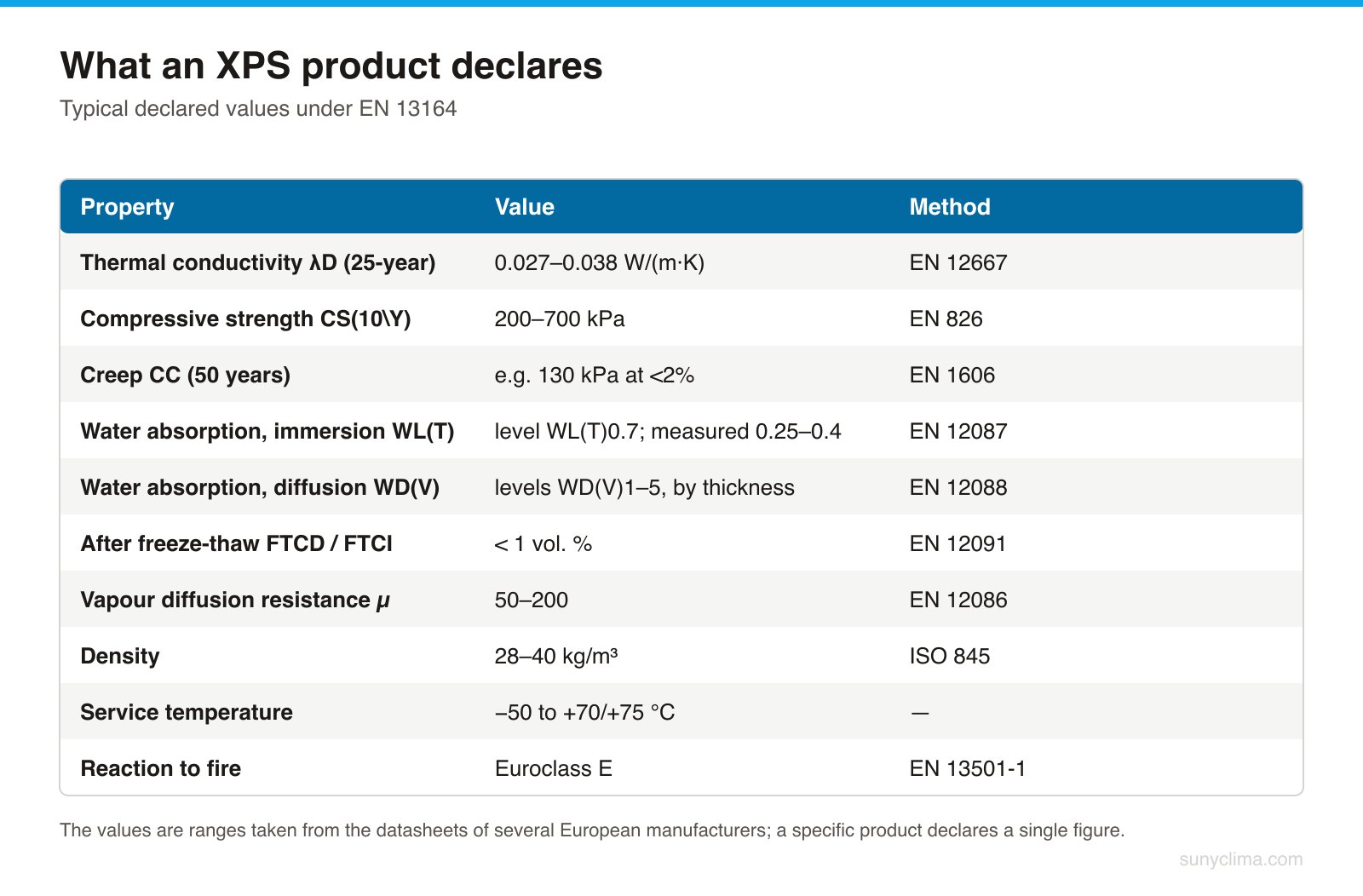
Heat crosses a foam by three routes: through the polymer walls, through the gas in the cells, and by radiation between the walls. In XPS the polymer is under 5% of the volume, and the gas is motionless because the cells are sealed. The result is a declared λD between 0.027 and 0.038 W/(m·K) across European declarations — a wider spread than most tables admit. One Austrian product declares 0.027 W/(m·K) from 40 mm right up to 400 mm; mainstream lines sit at 0.029–0.031; one Greek maker's 500 kPa grade is declared at 0.033 for 20–30 mm, 0.036 for 40–50 mm and 0.038 from 60 mm up.
And the rule that surprises people: thicker boards have a higher λ per metre — one line climbs from 0.030 at 20 mm to 0.038 at 120 mm and above. That does not make thick worse: R = d/λ still rises with thickness, just not in proportion. Compressive grade matters less than is usually said; thickness and blowing agent dominate.
A detail most readers skip: serious makers declare λ "after 25 years", to EN 12667. The figure already accounts for ageing — it is not a day-of-manufacture value.
Water absorption
Here XPS has no real rival. Two numbers are declared, because two mechanisms are at work:
- WL(T) — long-term immersion. The board sits in water and the uptake is measured. The standard offers only three levels — 0.7, 1.5 and 3% by volume — and almost every serious board declares WL(T)0.7. What is actually measured is lower: makers report 0.4% and even ≤0.25%.
- WD(V) — absorption by diffusion. The harder test: a temperature and humidity gradient is held across the board and the moisture condensing inside is measured. There are five levels, WD(V)1 to WD(V)5, and they shift with thickness within a single product: one line declares WD(V)3 below 50 mm, 2 at 50–70 mm and 1 above 80 mm. This is the number that matters for an inverted roof.
For a non-specialist: a month underwater leaves XPS holding under one per cent water by volume, with λ essentially unchanged.
Water vapour diffusion resistance (µ)
The µ factor says how many times harder water vapour finds the material than the same thickness of air. Declared XPS values run 50 to 200, often as a thickness-dependent band — a flat 150 on some products, 80–200 on others. XPS is a serious vapour retarder in its own right. For anyone who does not design walls, the short version is that you should not line the inside of an external wall with XPS to make the room warmer — the moisture the room gives off stops leaving that way and collects behind the board.
Compressive strength and creep
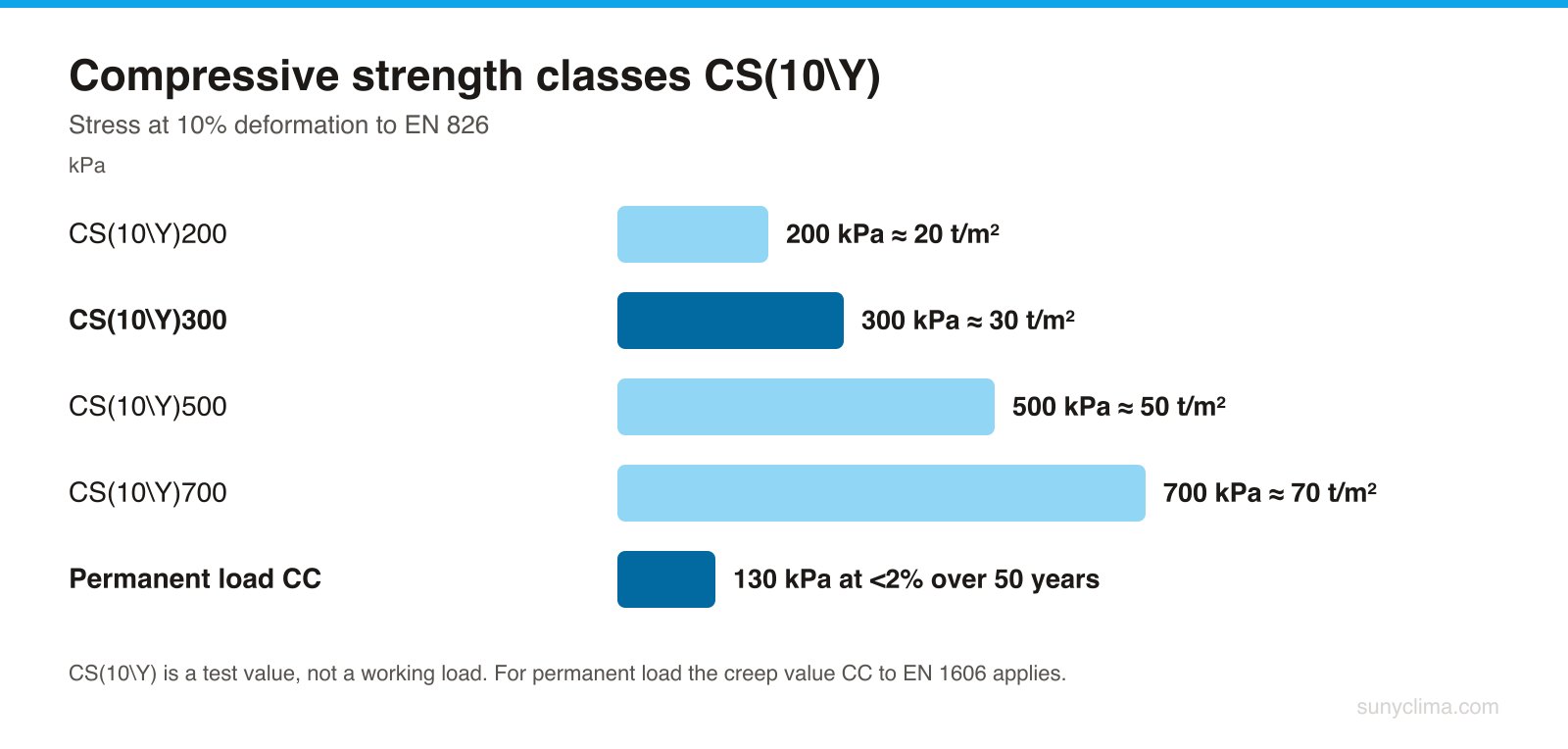
The closed cell is structural as well as thermal — every cell is a sealed chamber resisting collapse. The declared value is CS(10\Y), stress at 10% deformation to EN 826. The ladder in the standard runs from 100 to 1000 kPa, but what you actually meet is 200, 300, 500 and 700; nothing above 700 is sold in volume in Europe. For scale, 300 kPa is about 30 tonnes per square metre.
But CS(10\Y) is not a working load. For sustained loading you read creep, CC. One maker declares CC(2/1.5/50)130 kPa for its 300 kPa board: under a permanent stress of 130 kPa, deformation after 50 years stays below 2%. The long-term allowable load is therefore around 40% of the headline figure. Anyone designing under a screed or a raft works with the second number.
Frost resistance
The test is deliberately brutal: specimens are saturated, then run through freeze-thaw cycles. Two figures are declared: FTCD after the diffusion test and FTCI after total immersion — typically under 1% uptake. The old FT symbol was dropped in the 2012 edition but still turns up on older sheets. With almost no water inside, there is almost nothing to freeze and tear the structure apart — hence XPS in frost protection for roads, bridges and runways.
Reading the EN 13164 code
EN 13164 is the harmonised European standard for factory-made XPS products. It does not say "XPS shall be like this"; it says what the maker must declare and by which method. Hence the chain of codes on the label and in the declaration of performance:
XPS – EN 13164 – T1 – CS(10\Y)300 – CC(2/1.5/50)130 – DS(70,90) – DLT(2)5 – WL(T)0.7 – WD(V)3 – FTCD1
Word by word:
| Code | What it declares | Method |
|---|---|---|
| T1 / T2 / T3 | Thickness tolerance. T1 loosest, T3 tightest (±1 mm). | EN 823 |
| CS(10\Y)300 | Compressive strength at 10% deformation, 300 kPa. | EN 826 |
| CC(2/1.5/50)130 | Creep: under 2% after 50 years at 130 kPa. | EN 1606 |
| DS(70,90) | Dimensional stability at 70 °C, 90% RH. | EN 1604 |
| DLT(2)5 | Deformation under load and temperature, up to 5%. | EN 1605 |
| WL(T)0.7 | Water absorption by immersion: up to 0.7 vol%. | EN 12087 |
| WD(V)3 | Water absorption by diffusion: up to 3 vol%. | EN 12088 |
| FTCD1 | Uptake after freeze-thaw: under 1%. | EN 12091 |
| MU | Water vapour diffusion resistance. | EN 12086 |
| λD | Declared thermal conductivity, per thickness band. | EN 12667 |
Reaction to fire is declared separately, to EN 13501-1. For ordinary XPS it is Euroclass E — down to the flame retardant, not the polymer: a board made without one is declared Euroclass F. It burns, it must be covered by a non-combustible layer, and it should never be left exposed in an occupied space.
Blowing agents: from CFC through HFC to CO₂ and HFO
The gas used to foam XPS is also its environmental biography. The first generations used CFC-12, which destroys ozone; the Montreal Protocol ended that and the industry moved to HCFC-142b, banned for XPS in the EU from 1 January 2002. Next came HFCs — mainly HFC-134a, no ozone-depleting potential but a high warming potential — which the F-gas regulation stopped for XPS on 1 January 2020. Today it is CO₂, hydrocarbons and HFOs such as HFO-1234ze; the 2024 regulation has already dated their end too, at 1 January 2033.
There is a technical side too. Some of the cell gas is replaced by air over time and λ shifts — which is why the declared figure is quoted "after 25 years". In CO₂-blown boards that exchange finishes within months and the curve is essentially flat; in HFC- and HFO-blown boards the low λ depends on gas staying in the cells.
The second big change is the flame retardant. For decades both EPS and XPS contained hexabromocyclododecane (HBCD). In 2013 it was listed as a persistent organic pollutant under the Stockholm Convention and phased out — for EU XPS by August 2015 — in favour of a brominated styrene-butadiene copolymer. The practical meaning: old XPS from demolition is waste with restrictions attached, while new boards recycle far more easily.
Temperature, sunlight and fire — the three limits
The declared service range is −50 to +75 °C, with several makers quoting +70 °C instead — publish it as the band it is. The lower limit is effectively theoretical: cold does not change XPS, which is why it lines cold stores and ice rinks. The upper limit is real.
The reason is chemistry. Polystyrene is amorphous, with a glass transition put at 90 °C by some sources and 100 °C by others, and it softens below that. Past the limit the board loses dimensional stability — it bows and shrinks. So XPS is never poured over with hot bitumen and never placed against an uninsulated flue.
Sunlight is a separate problem and the most common site mistake. UV degrades the surface: it yellows, chalks and rubs off under a finger. Makers ask for boards to be covered within 60 days (up to 90 by other sources), with the film off only immediately before installation. The underrated hazard: a board in direct sun or under dark sheeting heats past +75 °C and deforms without the weather ever being hot.
Reaction to fire, as above, is Euroclass E. XPS always works covered — under a screed or ballast, behind render, or between the faces of a panel.
Where XPS is used
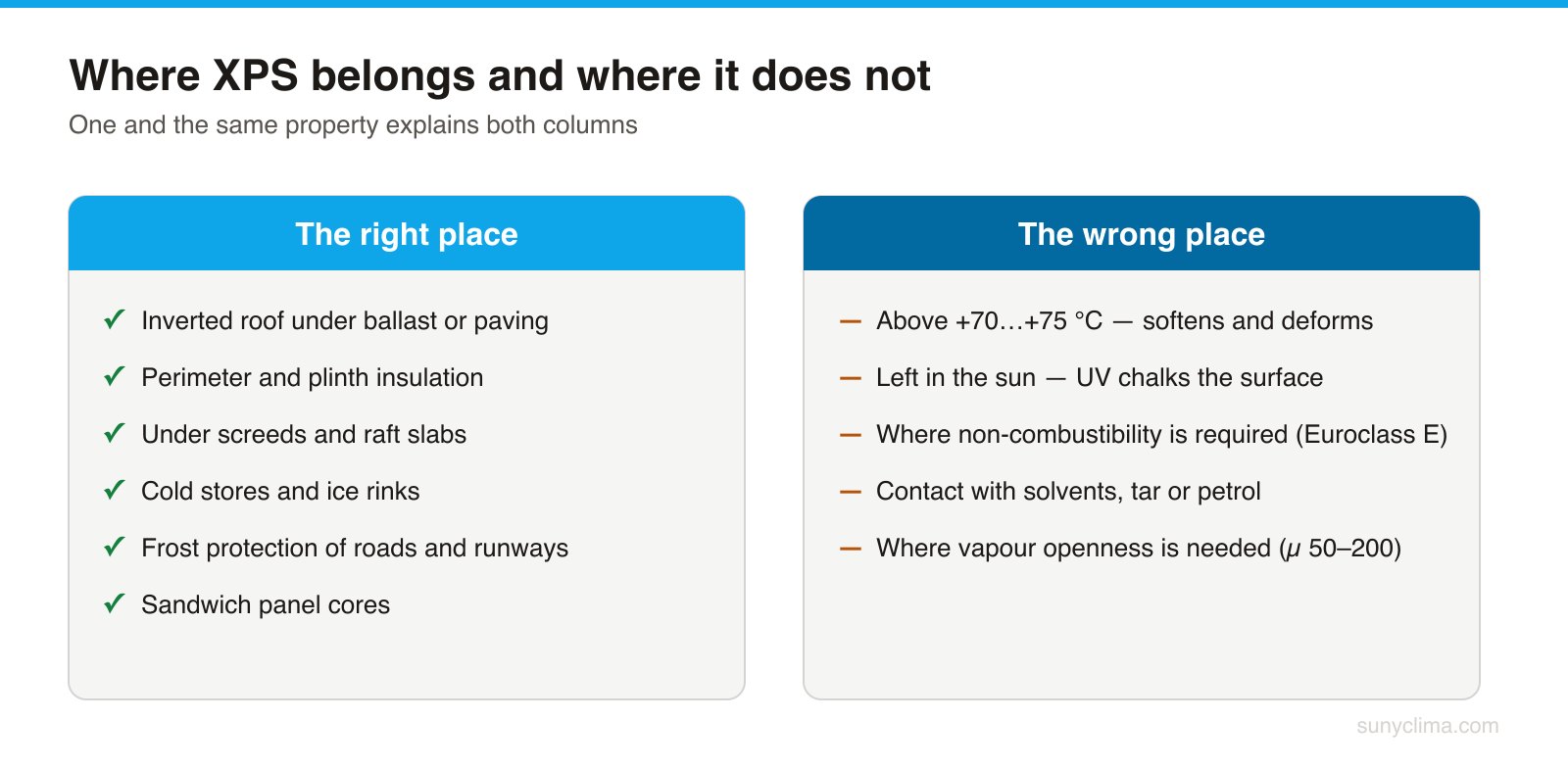
The combination "barely absorbs water + carries load + survives freezing" is rare, and it defines where the material is at home:
- Inverted roofs. The insulation sits above the waterproofing and lives wet, under ballast, paving or planting. It demands declared WD(V) and freeze-thaw performance — and XPS is the only mainstream material that survives both.
- Perimeter and plinth insulation. The outer face of basement walls, against ground moisture and backfill pressure.
- Under screeds and raft slabs. Permanent load, no replacing it later — where the 500 and 700 kPa classes and the creep figure earn their keep.
- Cold stores. Constant temperature gradient, condensation risk, freezing.
- Frost protection — roads, bridges and runways.
- Sandwich cores. Between two strong faces XPS gives a light, stiff, warm board — from industrial panels to decorative entrance-door panels, made to order here in Bulgaria.
Conversely it is the wrong choice at high temperature, on an uncovered façade, where non-combustibility is required, and where vapour openness is the design intent. For the wider picture see the technical parameter tables and the materials section.
Cutting, machining and bonding — and the solvents that destroy it
Cutting. A knife scored along a straight edge handles up to about 30 mm; beyond that, a coarse-toothed saw or a hot-wire cutter, which gives the cleanest edge but needs ventilation. Production work is CNC-routed — easy on the machine, abrasive to the tool because of the mineral additives, and demanding on extraction, since the swarf is light and static.
Bonding is where the real danger sits. Polystyrene dissolves in aromatic and ketone solvents. Toluene, xylene, acetone, petrol, cellulose thinners and solvent-based bituminous primers literally melt the board — not cosmetically, but eating out the core and leaving a hole. Makers also warn against tar, formic acid and gases such as methane, propane and butane.
What does work: solvent-free adhesives — one-component polyurethane foams and adhesives declared "polystyrene compatible", cement-polymer mortars, water-based bitumen emulsions, cold solvent-free bitumen. Resistance to mineral and food oils, paraffin and fats is moderate rather than unconditional. It is very good to lime, cement, plaster, seawater, alkalis, bleach, most acids, alcohol and silicone.
The site rule: before bonding XPS with an unfamiliar adhesive, put a drop on an offcut and wait a few hours. If the edge has shrunk, pitted or gone tacky, it contains solvent and must not be used. The check takes minutes and saves a whole re-done insulation layer.
Common mistakes and misconceptions
- "XPS is just expensive EPS." Different structure, water absorption, strength and applications. Only the raw polymer is shared.
- "It doesn't absorb water, so I can leave it exposed." Water is not the problem — sunlight is. Six months uncovered leaves a crumbling surface.
- "It says 300 kPa, so it holds 30 tonnes." At the moment of testing, at 10% deformation. For permanent load the creep figure applies — roughly 40% of it.
- "Thickness decides everything." It decides R = d/λ, but λ itself moves with thickness, and in a real assembly the weak link is usually elsewhere — frame, profile, edge, joint.
- "Colour shows quality." Colour shows the factory.
- "Euroclass E is good enough." The class describes the material, not the construction. XPS must be covered.
How to read an XPS datasheet in one minute
- The standard. EN 13164 and the full designation code. Missing, and nothing specific has been declared.
- λD for your thickness. Not the first figure in the row, but the band your board falls into.
- CS(10\Y) and CC. Peak load, then permanent.
- WL(T) and WD(V). In a wet application WD(V) is the more important.
- FTCD. Essential if the board will freeze while wet.
- The T class. In a precise rebate or a sandwich, T1 versus T3 is a flat face against a wavy one.
- Service range and reaction to fire. The two non-negotiable limits.
Those seven lines compare two quotations on substance rather than colour and price per cubic metre. For panels with an XPS core, start from the selection guidance, browse the catalogue and describe your case in the enquiry form.