Sunyclima
Болгарський виробник декоративних панелей для вхідних дверей та віконних рам
HPL is not a brand and not a thickness — it is defined by its process: ≥ 120 °C and ≥ 5 MPa. Here is what HGS, CGF and EDF actually mean, where CPL and melamine-faced board differ, and how to read a data sheet.
The kitchen worktop, the school lab bench, the divider between toilet cubicles at the airport, the lining inside a train carriage, the cladding on the nursery across the road — you probably touch HPL every day without calling it that. It is everywhere precisely because it does not draw attention to itself.
This article is about the material, not any one product made from it. HPL as the face of an entrance door panel is covered separately in the article on HPL door panels. Here we look at HPL the way a manufacturer and the standard do: what the letters in the grade code mean, where the line runs between HPL, CPL and melamine-faced board, why a board laminated on one side will bow, and which HPL bends rather than cracks.
What the name actually means
HPL stands for High Pressure Laminate. It is not a brand and nobody owns it: Formica, Resopal, Abet, Fundermax, Polyrey and Trespa are brands; HPL is the material they make. "Compact" gets used as a synonym, but compact is only one of its forms.
The definition sits in EN 438-1 (international twin ISO 4586) and is quoted verbatim in ICDLI's product data sheet: decorative surface layers and core layers bonded by a high pressure process, typically ≥ 120 °C and ≥ 5 MPa. Note what defines the material — not the look, not the thickness, not the price, but the process.
The raw materials are disarmingly ordinary — three papers and two resins:
- Kraft paper, 80–300 g/m² — absorbent and unbleached. It is the core and supplies the thickness.
- Decor paper, 50–160 g/m² — bleached and pigmented, a solid colour or a printed pattern.
- Overlay, 15–80 g/m² — transparent, unpigmented, highly absorbent, with one job: abrasion resistance.
- Phenolic resin for the core and melamine resin for the face.
Splitting the job between two resins is no accident. Melamine gives a hard, colourless, lightfast surface, but is expensive and brittle in bulk; phenolic is tough and cheap, but brown and prone to darkening in daylight. So one goes outside, the other stays where nobody looks. The dark brown edge of a compact sheet is that phenolic core.
How it is made
The papers are unwound, dipped in a resin bath, saturated and dried, leaving dry paper whose resin has not yet reacted. The build-up is assembled in a dust-free room — overlay, decor, as many kraft layers as the thickness demands, a back layer — and goes into a multi-daylight press.
Presses with up to 45 openings are in use, each taking up to 24 single-sided laminates (0.5–1.9 mm) or at least one compact sheet (2–20 mm). Loaded cold, taken to 5–8 MPa and heated above 120 °C, cycles run to 100 minutes; some plants go higher, 9 MPa at 140–150 °C over 40–50 minutes. The standard's 5 MPa and 120 °C are a floor, not an operating point. The resins liquefy, flow between the fibres and cross-link irreversibly, the fibres locked in as reinforcement. One detail explains much of the sheet's stability: the pack is cooled under pressure, releasing internal stresses before it leaves the press.
Sheets are then trimmed, and single-sided laminates sanded on the back so they glue well: that brown, rough back is a bonding surface, not a second-rate face. The finish — gloss, matt, wood pore — is an imprint left by the press plate in the melted melamine, which is why decor and finish are specified separately.
HPL, CPL and melamine-faced board
This is where quotations quietly diverge: from three metres away all three look identical, and they cost nothing like the same.
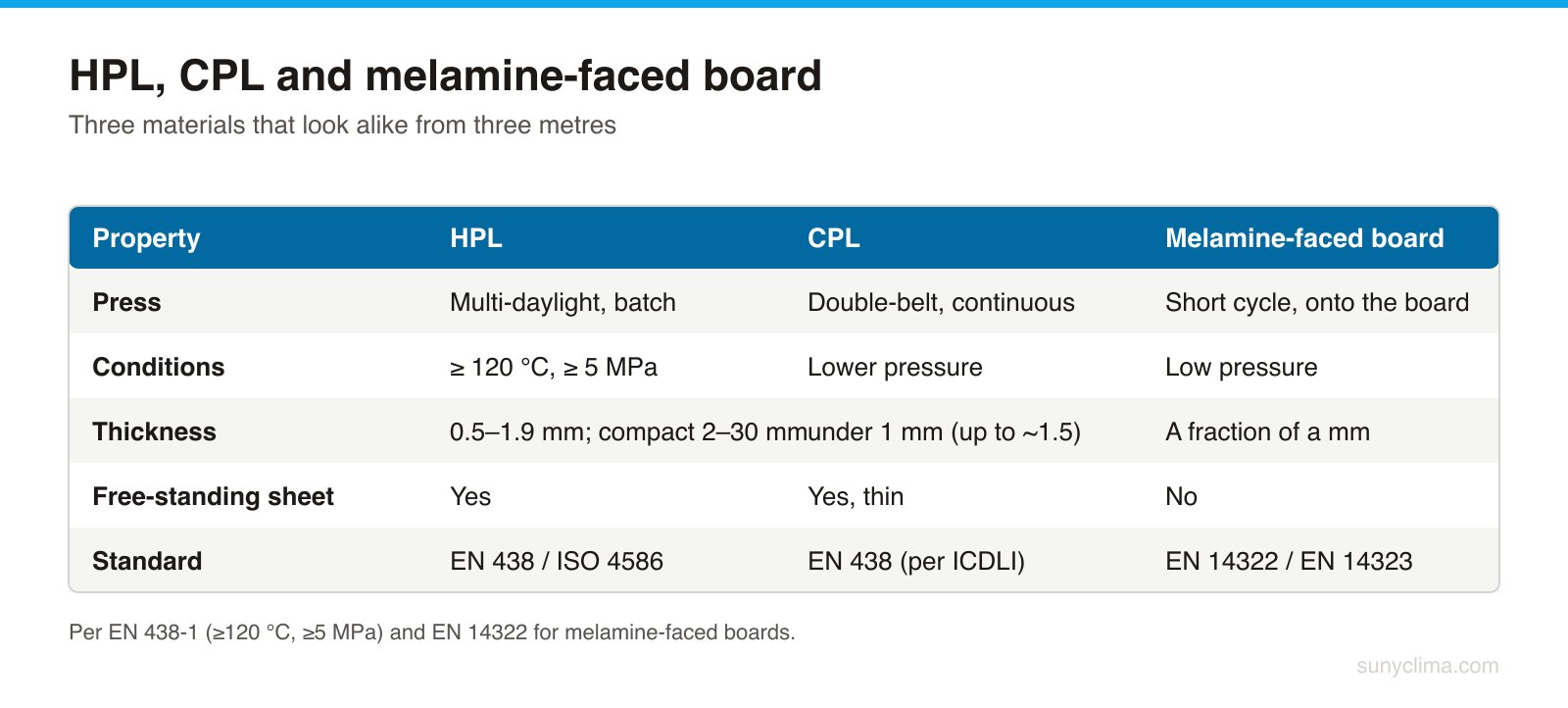
HPL is a sheet in its own right, existing independently of whatever it will be bonded to — and in compact form there is nothing to bond it to.
CPL (Continuous Pressure Laminate) is also free-standing, but comes off a different machine: a continuous double-belt press running endless webs of treated paper between steel belts at 8–25 m/min, at lower pressure and much smaller thicknesses — usually under 1 mm, by other accounts to roughly 1.5 mm. It is cheaper and almost always fully bonded down. The industry body ICDLI calls it HPL too: quality is defined by EN 438 and ISO 4586, not by the machine.
Melamine-faced board — chipboard or MDF with a melamine surface — contains no separate sheet at all. The impregnated decor paper cures directly onto the board in a short-cycle press, a fraction of a millimetre thick, and is covered not by EN 438 but by EN 14322 and EN 14323. Where HPL absorbs a knock, melamine-faced board chips and the particleboard shows through.
Hence one useful question for any quotation: which standard is the facing declared to? EN 438 means HPL. EN 14322 means melamine-faced board.
The EN 438 family: nine parts
EN 438 is a series, not a document, and each part covers a different product with different requirements. "Complies with EN 438" means nothing until somebody names a part.
- EN 438-1 — introduction and definitions.
- EN 438-2 — test methods; every data-sheet number points to a clause here.
- EN 438-3 — laminates under 2 mm, for bonding to substrates.
- EN 438-4 — interior compact, 2 mm and thicker, standard and flame-retardant.
- EN 438-5 — flooring-grade laminates under 2 mm.
- EN 438-6 — exterior compact, 2 mm and thicker, at two levels: moderate and severe.
- EN 438-7 — compact and composite panels for wall and ceiling finishes, suspended ceilings included; the 2005 edition still stands after the attempted revision was withdrawn.
- EN 438-8 — design laminates: pearlescent, wood veneer, metal.
- EN 438-9 — cores not covered elsewhere: coloured, metal-reinforced.
Parts 1 and 3–6 date from 2016, Part 2 carries amendment A1:2018, Part 9 is from 2017 and Part 8 from 2018. The 2016 revision left fingerprints on current data sheets: surface wear is judged on the initial point (IP) alone, the dry-heat test dropped from 180 °C to 160 °C, and the cigarette-burn test gave way to a microscratch method.
Reading the grade code
HGS, VGF, CGS and EDF are not article numbers — every letter carries information.
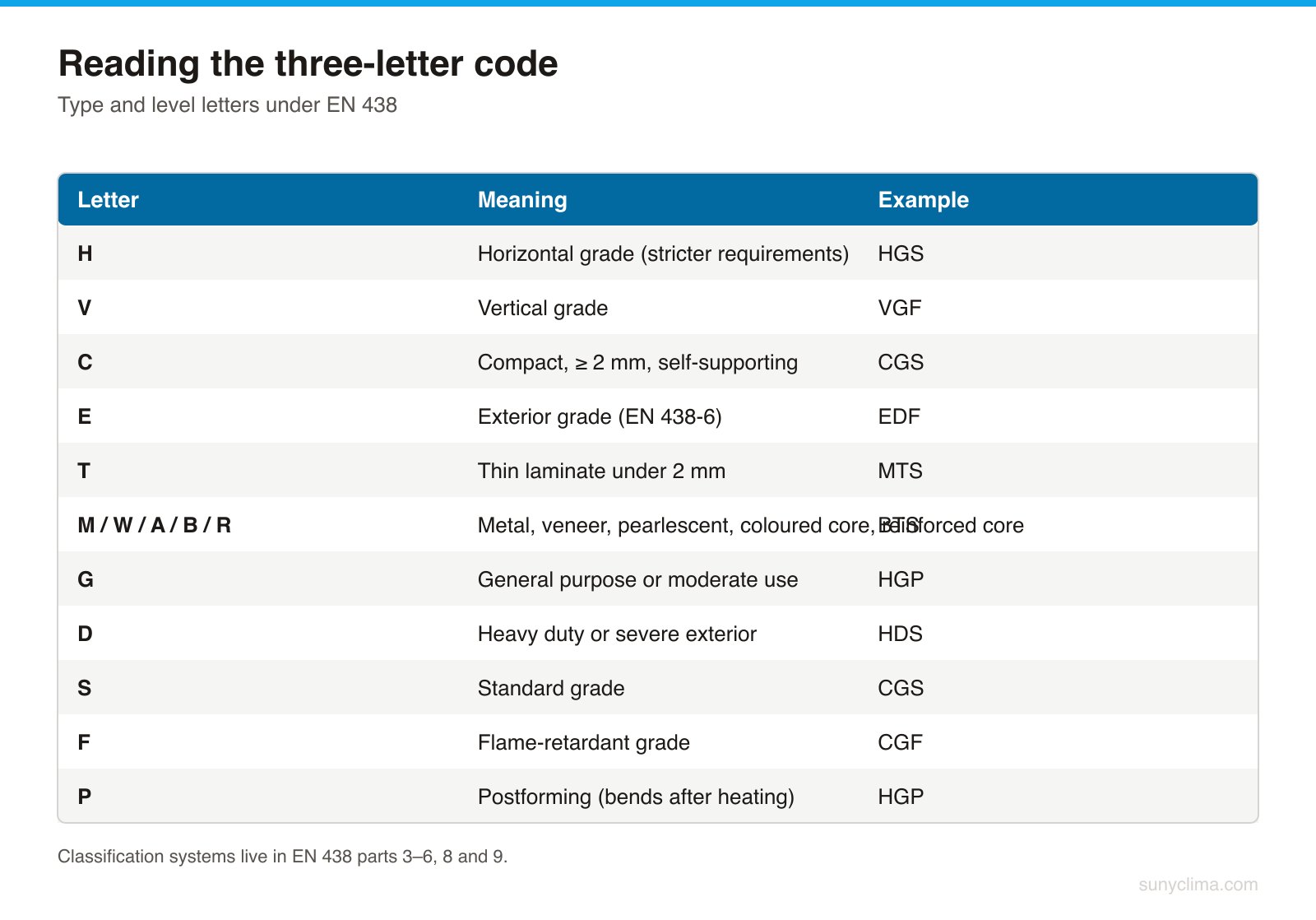
The leading letters give the type: H horizontal, V vertical, C compact, E exterior, T thin laminate under 2 mm, plus M (metal), W (veneer), A (pearlescent), B (coloured core), R (metal-reinforced core) and AC (flooring abrasion class). What follows sets the level: G general or moderate use, D heavy duty or severe conditions, S standard, F flame retardant, P postforming.
The pair most often misread is H and V. They describe not where the sheet may go but how hard it was tested — horizontal surfaces get rubbed, cut and left things on. Resistance to surface wear at the initial point is ≥ 50 revolutions for VGS/VGF/VGP, ≥ 150 for HGS/HGF/HGP and ≥ 350 for heavy-duty HDS/HDF/HDP. Scratch resistance climbs the same ladder: grade 1 for V, 2 for H, 3 for HD.
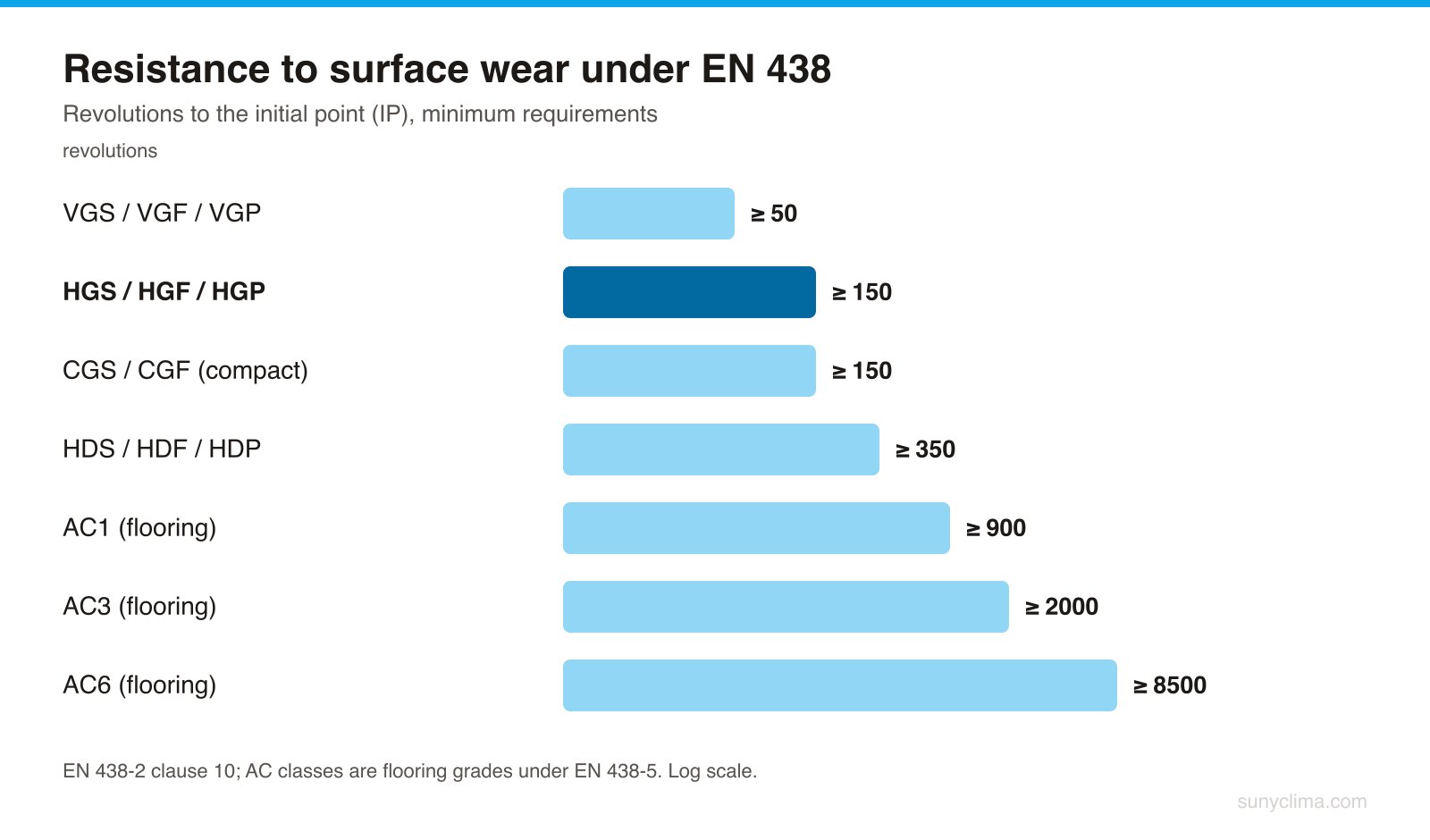
Flooring under EN 438-5 runs far higher: AC1 starts at ≥ 900 revolutions, AC6 at ≥ 8500. If somebody offers a wall-grade laminate for a floor, that is the missing number.
Compact, or laminate on a substrate
Not two quality levels — two constructions.
Bonding-grade laminate is a thin sheet, 0.5–1.9 mm, carrying nothing by itself. Glued to chipboard, MDF, plywood, metal or honeycomb, the composite does the work.
Compact is a thick sheet — 2 to about 30 mm — where the entire thickness is laminate: no substrate, no glue line, no edge banding. Industry guidance puts self-support at roughly 5–6 mm upwards (sources differ slightly), with sheets under 3 mm needing rigid support and sheets over 8 mm suited to large horizontal spans.
Sheets come large — fewer joints per square metre. Stock formats run around 3070 × 1240 and 3050 × 1320 mm, with sizes to 4320 × 1660 mm to order. The thickness tolerance grows with the thickness: ± 0.1 mm on thin laminates, ± 0.2 mm at 2–3 mm rising to ± 1.3 mm above 25 mm on compact. Flatness follows — 8 mm/m on 2–6 mm sheets against 3 mm/m above 10 mm. So a faint wave in raking light across a long compact door can be entirely within the standard rather than a defect.
Balancing: why a one-sided panel bows
The most repeated mistake in the trade, and it only shows up a week later.
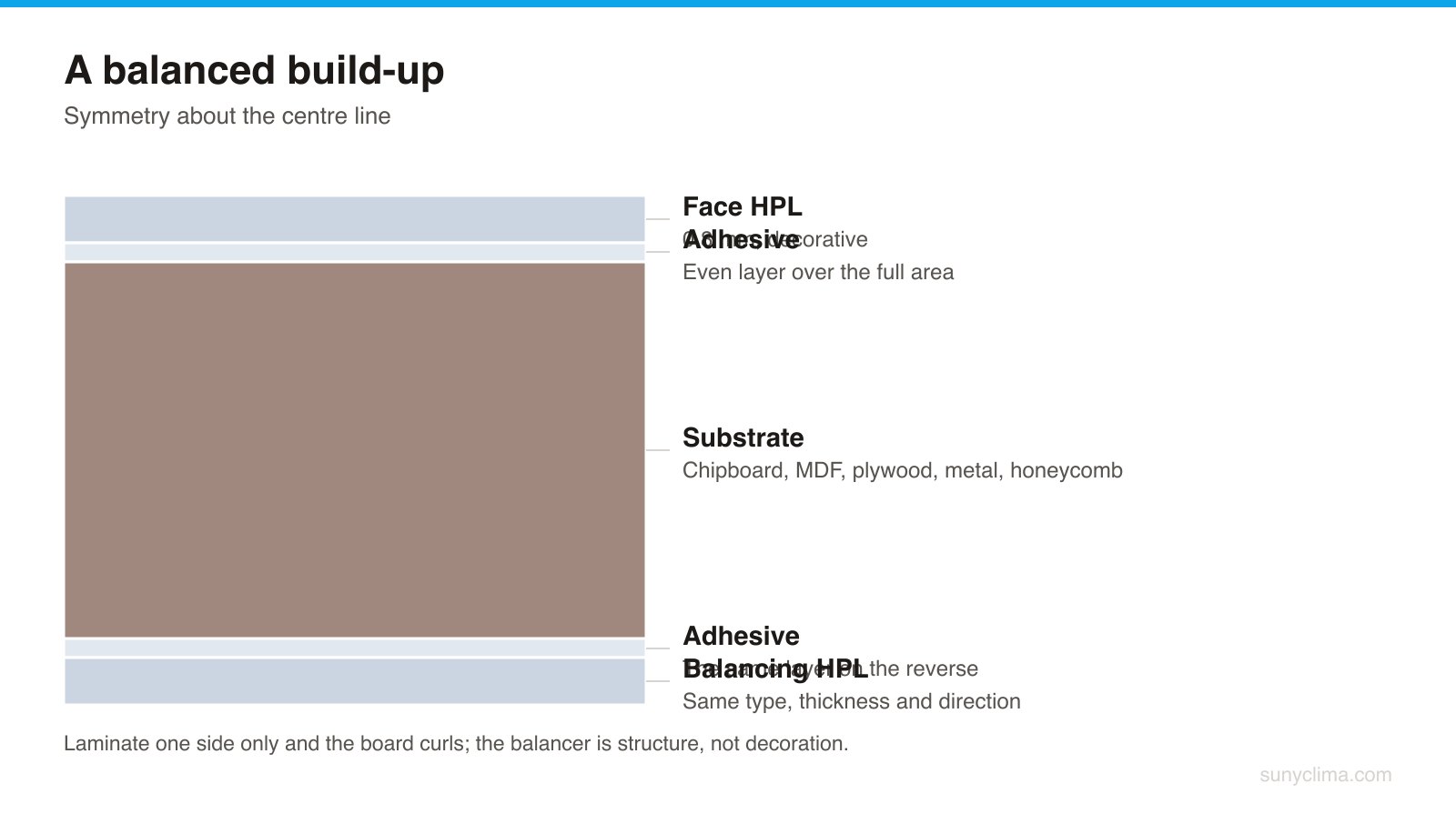
HPL acts as a diffusion barrier: once bonded, it stops the substrate taking up and releasing moisture through that face. Laminate the front only and the back keeps breathing, the faces move by different amounts, and the panel curls like a bimetallic strip. Hence symmetry — a balancing laminate of the same type, thickness and orientation on the reverse. Structure, not decoration.
The same holds with no glue involved. A compact sheet wants the same climate on both faces; on changing-room and cubicle doors, a humidity or temperature difference across the leaf is the classic cause of warping — which is why ventilation belongs in the specification. Compact is stored flat at 18–23 °C and 50–60 % RH, and the film comes off both sides at once. A sheet left leaning for weeks may never come back.
Postforming and cold bending
Postforming is a grade, marked P: HGP, VGP. The sheet is heated and wrapped around an edge so the surface continues without a joint — the rounded front edge of a worktop.
Recommended temperatures sit in a narrow band, 160–177 °C, with blistering above about 190 °C. Formability is tested under EN 438-2, clauses 31 and 32: the minimum radius on a 0.8 mm sheet is ≥ 8 mm, but only where the bending axis runs parallel to the sanding direction. Across it the rule doubles — ≥ 10 × thickness parallel, ≥ 20 × perpendicular, so 16 mm for the same sheet. Blister resistance is a separate test (clauses 33 and 34), and sources disagree: ≥ 15 s across the range for one maker, ≥ 10 s for postforming grades at another.
Cold bending is a different game, with radii an order of magnitude larger: about 10 cm for postforming grades, about 20 cm for standard and flame-retardant ones. A standard HGS taken to an HGP radius does not bend; it cracks.
How it behaves over time
A cured thermoset neither melts nor dissolves; the rest follows:
- Water and steam. Non-porous; EN 438-2 tests it against boiling water and vapour, and exterior grades are rated for wet conditions by mass increase.
- Heat. The dry-heat test runs at 160 °C (180 °C before 2016). The surface does not soften, nothing drips.
- Fire. Standard CGS compact reaches D-s2,d0 without further testing, but only at ≥ 1350 kg/m³ and ≥ 6 mm. Flame-retardant grades have no single class: B-s1,d0, B-s2,d0 and C-s2,d0 all appear in real declarations, because the result depends on thickness and substrate — thin FR compact drops to C. Read it off the certificate for the actual build-up, not off the F in the code. Gross calorific value is 18–20 MJ/kg to EN ISO 1716: HPL burns, but neither melts nor drips flame.
- Movement. Linear thermal expansion is 0.9 × 10⁻⁵ 1/K lengthwise and 1.6 × 10⁻⁵ 1/K crosswise, and dimensional stability at elevated temperature is anisotropic in the same way — a typical thin horizontal grade holds ≤ 0.55 % lengthwise against ≤ 1.05 % crosswise.
- Sunlight. Exterior grades to EN 438-6 face artificial weathering (EN 438-2, clause 29) — contrast ≥ 3 on the grey scale, appearance ≥ 4, a climatic-shock test and 80 % retention of flexural strength and modulus. EGS/EGF cover moderate conditions, EDS/EDF severe ones.
Indoors the industry puts expected service life at a minimum of 20 years with no loss of appearance. Outdoors, exposure can dull the surface without affecting fitness for use. HPL's numbers against the other panel materials sit in the technical reference.
In the workshop: feeds, angles and fixings
That a material over 1.35 g/cm³ eats tooling is covered in the HPL door panel article. More useful here are the numbers people work to.
- Sawing. Carbide or diamond tooling, slower feed than composite panels, 0.03–0.05 mm per tooth. On double-sided sheets, underside chipping is controlled by exit angle, a sacrificial board, or best a scoring saw.
- Edge routing. At least 2 mm and no more than 5 mm per pass. Chatter marks sand and polish out, and the edge takes silicone-free furniture oil. Free-standing corners are always slightly rounded.
- Drilling. Plastics drills, 60–80° point instead of 120° and 50–60° for through holes, easing the feed towards the exit. A blind hole leaves at least 1.5 mm behind it, a hole parallel to the face 3 mm.
- Fixings. Through holes 2–3 mm larger than the fastener, or elastic polyamide sleeves; one point fixed, the rest gliding. Pre-drilling is never optional.
- Assembly. Tongue and groove only from 10 mm up, groove width and wall at least 3 mm, depth 10 mm max; bond sheets in one grain direction only.
- Dust. Extraction is mandatory, and local overheating from bad tool guidance avoided.
One sentence for the customer: rounded cut-out corners and a polished edge are not styling. A sharp internal corner concentrates stress, and that is where the crack starts a year later.
Cleaning and repair
The everyday routine is boring, which is a good sign: water and a soft cloth, a non-abrasive detergent when needed, then rinse and dry. Abrasive pads do not corrode the surface but scuff the melamine — and a scuffed face is less chemically resistant and easier to stain. Prolonged contact with acidic toilet, oven and metal cleaners is the other thing to avoid; stain-by-stain methods live in the care section.
The limits of repair deserve plain speaking. A deep scratch cannot be filled back in — a thermoset does not soften back into place — and two-component adhesives and lacquers cannot be removed once cured. A compact edge can be re-routed and polished; the face cannot, which is why worktops are replaced by element rather than patched.
Where it is used — beyond doors
The breadth of application is what makes HPL credible — each use sets a test a door never sets:
- Kitchen and work surfaces — the postformed edge is why grade P exists.
- Laboratory benching — chemical resistance and the laboratory compact grades.
- Sanitary cubicles, lockers, changing rooms — compact with no glue line, taking constant humidity and pressure washing.
- Wall and ceiling finishes — to EN 438-7; in hospitals the joints are filled.
- Façades and balconies — exterior compact to EN 438-6, ventilated substructure.
- Flooring — EN 438-5, abrasion classes AC1 to AC6.
- Transport — rail EN 45545-2, ships IMO FTP Code, buses ECE R 118.
- Food environments — food-contact suitability rests on Regulations (EC) 1935/2004 and (EU) 10/2011, with EN 13130-1 the migration test some makers print. Surface and edges disinfect.
- Street furniture — bus shelters, playgrounds, information boards.
And doors and panels — the same rules over a smaller area. Entrance door panels are made to order in Bulgaria to the actual frame size, which is why the grade code is worth reading before ordering — see the materials overview and the catalogue.
How to read the data sheet
- Which part of EN 438 — 3 (thin), 4 (interior compact), 5 (flooring), 6 (exterior compact), 8, 9.
- The three-letter code — half the answer already — and whether the thickness quoted is the laminate or the finished composite.
- Surface wear (IP) in revolutions, and the scratch grade.
- Fire class to EN 13501-1 — it follows thickness and certificate, not the letter alone.
- Dimensional stability and expansion — lengthwise and crosswise apart.
- For exterior grades — weathering and climatic shock, and moderate (EGS/EGF) or severe (EDS/EDF).
Three misconceptions that cost the most
"HPL is HPL" — a wall-grade VGS and a façade-grade EDF sit in different parts of the standard. "We will bend it on site" — only a P grade, and only with heat. "Nobody sees the back" — everybody will, a week later, in the curve of the panel.
Choosing for one door rather than a project? Start from the panel selection guide, or made-to-measure orders.
In short: HPL is paper and thermosetting resin pressed at ≥ 120 °C and ≥ 5 MPa to a density above 1.35 g/cm³ — defined by its process, not its appearance. EN 438 covers it in nine parts, and the three-letter code tells you the rest: H/V/C/E for type, G/D for level, S/P/F for grade. Thin laminates are bonded down and balanced on the reverse; compact is self-supporting from roughly 5–6 mm up. Only P grades bend, and the sheet moves twice as much across as along.