Sunyclima
Болгарський виробник декоративних панелей для вхідних дверей та віконних рам
More than 60% of an HPL sheet is ordinary paper. Yet outdoors it outlives materials that sound far tougher. Here is exactly what happens in the press, and how to read the EN 438 numbers.
HPL is paper and resin. More than 60% of a sheet’s mass is cellulose paper — the same kraft paper used for heavy-duty sacks. The remaining 30–40% is cured resin: phenol-formaldehyde in the core, melamine-formaldehyde on the face. Nothing on that list sounds like something you would leave outdoors, facing south, through sun, rain and frost.
Yet that is exactly what HPL does, and better than plenty of materials that sound far tougher. The reason is not the ingredients but what happens to them under pressure.
What HPL actually is
The name stands for High Pressure Laminate. The material is defined by EN 438 (internationally, ISO 4586), which governs composition, grades and test methods. Under that definition HPL contains over 60% cellulose paper and 30–40% cured resins.
The sheet is a sandwich of papers, each impregnated with resin and dried beforehand:
- The core — anywhere from a few to a few dozen layers of kraft paper saturated with phenol-formaldehyde resin. The core supplies the thickness, the strength and the characteristic dark edge.
- The decor paper — a thin printed layer carrying the colour or wood grain, impregnated with melamine-formaldehyde resin.
- The overlay — a clear paper on top that optically disappears during pressing, leaving only the cured melamine resin as a wear surface.
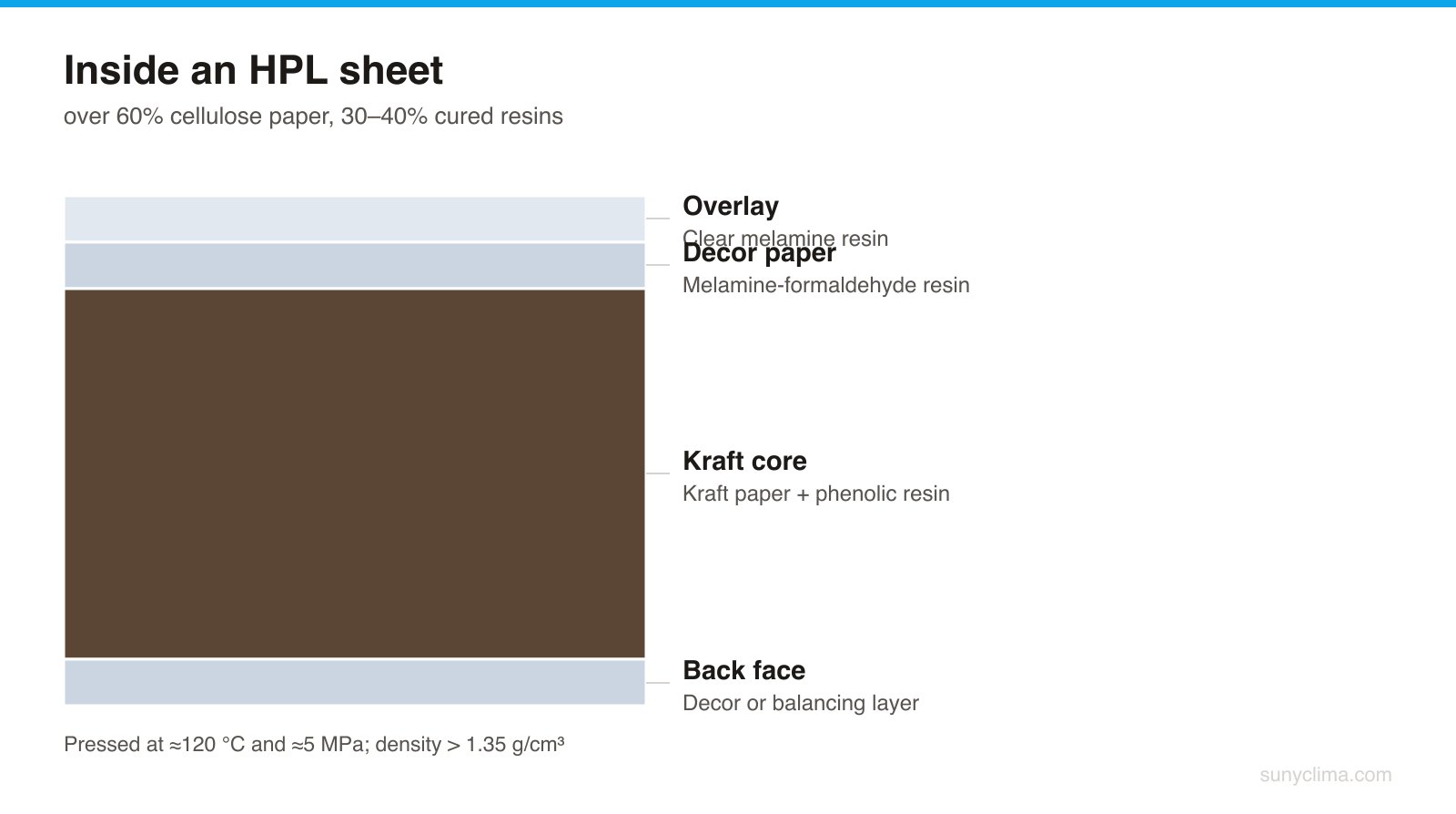
So far this is a tidy stack of paper. The material is born in the press.
The press: where paper stops being paper
The stack goes between heated platens at roughly 120 °C under a specific pressure of about 5 MPa. Five megapascals is around 50 bar — close to 50 kilograms bearing on every square centimetre of the sheet, applied across the whole area at once. That is the “high pressure” in the name — and what separates HPL from low-pressure laminates, where a decor film is merely bonded onto a board.
Two things happen under that combination. First, the resins melt and fill every void between the cellulose fibres — air is driven out and the paper densifies. Second, and more importantly, the resins polymerise. Phenol-formaldehyde and melamine-formaldehyde are thermosetting, not thermoplastic. Their chains cross-link into a single three-dimensional network, and the reaction is irreversible. You cannot melt the finished sheet back down the way you could melt a piece of PVC — there is no state for it to return to.
The result has three properties that explain everything else:
- Density above 1.35 g/cm³. The finished laminate is more than a third heavier than water — a densified monolithic mass, not a stack of glued sheets.
- It is non-porous. No open pores or capillaries survive in the sheet. Water has nowhere to get in, which means it has nowhere to freeze, expand and delaminate the material from the inside. That mechanism — water in the pores, then ice — is what kills most organic materials outdoors.
- Thermal stability. HPL does not melt. Given enough heat it decomposes instead: thermal decomposition starts above 250 °C and ignition occurs at around 400 °C. Summer sun on a dark door is nowhere near those figures.
That is the answer to the question in the title. The paper survives outdoors because it is no longer paper. It is a reinforcing filler inside a thermoset matrix that does not dissolve in water, does not soften in the sun, and does not remember it was ever a roll.
How to read the EN 438 grade letters
In specifications and quotations you will meet codes like HGS, CGS, HGP, HGF and CGF. Every letter says something:
| Letter | Position | Meaning |
|---|---|---|
| H | first | An HPL sheet that must be bonded to a supporting substrate |
| C | first | Compact — self-supporting, laminate through its full thickness |
| G | second | General purpose |
| S | third | Standard grade |
| P | third | Postformable — can be bent after heating |
| F | third | Flame retardant |
The first letter matters most for doors. H means a thin sheet that carries nothing by itself and has to be bonded to a substrate. C means compact: the entire thickness is pressed laminate, so the sheet is a structural element in its own right and cannot peel off its backing, because it has no backing. A compact edge is the same material as the face — which is why compact is routed, drilled and left exposed.
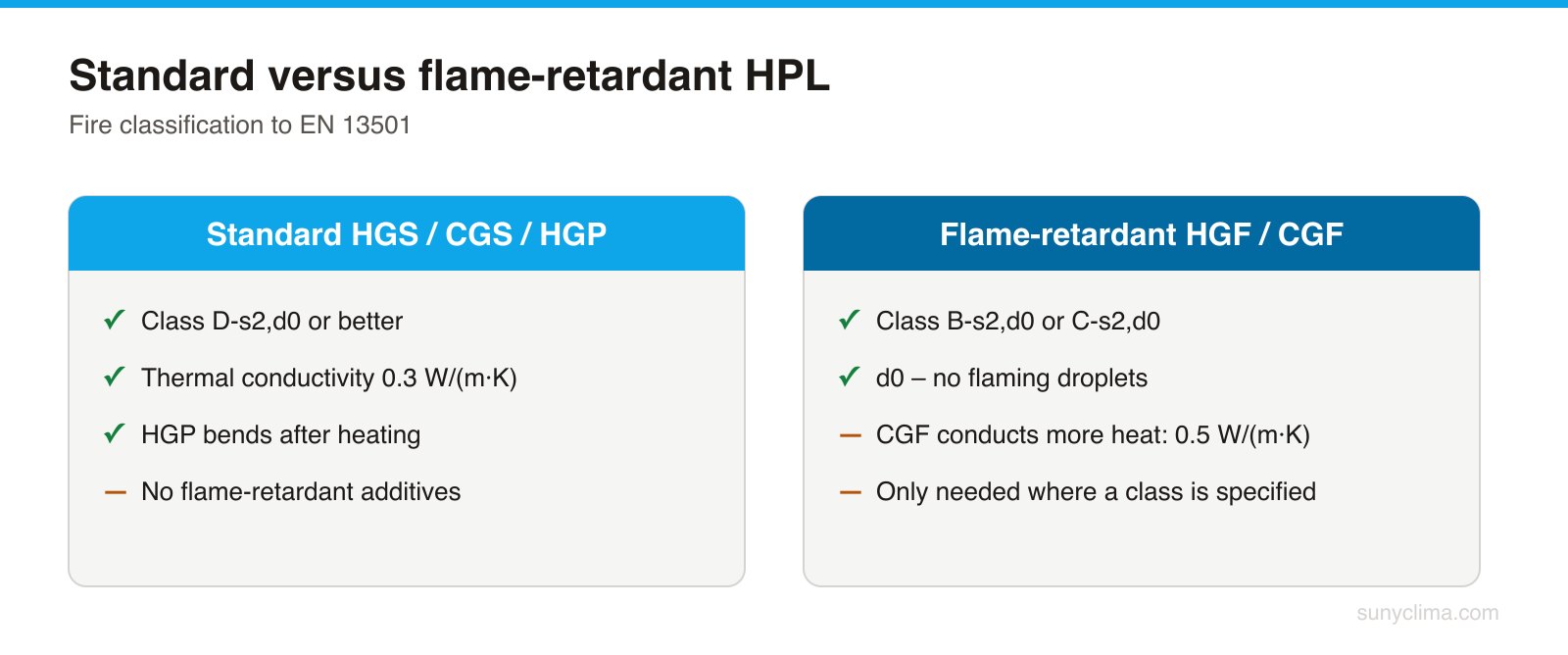
The second practical difference is the fire classification under EN 13501. Standard HGS, CGS and HGP reach D-s2,d0 or better. Flame-retardant HGF and CGF reach B-s2,d0 or C-s2,d0. The leading letter is the contribution to fire (B beats C, C beats D), s2 describes moderate smoke production, and d0 means zero flaming droplets. That last part is not a detail: on a door into a stairwell, burning drips are a serious problem, and d0 rules them out.
Exterior HPL: the part of the standard that counts
Not every HPL is made for outdoor use. EN 438-6 is the part devoted to exterior-grade compact laminate, and it sets two clear conditions.
The first is a thickness of 2 mm and above — thinner sheets fall outside its scope entirely. The second is a split into two levels: moderate and severe outdoor conditions. The difference is real and shows up after years, not months. A north elevation under a deep overhang is moderate; an unshaded south or west facade, mountain sun, or a salty coastline is severe, and there the correct level is not a luxury.
For a door panel this is the first question worth asking, well before colour. The overview of panel materials and the general guide to choosing a panel cover the rest.
The numbers, and what they mean for your door
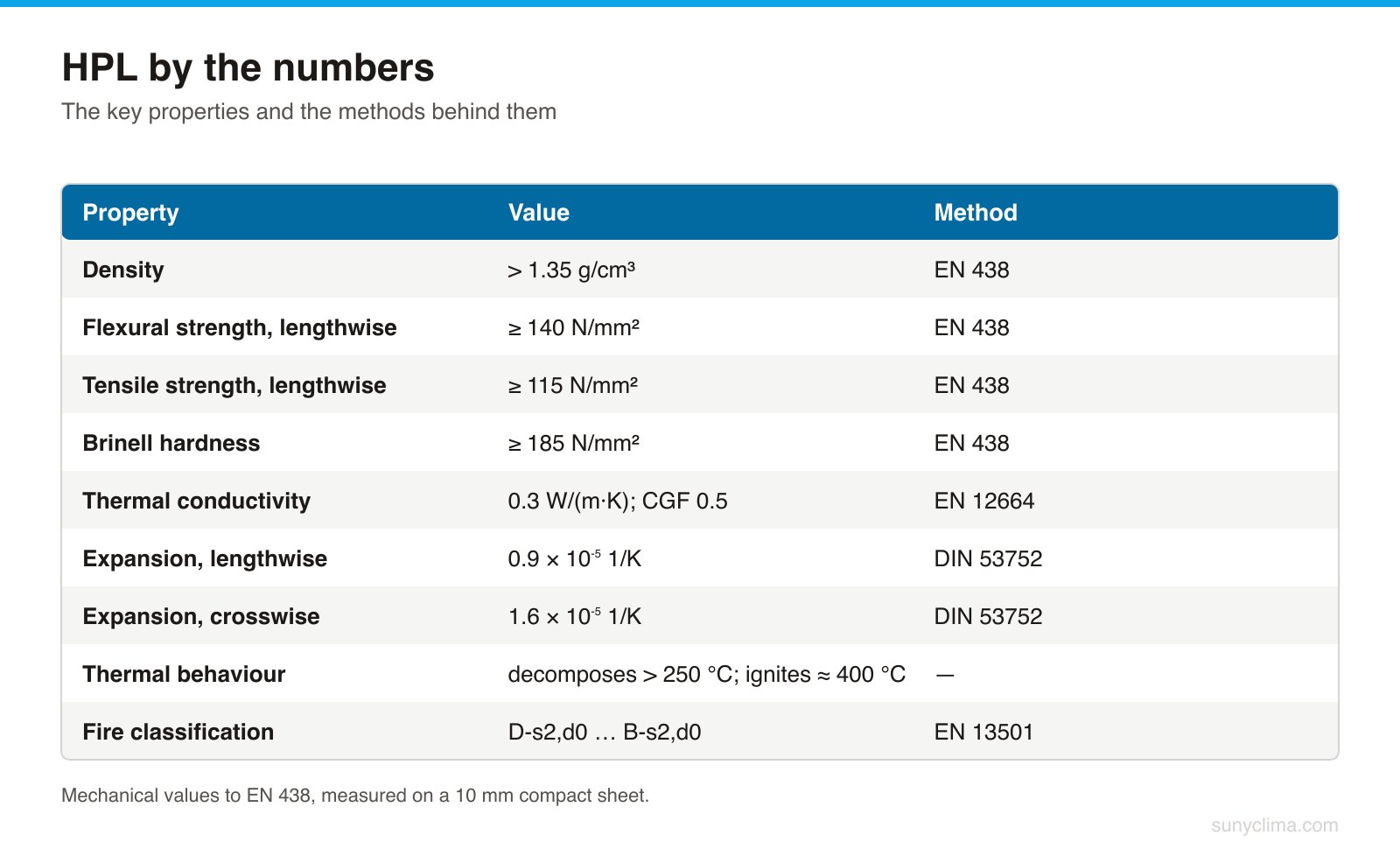
EN 438 measures mechanical values on a 10 mm compact sheet so they are comparable. Three of them describe how a panel behaves:
- Flexural strength, lengthwise: ≥ 140 N/mm². Resistance to bending — how much load the sheet takes before it breaks. On a door panel this is what lets it act as a plate rather than a membrane in a gust of wind or when the door is slammed.
- Tensile strength, lengthwise: ≥ 115 N/mm². Resistance to being pulled apart. Its practical value shows around openings: near a handle, a lock or a fixing, the material is loaded precisely in tension.
- Brinell hardness: ≥ 185 N/mm². Resistance to indentation. This is the number behind everyday scratch resistance — keys, bags, pushchair wheels and everything else that comes through a front door.
Add to those a thermal conductivity of 0.3 W/(m·K) to EN 12664; for flame-retardant CGF compact the figure is 0.5 W/(m·K). Read it the right way: this is a structural material, not an insulating one. HPL supplies the face, the strength and the durability; a panel’s insulation comes from the core between its two faces, which is a separate subject — see the comparison of XPS versus a timber core. If you want every material’s figures side by side, they are collected in the technical reference.
Expansion: the one number you have to work out
HPL has a grain direction. The paper layers are wound and laid in one direction, so the sheet expands differently along and across it. To DIN 53752 the coefficient of linear thermal expansion is 0.9 × 10⁻⁵ 1/K lengthwise and 1.6 × 10⁻⁵ 1/K crosswise — nearly double across the grain.
The figures look negligible until you multiply them. A dark panel on a south elevation comfortably swings 50 K between a winter night and a summer afternoon. On a 2000 mm sheet that gives 2000 × 1.6 × 10⁻⁵ × 50 ≈ 1.6 mm across the grain, and about 0.9 mm along it. A panel clamped with no clearance has nowhere to put that movement — so it turns it into bowing, or into a crack radiating from a fixing.
The working rules follow directly. Drill fixing holes oversize by at least the movement you calculated plus a margin; tighten fixings so they hold but still allow the sheet to slide; fix one point and let the others float; and keep clearance around the perimeter where the panel meets the rebate. Fitters who use compact regularly know these rules from worktops and facades; they transfer one for one. And for a homeowner: when a dark panel on a south elevation bows, the cause is almost never the material but a fixing that left it nowhere to move.
Sun, rain and dirt
The non-porosity that made the sheet frost-proof also earns its keep daily. Dirt has nothing to key into: it sits on the surface rather than in it. That is why HPL resists most household chemicals and cleans with water, a mild detergent and a cloth.
There is a limit, though: strong acids and alkalis damage the surface. Drain unblocker, strong caustic cleaners, aggressive degreasers — these leave a dull patch that does not come back. The same goes for abrasive pads and powders: they scuff the melamine face until it loses its sheen in blotches. Full instructions live in the care section.
Working the material: cutting, routing, drilling
Density above 1.35 g/cm³ and hardness above 185 N/mm² have a flip side — the material eats tooling. Compact HPL is cut and routed with carbide or diamond; high-speed steel blunts fast. Support the sheet along the whole cut line so the underside does not break out, and radius the internal corners of any cut-out instead of leaving them square. A sharp internal corner is a stress concentrator, and that is where a crack starts once the sheet begins to move. The practical consequence for a buyer: cut-outs for a handle, a spyhole or a letterplate belong in the workshop on a prepared sheet, not on site with an angle grinder.
Against metal panel faces the difference is obvious on the bench; that comparison is in the article on aluminium composite and stainless steel.
When HPL is the right choice
HPL wins when you want a face that takes physical contact and asks for nothing in return: scratch resistant, non-porous, stable in sunlight, with an exposed edge that has no layer to peel — and a wood grain without the maintenance of wood.
It is not a universal answer. If a metal look is the priority, or a specified fire class forces a flame-retardant grade, compare the options in the catalogue. Panels are made to order in Bulgaria to the frame’s own dimensions, so the choice of material is a real choice rather than a choice between what is in stock.
In short: HPL is over 60% paper and 30–40% thermosetting resin, pressed at ≈120 °C and ≈5 MPa to a density above 1.35 g/cm³. The pressing is irreversible and the result is non-porous — that is where outdoor durability comes from. For exterior use look for compact to EN 438-6, 2 mm thick or more, at the right level for moderate or severe conditions. Work out the expansion (1.6 × 10⁻⁵ 1/K across the grain) and let the panel move. Avoid strong acids, alkalis and abrasives — everything else washes off with water.