Sunyclima
Болгарський виробник декоративних панелей для вхідних дверей та віконних рам
Bond looks like solid metal but is a 0.5 / 3 / 0.5 mm sandwich — which is exactly why it folds along a routed V-groove. And with stainless, 304 versus 316 is decided by environment, not budget: PREN ≈18–19 against ≈25.
When a customer says “I want metal on the door”, that sentence hides two very different materials: bond — an aluminium composite panel, ACP, also sold as Dibond — and stainless steel. From across the street they look related: a smooth, cool, industrial face with no grain. Up close they are different things, cut on different machines, ageing in different ways, chosen for different reasons.
Bond is a sandwich, and that is precisely what makes it useful rather than a cheap stand-in. With stainless, the choice is not about budget at all — it is about environment, and specifically about how much salt the door sees in a year. This article covers both, with the numbers a fitter can actually use in front of a customer.
Bond is a sandwich, not solid aluminium
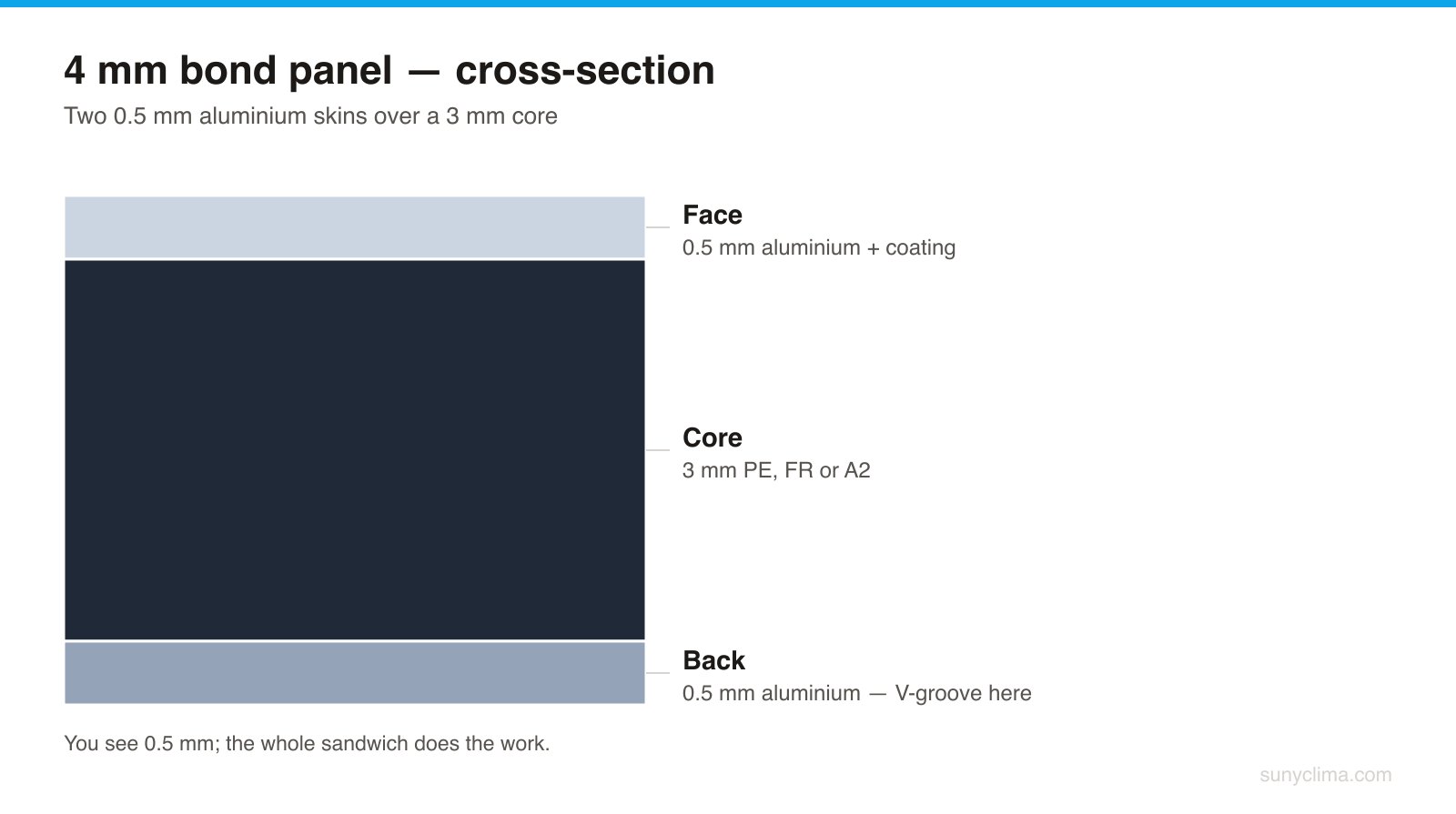
A standard aluminium composite panel is two 0.5 mm aluminium sheets bonded to a 3 mm core — 4 mm in total. You only ever see the outer 0.5 mm. The remaining 3.5 mm sit behind it.
Most customers hear that and think “so it isn’t real metal”. The opposite is true: the face is genuine aluminium with a genuine coated finish — nothing is imitated. The sandwich underneath is an engineering decision, not a saving. The two thin skins take the tension and compression; the core simply holds them apart — the same principle that makes an I-beam stiffer than a solid bar of the same weight. What you get is a panel that stays flat, stays light, and does not ripple in strong sun.
A solid 4 mm aluminium sheet of the same size would be considerably heavier — weight that ultimately hangs on the door hinges — and more expensive, without being any flatter. Bond is not a compromise against solid metal; it is the better way to put a metal face on a large flat surface.
There is a thermal side to this too. Aluminium conducts heat at roughly 170–200 W/(m·K) — about 5,000 times more than XPS. So the bond face is never the panel’s insulation; the insulation is the core behind it. When you compare U-values, compare the whole build-up rather than the facing material — the reasoning is set out in full in the technical parameters of panel materials.
Three cores, three fire behaviours
The core is where a bond panel’s fire behaviour is decided. Three types are common:
- PE — plain polyethylene. Lightest and easiest to work, but highly combustible.
- FR — flame retardants added to the core; the middle option.
- A2 — a mineral core with over 90% mineral filler. Its EN 13501-1 classification is A2-s1,d0: effectively non-combustible, with very little smoke and no flaming droplets.
On a single entrance door the area is small and the difference rarely becomes an argument. But the moment the panel goes into an apartment block entrance, a public building or an escape route, the designer may specify a class — and then the core has to be written into the order rather than assumed. Ask about it before you quote, not after.
Routing and folding: the whole tolerance is 0.3 mm
Bond’s most useful property is that it folds along a straight line without breaking. That is how cassette faces and wrapped edges are made — the ones with no visible trim anywhere on the perimeter.
The method: a V-groove is routed from the back, through the rear skin and almost all the way through the core. Behind the face skin, roughly 0.3 mm of core is deliberately left in place. The panel folds along that groove and the face stays continuous — it simply bends through a small radius.
Those 0.3 mm are the entire job. Cut the groove too deep and the tool touches the face aluminium: the edge cracks, or a hairline shows through, and neither can be repaired. Cut it too shallow and the panel will not fold cleanly — the edge comes out with a wide radius and wrinkles. This is why the groove is cut on CNC and not by hand: a machine in good order holds groove depth to ±0.002 in (≈0.05 mm) — roughly six times finer than the 0.3 mm that has to survive behind the face.
The practical consequence on site: bond arrives with its edges already formed, so nothing has to be trimmed or capped during fitting. For the installer that is fewer operations on the job; for the customer it is a face with no profiles around the edge. If you are weighing a finished unit against a panel you fit into the sash yourself, the difference is explained in panel or ready-made decorative door.
Where stainless actually appears in a panel
Stainless is rarely the whole panel. It usually turns up in four roles: inlays and bands that divide the fields; frames around the glass; perforated or laser-cut fields with another material behind them; and full solid faces when the customer wants the whole door in metal.
Because stainless is normally the accent rather than the background, it is also the first place corrosion shows. One rust spot on a 40 mm band ruins the whole door. From there, only one question remains: 304 or 316.
304 versus 316: the difference is called molybdenum
The two grades look identical and polish identically. The difference is chemistry:
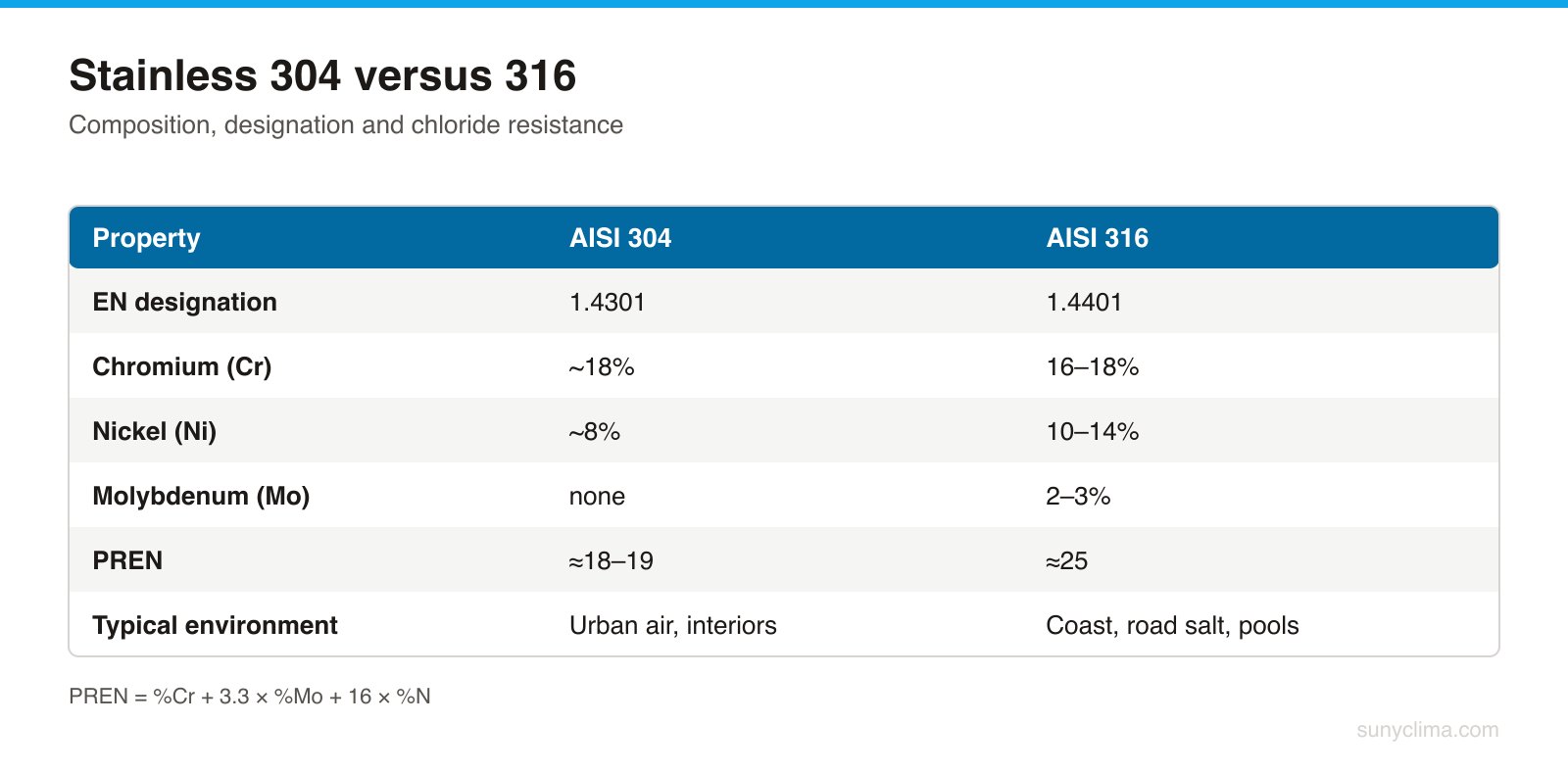
- 304 (European designation EN 1.4301): about 18% chromium, about 8% nickel, no molybdenum.
- 316 (European designation EN 1.4401): 16–18% chromium, 10–14% nickel and 2–3% molybdenum.
Chromium is what makes the steel stainless: it forms a thin passive oxide film that heals itself when scratched. Molybdenum does not replace that film — it makes the film hold up against chlorides. And chlorides are the one thing that breaks the passive layer in small local spots rather than evenly across the surface.
Beyond pitting, molybdenum also helps in the two situations installers dislike most: crevice corrosion — under a gasket, behind a washer, in an unwashed joint where moisture sits and never rinses away — and stress corrosion cracking in folded or heavily tightened parts.
The EN designations matter in practice because they are what appears on the material certificate and the invoice. If the paperwork says 1.4301, you bought 304, whatever was said on the phone.
PREN: the number to use with the customer
When you need to explain why 316 is not an unnecessary expense, the shortest route is PREN — the Pitting Resistance Equivalent Number. The formula is simple:
PREN = %Cr + 3.3 × %Mo + 16 × %N
Put the compositions in and you get ≈18–19 for 1.4301 (304) and ≈25 for 1.4401 (316) — roughly a third higher, with almost the same amount of chromium. The whole gap comes from that factor of 3.3 in front of the molybdenum. The formula and the way it is calculated are published by the British Stainless Steel Association.
PREN is not a guarantee and not a service life. It is a comparison scale, which is exactly why it works in conversation: “your door is 300 metres from the beach; in that air, the difference between 18 and 25 shows up within a few seasons” is an argument a customer grasps immediately. The decision is about environment, not about a budget tier.
The short rule. 304 (1.4301) is enough inland — urban and suburban air, interiors, doors under a covered entrance. 316 (1.4401) is the choice wherever chlorides are in the air or on the ground: the Black Sea coast and its salt mist, streets and car parks that get salted through winter, entrances beside a pool or spa, industrial air. If a door falls into two of those categories, the question has already answered itself.
There is a third scenario that gets missed: mixed parts. A 316 face with 304 fixings — or the other way round — drops the whole assembly to the weaker element, and it does so exactly in the crevices where corrosion starts. If you specify 316, specify it for the entire assembly.
Cutting stainless: laser or waterjet
How the stainless was cut matters at the edge — and the edge is the first thing to corrode. A laser cuts with heat: on a 10 mm 316L sheet the cut leaves a heat-affected zone of 0.3 to 1 mm. A waterjet cuts cold — abrasive and water, no heat-affected zone.
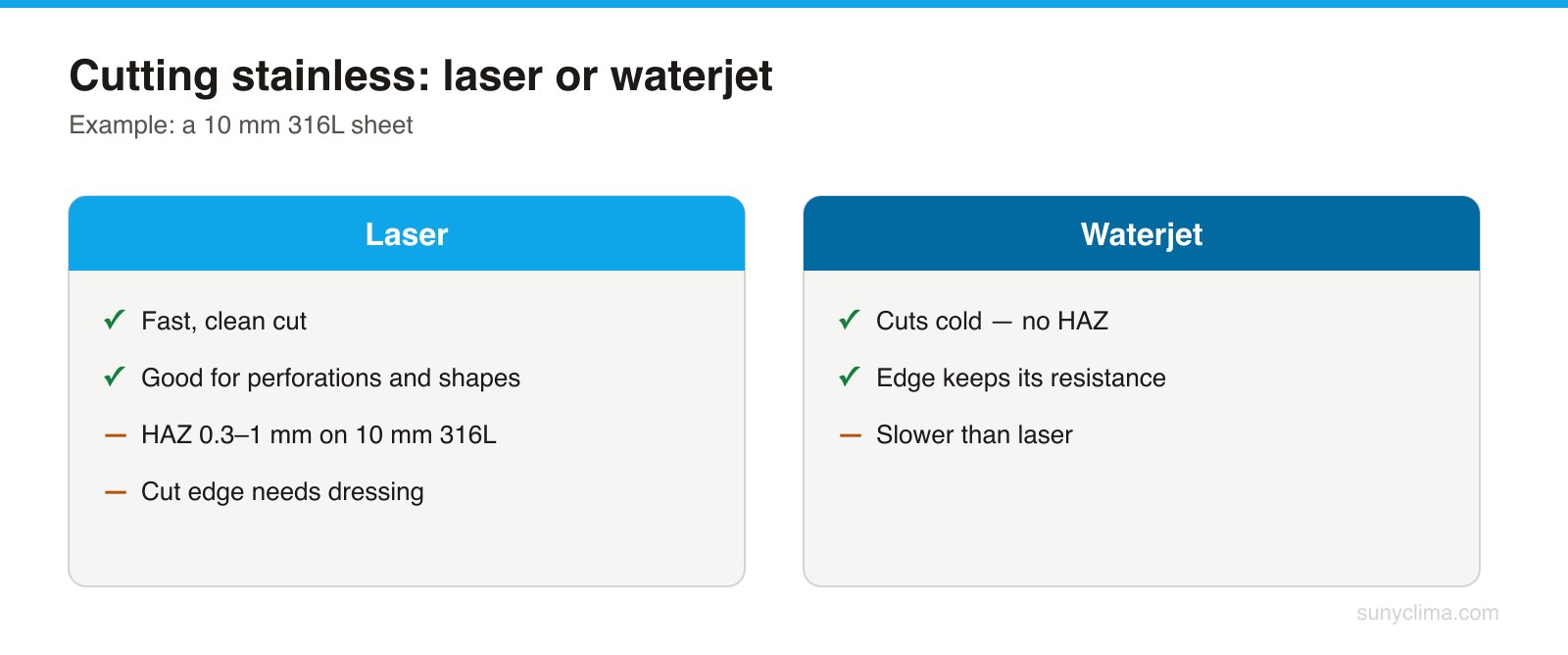
For the thin bands and perforations in a decorative panel, laser is a perfectly normal choice, particularly for a door in an urban setting. But once you are specifying 316 near the sea, the edge deserves attention: either waterjet, or dressing and cleaning the cut after lasering. That is the difference between a panel that still looks right after five seasons and one with a dark line tracing every perforation.
Choosing in practice
- Settle the environment before the material. Distance to the sea, winter road salting, proximity to a pool or industrial area. That decides 304 versus 316.
- For bond, put the core in the order. PE, FR or A2 — written down, not assumed, especially for public buildings.
- Check that edges are folded, not capped. A routed V-groove and a fold give a face with no visible trim.
- Never mix grades in one assembly. Fixings and inlays should match the face grade or exceed it.
- Think about maintenance while choosing. Salt washes off with plain water — but only if somebody does it; see panel care.
If you are after something between the two — the metal look without the metal — have a look at what an HPL panel is and why it lasts, and at the general guide to decorative panels for entrance doors. The full overview of facing materials is under materials.
Every panel is made to order by a Bulgarian manufacturer and built to the specific opening — size, core, stainless grade and the position of the inlays are all set in the order rather than picked off a shelf. Browse the catalogue for standard models, or custom orders if the bond-and-stainless combination has to be a one-off.