Sunyclima
Βούλγαρος κατασκευαστής διακοσμητικών πάνελ για πόρτες εισόδου και κουφώματα
A polyol, an isocyanate and a gas locked inside the cells. Why PUR/PIR has the lowest thermal conductivity of the three, why that conductivity ages, and what “declared λ to EN 13165” really means.
Polyurethane is the material almost everyone has touched without knowing its name: the rigid yellowish foam in a fridge wall, the core of a sandwich panel on an industrial shed, the foil-faced board on a flat roof, the foam from the gun can used to fit a window. Same chemistry throughout, differing only in density and recipe.
In construction you meet it as PUR and PIR. The difference is a single number in the formulation, and it changes a surprising amount: upper service temperature, fire behaviour, the class declared under EN 13501-1. And between the three foams there is one distinction rarely explained honestly to a customer — polyurethane has the lowest thermal conductivity, but that conductivity changes over time, while EPS essentially does not.
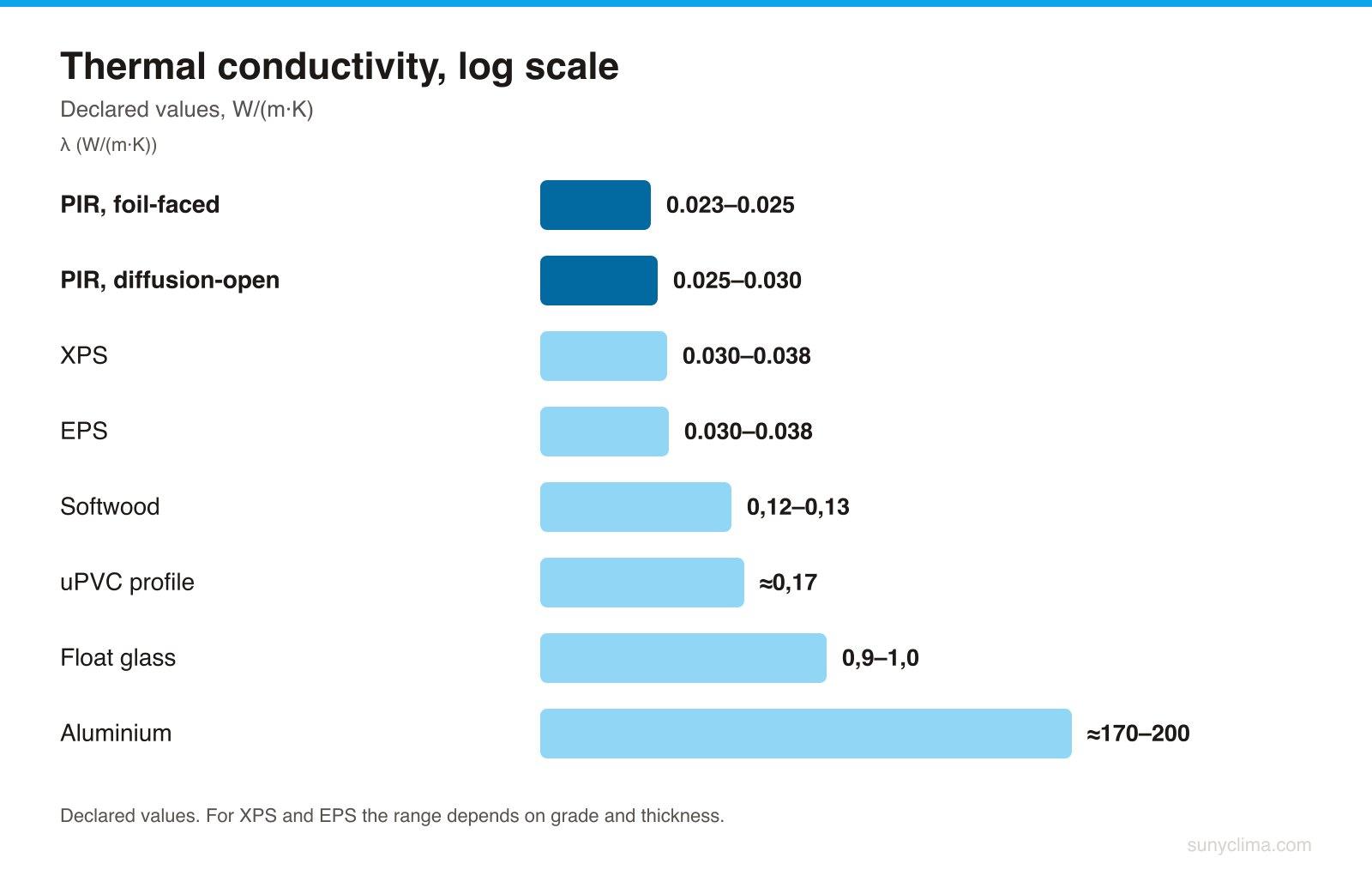
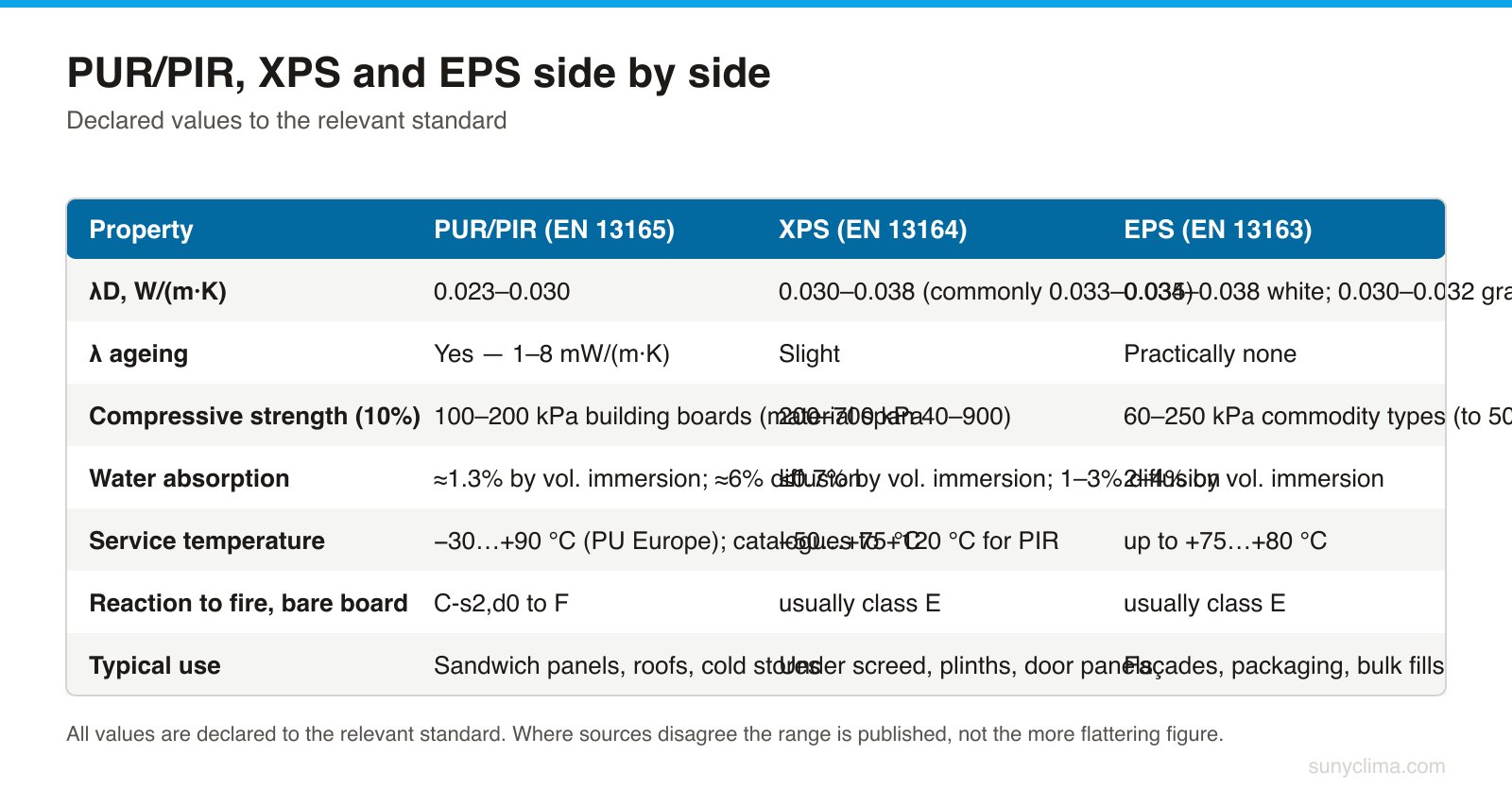
Three sentences worth keeping: PUR/PIR has the lowest λ of the three — declared 0.023–0.030 W/(m·K) against 0.030–0.038 for XPS (commonly 0.033–0.035) and 0.030–0.038 for EPS. That λ ages as the cell gas is replaced by air, which is why EN 13165 requires an aged value rather than the value of a fresh board. And the facing is not packaging: aluminium foil holds the gas in and lowers declared λ by several milliwatts.
What polyurethane is: the chemistry in plain language
Polyurethane does not arrive as a finished plastic. It is made on the spot — in the mould, inside the wall of a panel, or straight into the cavity of a door — from two liquid components:
- Polyol — a liquid carrying many hydroxyl (–OH) groups. It provides the backbone of the future plastic, and the catalysts, flame retardants and blowing agent are blended into it.
- Isocyanate — usually polymeric MDI, a liquid carrying reactive –N=C=O groups.
The moment the two liquids meet, –OH and –N=C=O join into a urethane linkage. The reaction is exothermic — it generates its own heat and is accelerated by it, hence the sensation every fitter knows: the can warms in your hand while the foam rises. That heat is what blows the foam, by two mechanisms:
- Chemical. Isocyanate also reacts with water, producing an amine and carbon dioxide; the amine then reacts with more isocyanate to form a urea linkage. In rigid systems this water reaction fires first.
- Physical. A low-boiling blowing agent is pre-dissolved in the polyol — pentane, cyclopentane, HFOs in newer systems. The heat of reaction vaporises it and it inflates millions of cells.
The mix froths within seconds, gels and cures irreversibly into a thermoset: it will not melt again, and at high enough temperature it chars. Most importantly, the blowing agent stays locked inside the closed cells — PU Europe puts the closed-cell content above 90%, with individual data sheets often claiming 95% and more. It is that gas, not the plastic, which explains the record-low conductivity, and also why it later degrades.
PUR and PIR: one number in the recipe
The number is the isocyanate index: how much polyisocyanate the formulation contains relative to the amount theoretically required to react with all the active hydrogen present, times 100. An index of 100 means "exactly enough".
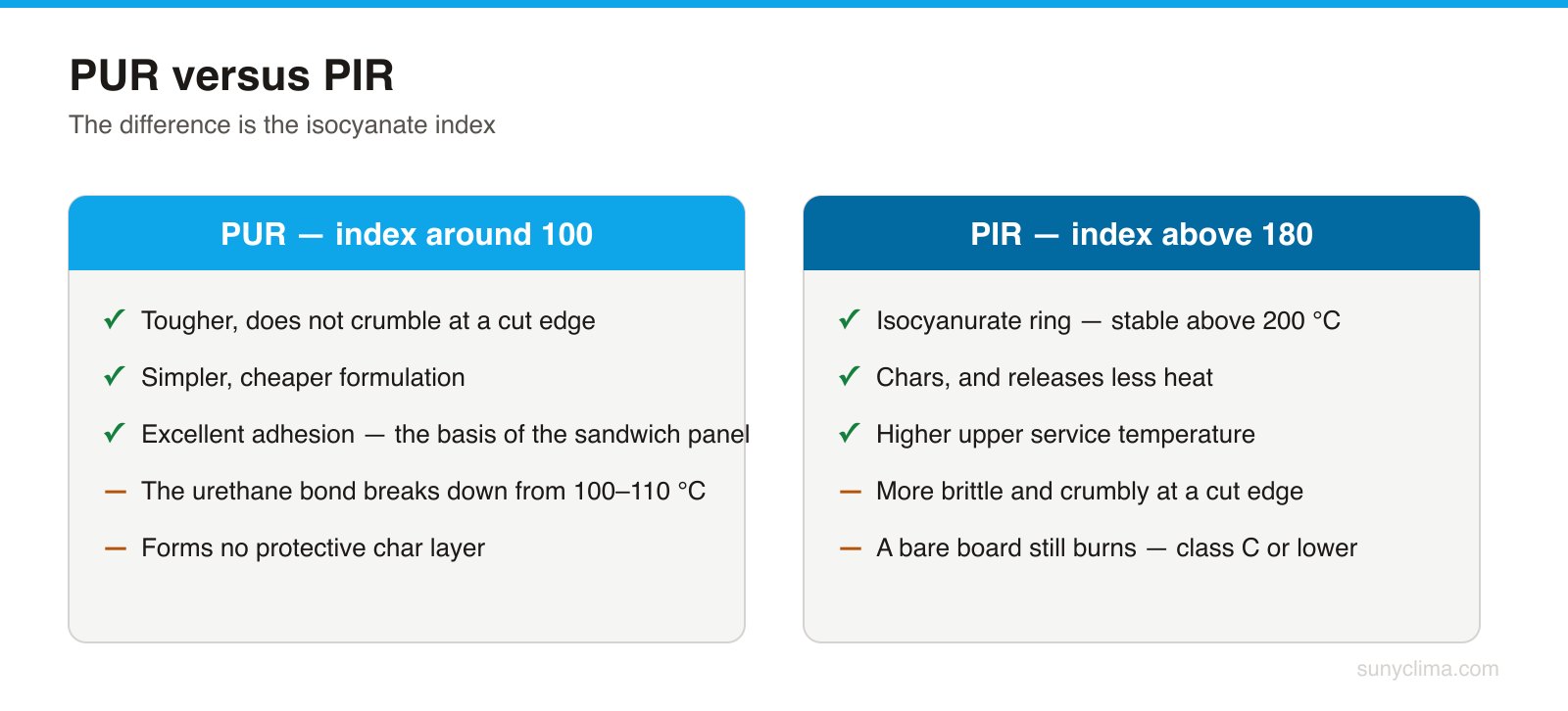
- PUR — polyurethane in the narrow sense. The index is around 100: almost all the isocyanate ends up in urethane linkages.
- PIR — polyisocyanurate. The index is above 180 — the threshold the literature most often cites, though there is no precise point at which PUR ends and PIR begins. The surplus isocyanate has nothing else to react with, so with a trimerisation catalyst it reacts with itself: three isocyanate groups close into a six-membered isocyanurate ring.
That ring is far more thermally stable than an ordinary urethane bond, and it buys three things: a higher service temperature; better fire behaviour, because PIR releases less heat and forms a protective char layer that slows the flame from working inwards; and, in consequence, better behaviour in the finished assembly. The numbers behind it: the isocyanurate bond begins to break down above 200 °C, the urethane bond already at 100–110 °C.
The price is small but real: PIR is more brittle at a cut edge and fussier to produce, which is why much of what is sold is a PUR/PIR hybrid — index high enough for isocyanurate rings, not so high that the board crumbles. The product standard covers both: EN 13165, "factory made rigid polyurethane foam products".
The forms it takes
One chemical family, five very different products:
- Rigid faced boards. Laminated continuously between two rolls of facing — aluminium foil, mineral fleece, kraft paper, bitumen-coated tissue. Density typically 30–45 kg/m³.
- Sandwich panel cores. Foam poured between two steel sheets is insulation and adhesive at once — the panel works structurally because the core holds the faces together.
- In-situ spray foam. On catalogue data the closed-cell version runs 30–60 kg/m³ with λ down to 0.020–0.022 W/(m·K); the open-cell version only 8–15 kg/m³ at λ 0.035–0.042 — cheaper and breathable, but no moisture barrier.
- Injected foam. Shot into a closed cavity: doors, roller-shutter boxes, water heaters, refrigeration cabinets. In appliances manufacturers quote 30–40 kg/m³ and an initial λ of 0.018–0.020 W/(m·K) — which is what lets a fridge have thin walls and a large interior.
- One-component gun foam. An isocyanate prepolymer curing with moisture from the air, hence the advice to wet the joint. It is not an insulation product to EN 13165: fire class E (B3 or B2 under DIN 4102-1), and its λ is not comparable with a board's.
Why λ is the lowest — and why it ages
Heat crosses a foam by three routes: through the solid plastic, by radiation between cell walls, and through the gas inside the cells. Polyurethane wins on all three — low density, very fine cells, and a cell gas that conducts heat less readily than air. A fresh PIR board therefore measures around 0.020–0.024 W/(m·K), which neither XPS nor EPS reaches.
The catch is that gases move — the foam is not hermetic, just a very slow membrane:
- Carbon dioxide leaves quickly — in measurements by Schumacher and colleagues the CO₂ from the blowing reaction is effectively depleted after about 150 days.
- Air comes in. Huntsman measured an air partial pressure inside the cells of a fresh board of only 0.02–0.05 bar, climbing towards atmospheric over the years — and air conducts heat considerably better than the blowing agent it displaces.
- The blowing agent leaves slowly. In the same work cyclopentane was still detectable after 1,400 days; it does not disappear, it gets diluted.
The result is a gradual rise in λ over the first years that then levels off. This is lambda ageing, and unlike much of what circulates in the trade it is real, measurable and standardised.
What "declared λ to EN 13165" actually means
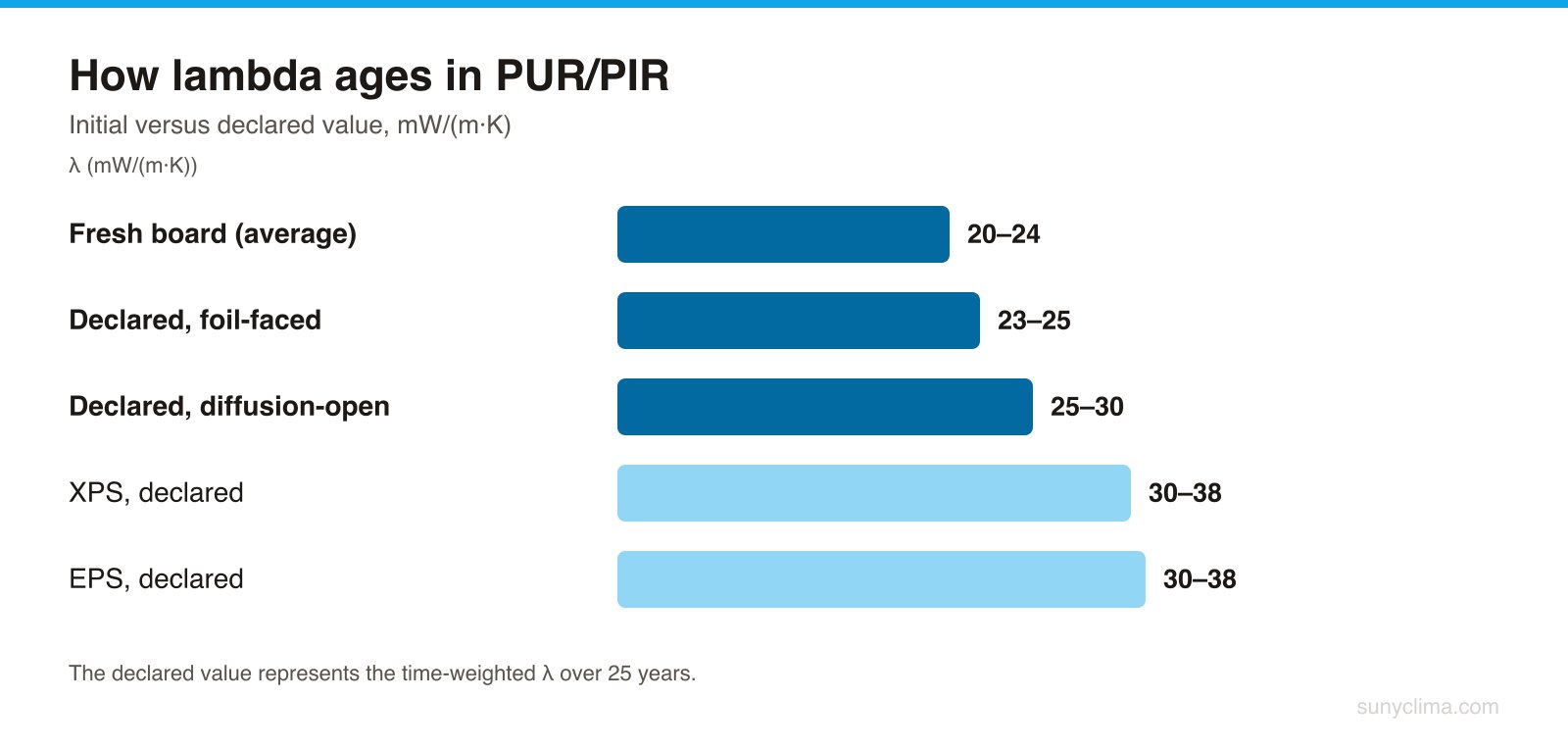
Annex C of EN 13165 does not ask for the value of a fresh board but for the time-weighted average λ over 25 years of use — a value typically reached after about 8 years in service for diffusion-open boards; a 30 mm diffusion-tight board reaches the same average only at around year 12. Two routes to it are permitted:
- The fixed increment method. Initial λ is measured at 10 °C and an increment added, set by blowing agent, thickness and facing. For pentane-blown boards with a diffusion-open facing under 80 mm it is 5.8 mW/(m·K); in the 80–120 mm band 4.8 and at 120 mm 3.8, because thicker boards age more slowly; for diffusion-tight facings it is very small. First the board must pass a normality test: 20 mm of unfaced core foam held 21 days at 70 °C, λ rising no more than 6.0 mW/(m·K) for pentanes.
- The accelerated ageing method. The complete product, facings included, is held 175 days (25 weeks) at 70 °C, λ is measured, and a safety increment added — reducible — or set to zero — if a separate "acceleration test" proves 70 °C accelerates the process enough; zeroing is permitted only for diffusion-open boards.
Statistics are then applied and the value rounded upwards to the nearest 1.0 mW/(m·K) — hence round figures like 0.023, 0.026 or 0.028 on data sheets.
The published numbers are instructive. In a Huntsman evaluation of eight European pentane-blown boards from four producers, initial λ ranged from 20 to 24 mW/(m·K), averaging just above 22. By the fixed-increment route the declared values came out at 25–30 mW/(m·K) diffusion-open and 23–25 diffusion-tight. Ageing alone eats 1 to 8 milliwatts — the difference between excellent insulation and merely good.
Why this matters when you are holding two data sheets
Here is the trap. XPS ages too, and it likewise declares an aged value ("after 25 years"), but the effect is far smaller, and EPS does not age thermally at all: no volatile blowing agent is left in its cells, which are already full of air.
So comparing the initial λ of a PUR board with the declared λ of an EPS board compares two different moments in these materials' lives. Declared against declared is the fair test — polyurethane still wins, by a narrower margin than the sales sheet suggests. A tidy table of every material in a door is in the technical parameters article.
Facings: not packaging, but part of the product
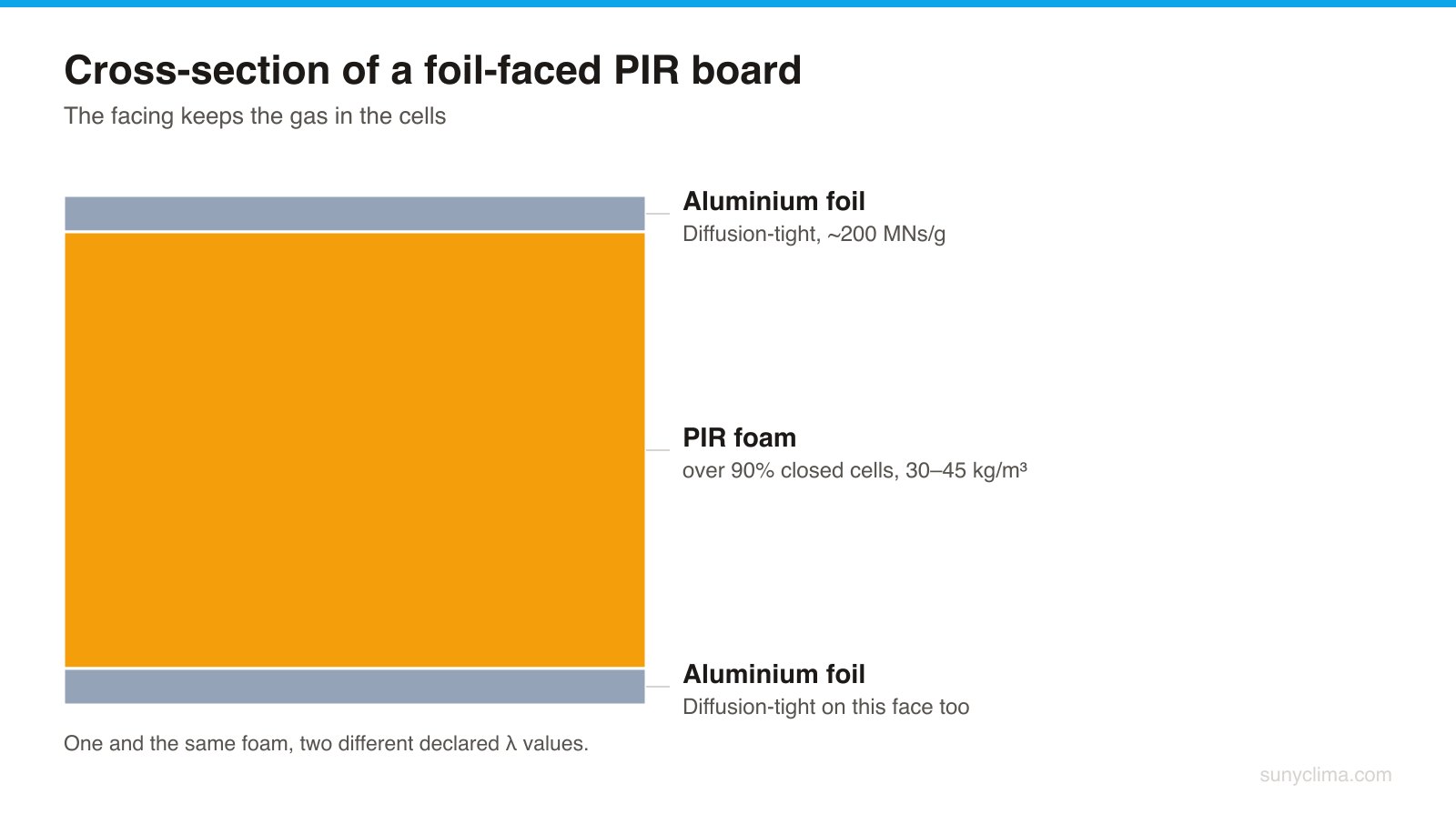
If the gas escapes through the surface, the surface is decisive — which is why PIR boards are made between two facings and why the facing type appears in the declaration. The size of the effect is visible in the increments themselves: a diffusion-open board under 80 mm takes 5.8 mW/(m·K), while a diffusion-tight facing takes very little. So the same foam is declared at 23–25 mW/(m·K) with foil and 25–30 mW/(m·K) with glass tissue — identical chemistry, because the foil holds the gas in and the tissue lets it through.
- Aluminium foil is diffusion-tight, slowing both the blowing agent leaving and the air arriving, and works as a vapour barrier. It will not take hot bitumen directly.
- Mineral-coated or bitumen-coated tissue and kraft paper are diffusion-open, so declared λ is higher, but they accept torch-applied membranes and renders. Facings are chosen for the neighbouring layer, not for the insulation.
The practical rule: never compare the λ of two boards without comparing their facings — and remember that every cut edge is diffusion-open.
Fire and smoke: the honest version
This is where most of the nonsense is spoken. Polyurethane is organic and it burns. PU Europe puts ordinary PUR/PIR boards anywhere from C-s2,d0 to F under EN 13501-1, depending on formulation and facing. None of the three materials here is non-combustible — XPS and EPS are organic too and also usually class E. A1/A2 belongs to mineral wool and cellular glass, not to hydrocarbon foams.
So what does PIR buy? Three concrete things:
- Char formation. Under fire the isocyanurate rings build a hard charred layer that slows the flame front. Polystyrene, by contrast, melts and retreats from the flame.
- Lower heat release. Comparative studies consistently show a lower peak heat release rate and better thermal stability for PIR than for PUR.
- A better class in a system. That is what lets sandwich panels with a PIR core and steel faces to EN 14509 climb into class B. Sources differ here and it is worth knowing: PU Europe writes that metal-faced PUR/PIR panels "can reach B-s2,d0", while a number of manufacturers declare B-s1,d0 for specific panels. Check the declaration of performance for the actual panel rather than the general claim.
And smoke is the real risk: burning rigid polyurethane gives off dense smoke, carbon monoxide and hydrogen cyanide — the nitrogen has nowhere else to go. Hence two rules. The fire class is declared for the product with its facing and in its end use, not for the foam alone; and a large area of exposed bare foam in an occupied space is a bad idea whatever the certificate says.
Temperature, stability, water and strength
Sources disagree here more than one would like, so the ranges are published as found.
- Service temperature. Cold does not limit the foam. The upper limit is contested, and it matters who is speaking: PU Europe gives PUR and PIR the same limits — −30 to +90 °C long-term, up to 250 °C briefly — while manufacturers’ catalogues split the two (+80 to +110 °C for PUR, around +120 °C for PIR). The chemistry supports the direction — isocyanurate breaks down above 200 °C, urethane from 100–110 °C — but those numbers are catalogue figures, not standards. XPS runs out at +70…+75 °C, EPS at +75…+80 °C.
- Compressive strength. To EN 826 at 10% deformation, building boards usually sit at 100–200 kPa — roughly 100 kPa for wall and roof, 120–150 for floors, 150–200 reinforced. As a material PUR/PIR spans far wider: 40 to 900 kPa depending on density. Commodity XPS grades run 200–700 kPa, so at equal thickness and in ordinary products polyurethane loses on compression.
- Water. EN 13165 declares kilograms per square metre (WS(P) and WL(T)) rather than percentages, which makes the numbers look incomparable with polystyrene. Converted to volume percent, PU Europe gives fleece-faced PIR around 1.3% after the 28-day immersion of EN 12087, around 6% in the EN 12088 diffusion test, and 2–7% for unfaced foam after freeze–thaw cycling. Against XPS at ≤0.7% (immersion) and 1–3% (diffusion) the picture is unambiguous: on water XPS beats PIR, with EPS third at 2–4%.
- Dimensional stability and UV. A thermoset does not melt or creep, so PIR tolerates hot bitumen where polystyrene does not. Sunlight degrades all three: store covered.
Sandwich panels: where polyurethane is at home
The material is close to irreplaceable in the metal-faced sandwich panel to EN 14509: a PUR/PIR core that manufacturers quote at λ around 0.020–0.023 W/(m·K), between two profiled steel skins — insulation, structure and finished façade in one element. For cold stores it is the de facto standard: the foam-to-steel bond is strong enough that the panel behaves as a composite beam. The same logic works in miniature in doors, where the core decides the thermal performance and the faces decide appearance and durability.
How it is cut, worked and — above all — how it bonds
- Cutting and dust. A sharp knife for thin boards, a fine-tooth saw for thick ones; unlike polystyrene, hot wire does not work — the material chars rather than melts. Routing raises fine, irritant dust, and the foam holds no screw.
- Bonding. The big advantage: polyurethane bonds to almost everything — steel, aluminium, timber, paper, concrete, HPL. That is why the sandwich panel exists: the foam is the adhesive.
- The same advantage is the nuisance. Fresh foam bonds just as well to hands, tools, glass and frame. Uncured it comes off only with a dedicated cleaner; cured, only mechanically.
- Safety. Isocyanates are sensitisers. Since 24 August 2023, under Regulation (EU) 2020/1149, professional use of products containing more than 0.1% diisocyanates requires completed training, renewed at least every five years. That includes gun foam.
The three materials side by side
A comparison is worth something only if it plays by one set of rules: declared values, the same standards, no hiding where each one loses.
Where each genuinely wins
- PUR/PIR wins when thickness is constrained. For the same thermal resistance a polyurethane board is about a third thinner than a polystyrene one, so wherever there is no room — a shallow roof, a fridge wall, a rebate of fixed depth — it is the logical choice. It also wins on upper service temperature, and in a system with non-combustible faces it classifies better on fire.
- XPS wins on compression and water. Grades of 200–700 kPa and water absorption of ≤0.7% by volume on immersion — against roughly 1.3% for PIR — make it the material for under-screed floors, perimeter insulation and inverted roofs. Details in the separate article on XPS.
- EPS wins on stability over time and on cost. Its lambda does not change, it comes in many density grades, and it is the most economical choice on façades where thickness is available. How it differs from XPS is covered here.
In decorative entrance-door panels XPS dominates — not because it is "better" in the abstract, but because at 24–48 mm the λ gap to PIR is not decisive while compressive strength and moisture behaviour are. Reaching a specification is covered in the selection guide, face-and-core combinations in materials.
How to read the data sheet
- Look for λD, not "λ". D means declared, already aged to EN 13165; anything labelled "initial" is not for comparison.
- Check the facing next to the number, and the thickness with it: the same foam can come out at 0.023 or 0.028, and thinner diffusion-open boards age more.
- RD is derived — thickness divided by λD, rounded down. If an R and a λ do not reconcile, one is not declared.
- The codes carry meaning. CS(10\Y)150 = compressive strength at 10% deformation, min. 150 kPa; WS(P) and WL(T) = water absorption, short- and long-term, in kg/m²; NPD = no performance determined.
- The fire class belongs to the product, not to the foam. A class C or E board and a class B panel can describe the same core.
Common mistakes and misconceptions
- "PIR doesn't burn." It does — it chars better and releases less heat, but a bare board is class C or lower.
- Comparing a fresh PUR λ with a declared EPS λ. The commonest sleight of hand in quotations. Compare declared with declared.
- "Gun foam is the same stuff." Chemically, nearly; technically no — different structure, different class, no declared λ.
- A standard PIR board under load. 100–150 kPa is not the 200–700 kPa of a commodity XPS board. Under screed, check the CS class.
In short: PUR/PIR is the most efficient of the three per millimetre, and the only one where you must check which lambda you are reading. PIR is PUR with a higher isocyanate index — more temperature-stable and better in fire. XPS is stronger under compression and water, EPS the most predictable over time. Choosing a core starts with core and thickness and continues in the frequently asked questions.